Less than a year-and-a-half into their partnership, Bears general manager Ryan Poles and coach Ben Johnson can communicate without words.
When they’re watching film, the GM senses his coach’s body language. In a league that this week saw even the great Sean McVay stumble when trying to explain how he stays in lockstep with his GM, that’s a great sign.
“It’s weird …” Johnson said Saturday night. “I’ll sit next to Ryan when those scouts are in there and I almost feel like we can feel each other a little bit, which is unique for a couple guys that really haven’t done it together for a very long time yet. He and I view players very similarly, so I’m sure we do feed off each other a little bit.”
They had the same vision of the NFL Draft, which ended Saturday night. Here are four things we’ve learned about the 2026 team:
Sacks will (probably) have to come from within.
The Bears didn’t trade for Maxx Crosby or sign Trey Hendrickson. They didn’t draft an edge rusher. Unless they trade for a dissatisfied veteran —Poles wouldn’t rule it out — defensive end lineup will have four players who were part of their pitiful pass-rush performance last year: Montez Sweat, Austin Booker, Dayo Odeyingbo and Shemar Turner. The four were never healthy at the same time last year.
Johnson said his staff needs to coach them better.
“We made a concerted effort on both sides of the ball there to make sure that we’re gonna get it to look more the way that we want it to look … ” he said. “That’s natural. That’s how you get better.”
The top tier of the edge rusher class was never going to fall all the way to No. 25 on Thursday night. Auburn’s Keldric Faulk, only 20 years old, offered an intriguing ceiling. After the Bears took Oregon safety Dillon Thieneman at No. 25, though, the Titans traded up take Faulk at No. 31.
A run on Round 2 edge rushers — five went in the first 13 picks — all-but-wiped out the chances of the Bears taking one. After that, it was worth wondering whether any edge rusher the Bears drafted would even be a lock to make the 53-man roster. The same was true in a weak defensive tackle class.
Johnson will have to keep scheming up help at left tackle.
The Bears probably would have been thrilled to take any of the six tackles drafted between Picks 9 and 21 Thursday — Utah’s Spencer Fano, Miami’s Francis Mauigoa, Alabama’s Kadyn Proctor, Clemson’s Blake Miller, Georgia’s Monroe Freeling and Arizona State’s Max Iheanachor.
With none available, the Bears will turn to either Braxton Jones, Theo Benedet, Kiran Amegadjie or Jedrick Wills at left tackle.
Johnson will, once again, have to help whomever wins that job. The Bears ranked in the top five in both two tight end usage and three tight end usage last year, helping to protect quarterback Caleb Williams and create mismatches for Colston Loveland and Cole Kmet.
Third tight end Durham Smythe followed offensive coordinator Declan Doyle to Baltimore. The Bears replaced him in Round 3 with Stanford’s Sam Roush, whose skill as an in-line blocker fits Johnson’s penchant for heavy formations.
With no third wideout of note, the Bears’ most common lineup could include two receivers, two tight ends and a running back.
“We’re going to have the ability to go heavy … and keep the defense in their base structure,” Johnson said. “Or we’re going to be able to be a little bit lighter — we’ve got speed on the outside.
“I think it gives [Williams] a lot of versatility to work with. We can dictate some terms to the defense and make sure we’re always attacking.”
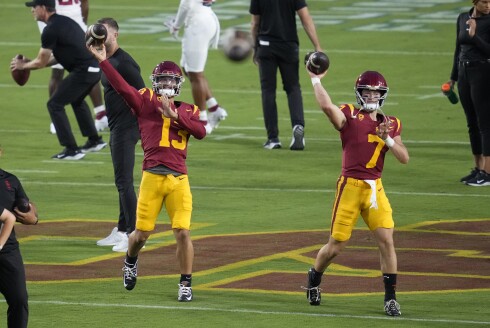
Williams threw to his teammates at USC this month. He’ll have to create chemistry with Roush and third-round round LSU receiver Zavion Thomas, though the latter should make more of an impact on kick returns.
“[Williams’] big goal here is to make sure he can get up to speed with these new pass catchers,” Johnson said. “And continue to refine his chemistry with the guys we already have.”
The Bears are leaning into Johnson’s DNA.
Johnson knew what he wanted from draft picks last year. But one year as head coach gave him not only a greater knowledge of the rest of his roster but the ability to further distill what he defines as the Bears’ type of player.
Johnson and Poles wanted athletes with loud skills — NFL NextGen Stats declared the Bears’ 2026 class the most athletic in the NFL — and competitiveness on and off the field.
“Guys that if you took football away from them, they really don’t know what to do with themselves,” Johnson said. “It’s a huge part, they eat it, they sleep it, they breathe it.
“I think we’re able to identify those type of guys. When you have guys like that, they usually find a way to come out on top.”
That’s part of what made the Bears’ last draft successful. This one remains confusing — the team drafted a backup center, third-string tight end and fourth wide receiver on Day 2. But Poles and Johnson were picky about getting the right culture fit.
“We found guys that fit our DNA and what we want to be about,” Johnson said.
Williams’ growth means they’re looking ahead, too.
Iowa center Logan Jones, the Bears’ second-round pick, figures to sit behind veteran Garrett Bradbury at first. If the Bears develop him, though, he’ll prevent them from having to pay skyrocketing free agent prices for centers next offseason. Six of the 11 NFL’s most expensive center contracts, in terms of guaranteed money, were signed earlier this year.
Roush’s growth could make Kmet expendable in a year or two. Texas cornerback Malik Muhammad could take Tyrique Stevenson’s place in 2027.
That financial savings could be used to pay Williams’ next contract. If he continues to improve, the Bears could extend his deal as early as January.
“We added competition,” Poles said. “And usually when you add competition, good things happen.”