University of Chicago professor Mehrnoush Soroush has been “unfunctional” since late February.
Soroush, who grew up in Iran and whose work in archaeology focuses on the Middle East, has struggled to communicate with her loved ones since the United States and Israel attacked her home country.
“My people, my civilians, my family, every part of my country, my cultural heritage, everything is being bombed,” she said.
For weeks, and now as the end of President Donald Trump’s two-week ceasefire draws near, she and other Iranians studying or working at universities in the U.S. have struggled to focus on school and work, distracted by the fear their loved ones abroad aren’t safe.
On college campuses across Illinois, students and faculty are grappling with the effects of the war, which has killed more than 2,500 people in Iran and injured another 26,000 as of Tuesday, according to the news outlet Al Jazeera, relying primarily on official government health and defense sources. Thousands more in Lebanon and across the region have also been killed or injured.
In the U.S., some students are not sure if they’ll be able to return home after graduation, while others trying to remain here have not been able to get their visas renewed.
The war has also had tangible effects on teaching and learning, with some colleges, including the University of Chicago, canceling or postponing study abroad and research programs in the region due to the violence. And the conflict has raised larger questions about free speech on college campuses and the state of anti-war activism, as some students hesitate to protest during the Trump presidency.
For Soroush, who moved to Tehran for college and got married there, the pain of knowing backdrops to cherished memories are now in ruins has become part of her research.
She created the Middle East Cultural Heritage at Risk in Armed Conflict project to document the destruction in Iran. The project has mapped nearly 100 sites so far, and Soroush estimates many more will be added.
“There is a famous song, and it’s beautifully sang … and [it] says that my home is on fire,” Soroush said. It’s how she envisions Iran now. “I just literally feel like it’s on fire.”
How the Iran war is affecting campus climate
In recent weeks, some colleges have evacuated students or staff from the Middle East. Northwestern University, for example, relocated “a small number” of graduate students doing research in the area, a spokesperson said.
Northwestern also increased safety measures at its Qatar campus, after Iran launched a retaliatory strike on a U.S. air base 16 miles away. That has included shelter-in-place orders, remote work and evacuations, according to the school’s student newspaper, The Daily Northwestern.
Many Iranians’ and Iranian Americans’ views of their government have been muddied by the war. Within the Iranian diaspora, people’s opinions on the war vary broadly, Soroush said. Many opposed Ayatollah Ali Khamenei, the Supreme Leader of Iran who was killed Feb. 28 in a joint U.S.-Israeli attack, and welcomed his death but condemn the ongoing attacks.
Mina Rezaei, an Iranian PhD student at Southern Illinois University Carbondale, said she and her husband danced when they heard about the death of Khamenei, who ruled over their home country with near-absolute authority and whose forces reportedly killed more than 7,000 Iranian protesters and activists earlier this year.
“I can say that when Ayatollah Khamenei was dead, I was very happy,” she said. “We are thankful to President Trump, honestly. But now, things are very complicated.”
They’re grateful Iran isn’t under Khamenei’s rule anymore but worry about the safety of their loved ones back home.
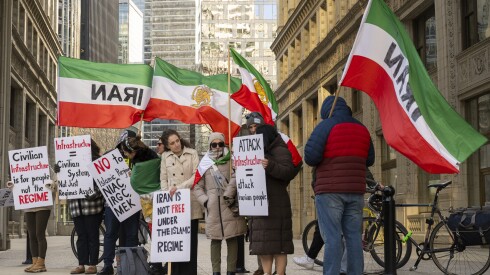
The range of views on the war has affected how students and faculty offer one another support.
In the past, Soroush found solace with other Iranians when violence hit the Middle East. She would invite students to her home, where they typically shared stories of Iran, unpacked current events and leaned on one another.
But now, she hesitates because she doesn’t know which side they’re on, she said, and she finds it difficult to connect with people who are celebrating the war.
During past conflicts, “I would just send an email to all the Iranian students and say, ‘Come over. You can feel some comfort in my home,’” Soroush said. “But then some of them will show up and be pro-war, right? And I can’t do that because I need to protect myself.”
The war has shifted things on campuses in other ways, too.
Omer Mozaffar, the Muslim chaplain and a professor of Islamic studies at Loyola University Chicago, said he’s seen signs in his classes of students grappling with the conflict.
Students are more withdrawn and distracted, and some have stopped participating in class as much as they typically do, he said. Some are skipping class more often and struggling to get assignments done. He’s heard rumblings of students questioning the possibility of being drafted into the military.
“It raises big questions about fairness in the world and unfairness in the world,” Mozaffar said. “How does this world operate? Young people are trying to navigate that.”
Fewer on-campus protests than in the past
College campuses have a history of organized anti-war protests, from mass demonstrations against the Vietnam War in the 1970s to the pro-Palestinian encampments that cropped up on Chicago campuses and elsewhere in 2024.
Students are just as interested in what’s happening in Iran and how it connects to the history of the Middle East and American foreign policy, said Jessica Winegar, a professor of anthropology and Middle East studies at Northwestern.
“Frankly, a lot of students become very surprised when they learn about the history of U.S. involvement in the region, and often that can make them angry and want to do something about it,” she said.
It’s not uncommon for Americans to be unaware of the decades of damaging sanctions against Iran or misunderstand the history between the two countries, said one Chicago-based PhD student who grew up in Iran.
“This emerging collective consciousness among Americans about politics and what is happening in the war, that could open up opportunities around collective organizing and collective action,” said the young woman, who spoke with the Chicago Sun-Times on the condition of anonymity because she fears doxxing and harassment.
While many students participated in demonstrations aftr the Oct. 7, 2023, attacks on Israel by Hamas and Israel’s subsequent bombardment of Gaza, Loyola’s Mozaffar said the anti-war sentiment is taking a different shape now.
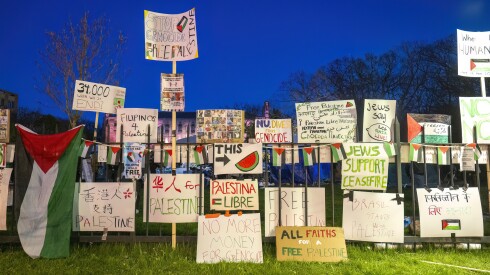
“Regarding the attacks on Iran, the displeasure is the same as it was regarding the attacks on Oct. 7 and Israel’s response,” he said. “But we barely have any protests taking place on campuses.”
Students and professors are more cautious after seeing the pro-Palestinian encampments draw counter-protesters and be cleared out by police, Mozaffar said. And since Trump has returned to office and taken steps to limit certain kinds of speech on college campuses, the fear has intensified, Mozaffar said.
Mozaffar said fears of doxxing and harassment have quieted some students who otherwise may have been more vocal about their opposition to the U.S. and Israel’s attacks on Iran. He has similar fears that speaking about the war in class brings some risk of harassment or criticism from Trump and other right-wing politicians.
But Mozaffar continues to discuss the war in class, encouraging students to debate and raise counterpoints, including to their own points of view.
“For the sake of our society, even with those fears, we still have to discuss these things,” he said.
The comparative lack of acknowledgement of the Iran war has disappointed some students and faculty members with ties to the country. Soroush, for example, said the University of Chicago hasn’t sent a school-wide email acknowledging the war and its consequences, but the school did so after Russia invaded Ukraine.
“We understand the pain and difficulty this brings – for members of the University community from Ukraine, Russia and Europe, and others who hoped a major conflict could be avoided,” University of Chicago officials wrote in a 2022 email obtained by the Sun-Times.
Soroush had hoped to read something similar when the war in Iran began.
“We’re not asking you to take a side,” she said. “We’re asking you to express solidarity, empathy, acknowledge the fact that there are impacted communities.”
A University of Chicago spokesperson didn’t respond to questions about university communications regarding the war.
War complicates some students’ post-graduation plans
The war has forced some students to rethink their post-college plans.
Rezaei’s husband, Kaveh Javanshirjavid, graduated with his PhD from Southern Illinois University Carbondale in December. It was the same month the Trump administration stopped issuing visas to people from certain countries, including Iran. Now Javanshirjavid can’t get a work visa, and Rezaei expects to have the same problem when she graduates later this year.
The family has been living on Rezaei’s small research assistant salary for the last four months. Javanshirjavid had a job lined up in the soybean industry, and Rezaei has a faculty job in statistics she hopes to start in July. But now those career plans are on hold.
Typically, they would ask family members in Iran for help. But they don’t want to do that with their families facing danger.
“We used our savings, but now I don’t know what we want to do,” Rezaei said. “It’s very stressful.”
The Chicago-based PhD student is also reconsidering her post-grad plans. Until recently, she had planned to return to Iran after she completes her degree. Her family and friends are still in Iran, and she keeps in touch with local activist networks there. But now, she worries that in a few years it will no longer be possible to live there.
“I don’t know if the country is the same country that I once left,” she said. “[But] I still have this faith that Iranian people can again rise from the ashes of the country.”