It’s a typical weekday afternoon at the intersection of Route 53 and Laraway Road, 40 miles southwest of Chicago, and semi-trucks thunder by in a steady stream.
They start at the sprawling warehouse complexes on the fringes of Joliet, rumble alongside the fading polyester petals of a roadside memorial for someone who died in a truck crash and roll past the ballfields where youth teams play, carrying goods for Amazon, IKEA, Walmart, Target and Dollar Tree.
In the next 10 minutes, 150 trucks will pass through the intersection. If you lined them up end to end, they would stretch more than two miles.
Three decades ago, this area was mostly prairie sprinkled with quiet subdivisions. But the early 2000s ushered in the age of online shopping. Then came the rise of next-day delivery. America’s retailers needed warehouses, fast, and the area outside Chicago — flush with interstates and rail lines — was perfect.
Few places in the nation have been transformed so completely so quickly. Since 2000, retail giants and developers have erected more than 146 million square feet of warehouse space in the Chicago area — equivalent in size to roughly 1,400 Home Depot stores.
The warehouses have brought new jobs. Still, people who live nearby say what has happened around them is a cautionary tale for other communities hoping to cash in on the warehouse boom.
On average, roughly 20,000 trucks pass through Joliet, pop. roughly 150,000 people, every day. Most keep to Interstate 80, but as many as 6,400 — more than five times as many as before the warehouse boom — use local roads and state highways.
They pummel roads, belch fumes and batter the pavement, contributing to road damage that requires millions of dollars of repairs paid for by local and state governments, according to budget and grant documents.
And crashes have become more common, according to a New York Times analysis that used satellite imagery, government documents and interviews with people who live in the areas, law enforcement officers and traffic safety experts to identify some of the largest clusters of warehouses in the Chicago area. Then, using state data from January 2014 through December 2024, reporters counted the number of crashes involving trucks that occurred on the surrounding roads.

The number of truck wrecks on those roads increased by 8% from 2021 to 2024 compared with truck accidents from 2016 to 2019, the four-year period before the COVID-19 pandemic. This was even as the number of crashes involving other types of vehicles on these roads dropped sharply, and truck crashes across the state remained largely flat.
In recent years, an average of nearly 550 people a year were injured in truck crashes in those neighborhoods, and one person died every month.
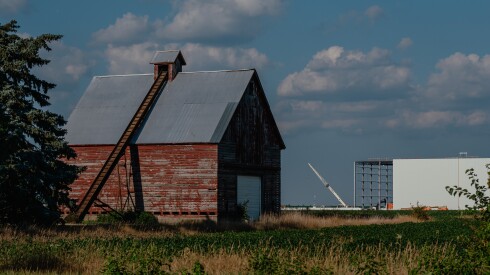
An industrial building can be seen rising in the distance among old farmhouses and rows of corn near CenterPoint in Joliet The ongoing construction of CenterPoint’s massive logistics and intermodal facilities has drawn controversy for its placement in historically rural and agricultural areas, where residents have complained about increased truck traffic, environmental impacts and the transformation of farmland into industrial zones.
Jamie Kelter Davis / The New York Times
Ian Hunnicutt was in line at the grocery store in the Will County town of Manhattan, southwest of Chicago, on a Monday evening last October, picking up frozen pizza and sushi rolls for dinner for his 13-year-old twin boys when his wife called.
She was hysterical. Something had happened to the kids, Ryder and Chance, while they were biking to the library. Find them, she told her husband through sobs.
He rushed through Manhattan, checking their usual haunts. Then, he rounded a bend and went around a police barricade.
He found Ryder holding a single Nike shoe — Chance’s shoe. It had flown off when he was struck and killed by a semi-truck while riding his bike.
“This is what Ryder was holding when my life changed,” Hunnicutt said, holding up the sandal. “When my world fell apart.”

The warehouse boom
Around the country, warehouses have popped up outside major cities, where land tends to be cheaper. Exceptionally dense areas include Ontario, Calif.,once dotted with dairy farms but now dominated by warehouses, and a stretch of Interstate 35 northwest of Dallas lined with distribution centers.
But Chicago is in a different league. The warehouse boom in the Chicago suburbs took off in earnest in the early 2000s with the construction of the CenterPoint Intermodal Center, the largest inland port in North America, where trucks and trains swap goods. It sits just outside Elwood, a Will County town of roughly 2,200 residents. In 2015, Amazon opened its first Illinois warehouse, in Joliet.

Intermodal container handlers at the CenterPoint Intermodal Center near Elwood. The facility is a massive freight hub where goods are transferred between rail and truck, serving as a key link in national and international supply chains. It is part of one of the largest inland ports in the United States, drawing significant truck and train traffic to the surrounding area, which includes several rural small towns.
Jamie Kelter Davis / The New York Times
For a study about warehouses and pollution, researcher Gaige Kerr examined real estate listings from the commercial data company CoStar and determined that there were roughly 6,800 warehouses in the Chicago area as of 2022. Their combined square footage eclipsed that of warehouse space in the Los Angeles metropolitan area — home to the nation’s two largest shipping ports — by 13%.
Of the nation’s 25 largest metro areas, Chicago had the most warehouse square footage per person, Kerr found.
According to 2024 data, the latest available from the Illinois Department of Employment Security, warehousing and transportation was the largest sector in Will County, employing nearly 37,000 people. Amazon is Will County’s largest employer.
“I think people have to look at this as an economic advantage,” said Mark Denzler, president and chief executive officer of the Illinois Manufacturers’ Association.
But, for years, people living in the area have complained of miserable conditions. Some said they have given up on the promises from government officials that the boom would bring a renaissance of restaurants and shopping centers.
Some still drive two or three towns away for groceries even though they are surrounded by warehouses stocked with the things they need. In certain places, retailers and developers — many that get tax incentives from the state — have gobbled up much of the usable land and pushed up property values to levels that once would have been unimaginable.
And many of the new jobs that have been created are part-time or low paying. In 2024, the majority of full-time employees at Amazon’s Joliet facility made an average yearly salary shy of $34,000, according to a report filed with the state.
Meanwhile, developers have continued to build.
This year, a 1.1 million-square-foot logistics facility is scheduled to open next to the only school in Elwood, just over a quarter mile from home plate of the school’s baseball field. Thousands of trucks could pass by each day.
Trucks prompt ‘Die-80’ nickname
Unsurprisingly, the increase in traffic has led to more crashes.
Madison Rose Frost was 8 years old when she was killed in March 2014 after her family’s minivan was struck by a truck on Route 53. Ten years later, Robert Roach Jr., 32, died a few miles from Madison’s roadside memorial following a collision with a stalled semi.

Such stories aren’t uncommon in the area of the warehouse boom. A truck driver, unaware that a vehicle had become lodged beneath his trailer, barreled down the Tri-State Tollway, dragging the car — and the woman inside — with it. Miraculously, she survived. A man was hit and killed in downtown Joliet minutes after he had been released from jail.
Sara Wittchen said she worries about crashes, something she never did while growing up in Joliet.
“Fatal accidents were reserved for 2 a.m. on the highway with a drunk driver,” Wittchen said. “It wasn’t Grandma Lucy in an Enclave going to Target.”
In the span of two months last fall in Will County, at least seven people died in accidents involving trucks. So far this year, at least 60 people have been injured in crashes, and two have died.
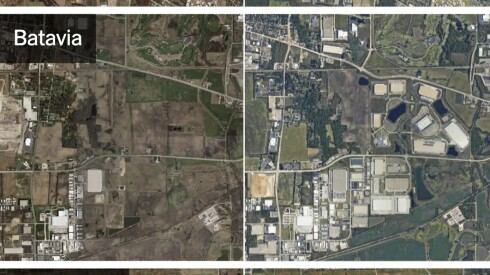
The crashes aren’t always the fault of the truck driver. But the hazards tend to be greater for the drivers in smaller vehicles.
And people have become increasingly wary of driving around this area.
Some even have a nickname for the stretch of I-80 that passes through Joliet: “Die-80.” More than 60,000 people have joined a Facebook group called “I-80 and I-55 Corridor DAILY DEATH TRAP.”
It’s where Ryan Hart was killed in 2020, when a truck rear-ended his camper at the height of morning rush hour. The camper and four other vehicles were engulfed in flames. Another driver also died.
Bob Ilibasic, a terminal manager at a trucking company, was a close friend of Hart.
“He’s never going to see the grandkids,” Ilibasic said. “All for a truck that didn’t stop.”
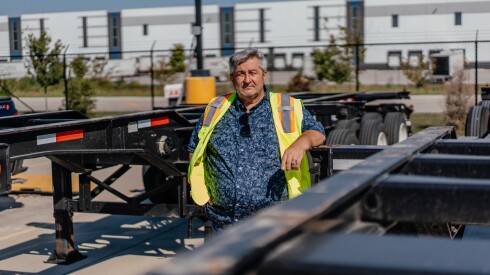
Bob Ilibasic was friends with Ryan Hart, who was killed in 2020 when a semi rear-ended his camper at the height of morning rush hour. Ilibasic is terminal manager for American Marine Express, managing a fleet of truck drivers. Of his friend, he says: “He’s never going to see the grandkids. All for a truck that didn’t stop.”
Jamie Kelter Davis / The New York Times
Residents fight back
Data from the Illinois Department of Transportation shows that the most hazardous places are the interstates, where truck crashes that cause traffic backups are common. But collisions occur on residential roads, too, even those that ban or limit trucks.
Trucks sometimes end up on these roads — and closer to residential areas — when the interstates get backed up. State data shows that more than 200 crashes from 2014 through 2024 involved damage to homes, playgrounds and schools. They flattened fences, tore through yards and smashed mailboxes.
Don Schaefer, president of the Mid-West Truckers Association, said drivers are forced onto a smaller number of routes as more municipalities try to restrict the use of local roads.
“There simply aren’t enough truck routes,” he said.
Many trucking companies don’t build in enough time for delays, said Zach Cahalan, executive director of the Truck Safety Coalition, an organization focused on reducing the number of deaths and injuries from truck crashes. Some truckers might feel pressure to make up lost time, he said.
“Truck drivers pay the cost,” Cahalan said. “And, of course, crash victims.”
Several police departments have added truck enforcement units to ticket drivers who violate weight and size rules. Joliet’s unit brought in $2.2 million in fines in its first 15 months, though city officials said many truck drivers have continued to break the rules.
Joliet is trying to divert trucks away from local roads, according to a city government official who said in a written statement: “Through recent agreements tied to major logistics developments,” the city “has required the use of a closed-loop truck network specifically designed to keep trucks off neighborhood streets.”
But community residents are skeptical that the designated loop will curb traffic from warehouses outside the NorthPoint development.
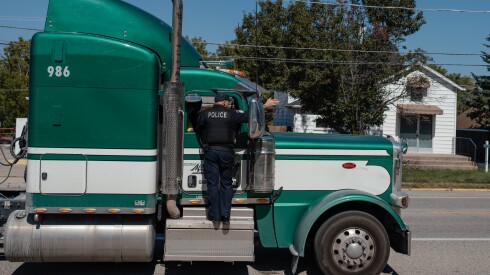
Joe Baez, a truck enforcement officer for the Manhattan police department, after pulling over a semi-truck that was loner than allowed.. The Will County town, used to be mostly farmland but in recent years has seen warehouses develop nearby. An intermodal facility in neighboring Elwood, called CenterPoint, has led semi-trucks to use farm roads and neighborhood streets through Manhattan as a shortcut even though that’s illegal. Many drivers consider the fines worth paying to avoid congestion on other routes.
Jamie Kelter Davis / The New York Times

A “no trucks” sign by a park in Elwood, which is home to part of the CenterPoint Intermodal Center — one of the nation’s largest inland ports, where cargo is transferred between trains and trucks, contributing to the heavy industrial traffic that moves through the area. Some communities have taken steps to ban or limit semi-trucks on local roads, putting up signs and ticketing and fining truckers.
Jamie Kelter Davis / The New York Times
Some residents and local governments have taken steps to stop more development or try to reduce traffic near residential areas, with mixed results.
After Delilah LeGrett moved, in part because trucks would rumble past her front door, she found out that NorthPoint, a Kansas City-based developer, wanted to move in, too. Her house is along the edge of a proposed logistics complex in Will County that, if completed, would be five times the size of Midway Airport.
The complex has faced lawsuits filed by, among others, LeGrett and her neighbors, locking up development and construction. But a settlement last year ironed out truck-route access, and the pending outcome of suits this year means the facility could soon break ground.

Delilah Legrette, a lifelong resident of Manhattan, started the group Just Say No to NorthPoint in 2017 and helped lead opposition to the proposed construction of a large intermodal facility. “We bought out here because, you know, it’s a great place to live,” she says. “We love the neighborhood, all of those things. But also, you know what? They’re not going to stick behind us a warehouse because we are nowhere near anywhere that would have a warehouse. And then NorthPoint comes along and says, nope, we’re going to put a million square feet directly behind your home.”
Jamie Kelter Davis / The New York Times
NorthPoint representatives wouldn’t comment.
According to Will County Executive Jennifer Bertino-Tarrant, the county government’s top official, the county is spending more than ever to alleviate traffic, make streets safer and reduce air pollution.
Manhattan, where Chance Hunnicutt died, has increased its number of officers on truck enforcement patrol over the past five years. from three to eight.
Following Chance’s death, officials put stop signs at the intersection of U.S. Route 52 and North Street, where he was hit. But the signs are a temporary measure until a permanent solution is determined.
Ryan Gulli, Manhattan’s police chief, said the accident is under investigation. No charges have been filed.
Chance loved the Grateful Dead, Purdue basketball and reptiles. He and his twin brother wanted to open pet shop when they grew up: Ryder would run the business, and Chance, who dreamed of becoming a veterinarian, would take care of the animals.
“I just keep waiting for him to come out of his room,” Hunnicutt said. “There’s a big part of me that just can’t swallow the fact that he’s gone.”
About two weeks before Hunnicutt lost his son, another son lost his father when a semi turned onto Route 53. The truck collided with a Dodge Dart, killing the Dodge’s driver, 40-year-old Adam Sigler.
His 2-year-old son, who was strapped in the back seat, survived.
Cam Rodriguez, a Chicago Public Media data reporter who grew up in Bolingbrook, reported this story as part of The New York Times’s Local Investigations Fellowship. This article was reported in partnership with Big Local News at Stanford University.
Contributing: Justin Mayo, Daniel Wood, Cheryl Phillips