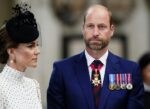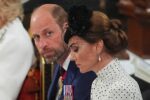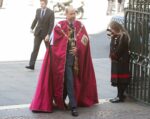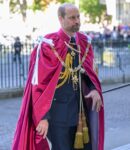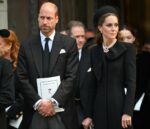
This past weekend, Kensington Palace gave an extensive and lengthy briefing to Roya Nikkhah at the Times. The briefing was from one of Prince William’s senior courtiers, possibly that poor crisis manager, all about William’s newfound “quiet faith.” I say “newfound” because for years, everyone has spoken openly about William’s personal agnosticism and his discomfort with the rituals, tenets and ceremonies of the Church of England (and possibly the rituals and tenets of all religions). The problem with the Times piece is that the briefing came ahead of William’s Wednesday appearance for the installation of the new Archbishop of Canterbury, and William’s relationship with the CoE was framed around how he had zero interest in the church when Justin Welby was Archbishop. Why is that? William saw Welby as a Sussex-ally, because Welby gave spiritual counseling to Prince Harry and Meghan ahead of their 2018 wedding. William held a grudge about that for eight years and he’s using that grudge to justify his lack of relationship with organized religion (and possibly God).
Without that bit about Justin Welby, I could have honestly made a case for William’s lack of interest in religion and the CoE. Yes, when he’s king, he’ll inherit the position of Supreme Governor of the CoE, but I could have made the argument that it’s fine that William isn’t a man of deep or meaningful faith, and people probably don’t want that from him anyway. The way that briefing unfolded though… it was painfully obvious that William is eye-rolling his way through this and just doing the bare minimum through his disgust. And that’s pretty offensive. Well, royal commentators have been tasked with polishing this faux-Christian turd. Enter Celia Walden, and her latest Telegraph column, “William’s ‘quiet faith’ is exactly what religion needs in modern Britain; Instead of bowing to wokery and colonial guilt, our future King has been disarmingly honest about his commitment to the Church.”
On Wednesday, the Prince will represent the King at the enthronement of the new Archbishop of Canterbury, Dame Sarah Mullally. There, he is due to affirm his support for the Church, and pledge an emphatically unwavering commitment to it.
It was in an attempt to put to bed years of speculation about the lukewarm nature of William’s faith, prior to this weighty occasion, that the Palace took the unusual step of giving the Sunday Times an extensive briefing. “The Prince of Wales’s commitment to the Church of England is sometimes quieter than people expect,” an aide told the paper, “and for that reason, it is not always fully understood.” The aide was careful to add that “his connection to the Church, and to the sense of duty that comes with it, runs deep”, but a clarification always runs the risk of reigniting former contentions, as anyone in PR knows, and this one did just that.
Right-wing Christian broadcaster, Calvin Robinson, declared: “Now is not the time for ‘quiet faith.’” Royalists insisted that a monarch’s faith needs to be more public and demonstrative to meet institutional expectations. Church of England critics argued that in a time of declining religious affiliation, only the most vocal believer could hope to rouse fervour.
Heavily intimated by some (and garishly spelt out, as always, on X) was the notion that while other religions were allowed to grow louder – literally so in the case of the communal Muslim prayer event held in Trafalgar Square earlier this month, which spiralled into controversy – Christianity, in all its forms, had become something vaguely shameful. It is to be kept on the down-low, lest we (all together now) cause offence.
It’s true that we have become shockingly cowardly about our established religion (if no longer statistically the faith of the majority of the population), banning teachers and stewardesses from wearing crosses, cancelling an advert featuring The Lord’s Prayer and deplatforming Christmas trees. And if a “quiet faith” means that the future King is going along with all that? God help us.
Only I don’t believe that this is about William bowing to wokery and colonial guilt. Not for a second. I don’t believe that this is him allowing his faith to be drowned out by others…No, I think the deliberate description of William’s faith as “quieter” is our future King being disarmingly honest about exactly where he is now in his spiritual evolution. (I’m not going to use the word “journey”, which should be banned unless a physical ticket is involved.) Because the Palace could have insisted that William was “just as much of a believer and a churchgoer as his grandmother before him”. And there’s a lot of “quiet” power in choosing honesty over diplomacy.
This is a fundamental difference between the UK and US: Britain has a national religion but no one expects their leaders or heads of state to feign piety, while the US does not have an official religion, yet Americans absolutely expect leaders to either BE pious or fake it with more enthusiasm than William. What I keep coming back to though is William’s inauthenticity and his half-assedness, and how that’s what people are catching on. Would it be more honest and welcoming for William to say “actually, I’m not religious at all but I believe in serving as the head of the Church of England?” I’m not sure that would be welcomed, but people would probably applaud him for his honesty. It is the fundamental contradiction of William specifically though – he couldn’t care less about Christianity, but he absolutely cares that people believe he’s been anointed by God to be king.
Photos courtesy of Avalon Red, Cover Images.