The Boston Red Sox seem to have at least one major, polarizing controversy every year. This season, it’s been the sudden firing of manager Alex Cora and six members of his coaching staff last Saturday after Boston got off to a disastrous 10-17 start. But across the country, another horrific start has started to tilt last year’s big controversy in the Red Soxâs favor.
That controversy, of course, was the stunning June 15 trade of Rafael Devers to the San Francisco Giants. Not only was the trade shocking because Devers was the Red Soxâs best hitter at the time of the trade, with a .905 OPS, but because Boston signed Devers to a franchise-record 10-year, $313.5 million contract just two years earlier.
But the Red Sox and chief baseball officer Craig Breslow are starting to look a lot smarter now, as Devers, over the first month of the season, has not only been off to a slow start, but the 29-year-old in his 10th major league season has simply been one of the worst players in baseball, according to his statistics as posted by FanGraphs.
The Red Sox did not get much in return for Devers, in outfield prospect James Tibbs III and left-handed pitcher Kyle Harrison. In fact, Tibbs III was traded just over a month after he was acquired, in a deal for pitcher Dustin May, who departed the Red Sox in free agency after the season.
But judged solely by Devers’ performance, the Red Sox move is looking better and better, as Devers looks worse and worse.

Devers Stat Puts Him Near Bottom of MLB
A quick look at Devers’ conventional stat line gives a good idea of exactly how bad the three-time All-Star has been over the Giants‘ first 30 games. A slash line of .211/.250/.298 with a dismal .548 OPS prior to Thursday’s action tells the story in its most succinct form. Deversâ power outage is perhaps best illustrated by the fact that he has hit only two home runs in 120 plate appearances.
That’s a rate of just one home run every 60 trips to the plate. Compare that to last year, when between the Red Sox and Giants, Devers belted 35 homers, a rate of one round-tripper every 20.8 plate appearances.
But the most discouraging number for Devers comes from the analytical baseball site FanGraphs, which calculates its own version of Wins Above Replacement for every MLB player, a stat known as fWAR.
Not surprisingly, the Los Angeles Dodgers‘ Shohei Ohtani currently leads MLB with an fWAR of 2.2.
Devers, on the other hand, has been the second-worst player in baseball so far this year with a negative fWAR of minus-0.8. Only Marcell Ozuna of the Pittsburgh Pirates has been worse, at minus-0.9, among hitters with at least 100 plate appearances.
Is the Change of Ballparks Affecting Devers?
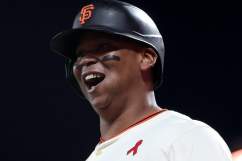
Devers’ meltdown, according to some analysts, is simply the result of his move to a less hitter-friendly ballpark, Oracle Park in San Francisco, after playing his whole career in Fenway. But Devers’ underlying metrics appear to show that he simply is not the same hitter, regardless of ballpark.
According to Statcast, Deversâ average exit velocity off his bat has been just 90 mph, ranking him in only the 58th percentile among MLB hitters. That’s down from 95 mph last year, which put Devers in the 97th percentile.
His bat speed of 71.2 mph places Devers in the 35th percentile, meaning 65 percent of MLB hitters get the bat around quicker. His strikeout percentage of 30.8 percent places him in only the 10th percentile, and his whiff rate of 32.2 percent ranks him in the 17th percentile.
Nor does Devers appear to be showing many signs of recovering from his crash. In the first game of a doubleheader against the Philadelphia Phillies on Thursday, Devers went 0-4 with a strikeout. In the second game, before rain delayed the game, Devers was 0-1 with a walk and a strikeout, though he did drive in a run with a sacrifice fly.
Like HEAVY’s content? Be sure to follow us.
This article was originally published on HEAVY
The post Red Sox Look Smart Trading Rafael Devers After Brutal Giants Start appeared first on HEAVY.