Audiences who visit the Ravinia Festival this weekend for an opening concert featuring the Chicago Symphony Orchestra, pop artist Lizzo and classical pianist Yunchan Lim will likely see and hear a few improvements.
They’ll be the first to experience the results of a $70 million makeover. The Highland Park venue’s signature stage, called the Hunter Pavilion, is bigger, freshly designed and features a brand new orchestra shell with enhanced acoustics. The new shell is inspired by the stained-glass windows of the Martin Theatre, the last original structure standing from when the 36-acre wooded park opened in 1904.
Audiences may notice, too, fewer seats in the pavilion due to a seven-foot increase in stage space. The pavilion now seats fewer people at 2,840 seats, down from 3,350. But Ravinia has invested in brand-new, cushioned seats that come with cupholders. They’re wider than the old chairs, too.

Another immediate change ticketholders may see is new perimeter landscaping that means fewer vantage points for lawn audiences who hope to catch a glimpse of mainstage acts. Several ornamental shrubs now fill in where a grassy picnic area used to be, sectioned off only by a railing. That part of the lawn was a highly-desired area for general admission ticket holders to peer into the pavilion.
While the Ravinia motif might itself seem unremarkable, the logo’s colorful, geometric panels are a recurring element throughout the park. They originate from the historic Martin Theatre’s windows, which were designed to evoke the trees and stage lights found throughout the entire campus.
But what will really stand out to concert enthusiasts are the new acoustics, designed by principal architect Michael Barnes of Chicago firm Lohan Architecture. Barnes and his team took inspiration from the stained glass to design ceiling reflectors for the new orchestra shell. They allow for an overall better listening experience for both audiences and orchestras like the CSO, which is marking its 90th season residency at Ravinia.

“[The pavilion] hadn’t really been touched since the 1990s. There were the functional and technical and programmatic things that we had to improve on,” Barnes said. “The stage has to be very flexible in terms of having a full orchestra shell to deliver sound out to the audience most naturally.”
Barnes paid close attention to the geometry of the Martin Theatre windows for the shell’s design. When visitors gaze up at its details, especially the ceiling reflectors, they’ll even be able to pick out some of the triangular shapes. “I just played around with it a little bit and extracted elements of it to develop the ceiling,” the architect said.
The original 1904 pavilion burned down in 1949. The rebuild’s acoustics, Barnes and the acoustic consultants said, hadn’t exactly performed well for the orchestra. Sometimes, the architect said, pointing to acoustic comparison files that showed high concentrations of the color red, the loudness of the brass section would drown out the rest of the orchestra.
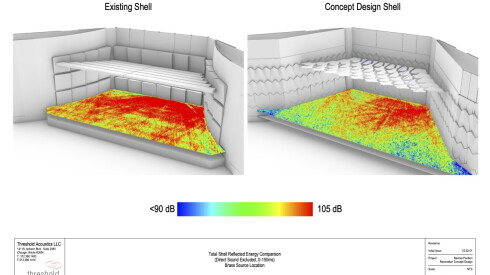
Pfeiffer noted that the CSO musicians “struggled with loudness” in the previous shell. “They struggled with hearing conditions across and up and down the stage,” he said. That’s important because while they’ll be watching conductor Marin Alsop’s baton to stay on beat, the instrumentalists also rely on listening to one another for cues and precision.
“This is predominantly about making a good hearing environment for the musicians so that they have a clearer, more cohesive sound,” Strong said. “And that in turn picks up better sound in the microphones, which makes it better for everyone.”
Todd Hensley, director at Schuler Shook, a Chicago-based theater and lighting design company that helped renovate the pavilion, said the CSO has already experienced the improved shell while rehearsing for Saturday’s opening night.
“In particular, the double basses and the cello should have a much improved time being able to hear themselves, and heard across the stage,” Hensley said.


The shell elements were made of a light foam material, Barnes said, which was then wrapped in a faux wood vinyl meant to echo the timber of the original 1904 pavilion.
All of the changes are a part of “harmonizing” the structures found throughout Ravinia, Barnes said.
Last year, phase one of the project included a new speaker system. That’s for artists such as Labrinth, Ricky Martin or Hugh Jackman, who are all slated to perform in Highland Park this summer.
The venue has also made notable improvements to its backstage area, called the Negaunee Foundation Artist Center. Now, touring artists have two full loading docks for all of their stage props and band equipment, plus access to a brand new video production room, green rooms for meals and meet and greets, and updated dressing rooms.
The CSO now has its own orchestra library in the basement of the artist center, along with climate-controlled storage areas for instruments that were previously subjected to corrosive, cold temperatures.

For Ravinia’s pop and rock shows this season, the orchestra shell walls will retract and ceiling reflectors will tilt and tuck away overhead. Those artists will probably want to hang their own tresses of lights and other accessories, Barnes says, so Ravinia has installed black curtains that can descend over the shell within minutes to make the stage appear more neutral.
Adjacent to the railroad, Ravinia first opened in 1904 as a summertime “high-end amusement park” meant to serve as an escape from city congestion. But ahead of the 125th anniversary in 2029, the operators of the renowned music park wanted to give the space a much-needed facelift. This round of renovations on the pavilion was considered phase two in a multiyear project.
“We realized that all of our stages are actually getting older and out of date,” Ravinia CEO Jeffrey P. Haydon previously told the Sun-Times. These renovations are all about keeping up with the “competitive music environment in Chicago,” Haydon said.
There is no timeline yet for the renovations and reopening of the Martin Theatre, but it is on Ravinia’s list of projects ahead of the 2029 anniversary, a spokesperson confirmed.


