America celebrates its 250th birthday on July 4. Local audiences can expect a wave of patriotic programming in spring and summer, from a live reading of the Declaration of Independence at the Newberry Library to a staging of the Tony-winning musical “1776” by DLO Musical Theatre in Danville.
As part of a change in its guidelines, the National Endowment for the Arts shifted its focus last year to funding initiatives that celebrate the milestone. About 20 Illinois cultural groups received money through the NEA’s “America 250” emphasis to total $661,000 — about half of the state’s total $1.2 million haul.

The city and state are rolling out their own slate of programming, too: Illinois America 250 and the Chicago America 250 initiatives will feature public art installations, exhibits, music festivals, educational tours and more.
The festivities kick off in earnest this month. On April 9, Newberry Library will open a new exhibition, “Free and Independent: The Declaration of Independence and the Words That Made the United States.” Later, on July 8, it will take part in a national live reading of the historic document.
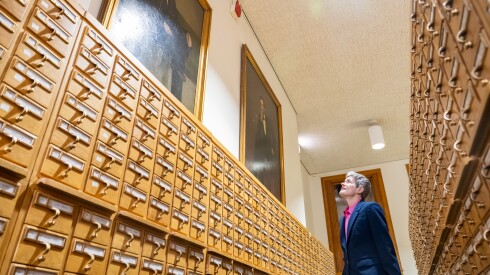
In his second term, President Donald Trump has trained his focus on American history and culture, including instituting an unprecedented review of materials at Smithsonian museums after deeming some displays on race, slavery and queer history “divisive.” The federal funding windfall has forced cultural groups to reckon with a tough question: How far can you go to interrogate the full and complex history of the country while also celebrating its progress?

Leaders of Illinois organizations say they are committed to taking a deep and nuanced look at the nation while also amplifying diverse perspectives. Among them is Duriel E. Harris, editor of “Obsidian: Literature & Arts in the African Diaspora,” a literary journal published by Illinois State University. In the forthcoming issue “Bond of a Nation: Ekphrasis & the Promise of America,” writers will examine the values of democracy.
“We have recognized for some time that [the country] is not living up to those ideals,” Harris said. “The essence of love is truth-telling. How do we evolve and become the best that we can be? It is through constructive criticism.”
National Endowment for the Arts stabilizes following 2025 cuts
The NEA-supported programming for “America 250” spans institutions of all sizes and audiences of all ages and comes at a time when the Trump administration is limiting history education by banning “discriminatory equity ideology” in schools and removing references to slavery and racism at national parks and historic sites.
The government has also pushed back on criticism of certain historical figures by erecting a statue of Christopher Columbus near the White House, and reinstalling a previously toppled statue of Confederate general Albert Pike in Judiciary Park.
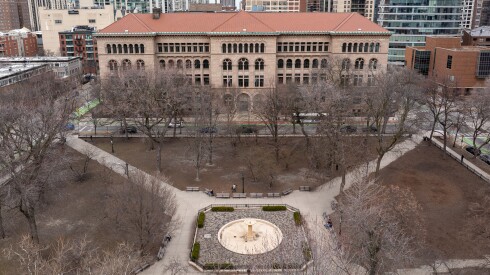
The Newberry Library aims to offer “thought-provoking exhibitions,” said Jill Austin, who serves as the organization’s vice president of public engagement. One exhibit on political illustrations will feature both patriotic and dissenting commentary about the country during times of war.
Tyler Pasciak LaRiviere/Sun-Times
At the Newberry Library, the aim is to offer “thought-provoking exhibitions,” said Jill Austin, who serves as the organization’s vice president of public engagement. “Free and Independent” will break down the “problems and the promise” of the Declaration of Independence, while highlighting the perspectives of tribal nations and those who took issue with slavery at the time, according to Austin.
An exhibit on political illustrations will feature both patriotic and dissenting commentary about the country during times of war. Other relevant programming includes a presentation of Revolution-era items during “Newberry Fest” and the NEA-supported “Impressive Textiles: Printing on Fabric,” which includes a commemorative handkerchief celebrating George Washington and campaign banners for Abraham Lincoln.
“We wanted to go beyond a celebration to really explore the history and help people understand the nuances of it more deeply through our collections,” Austin said.
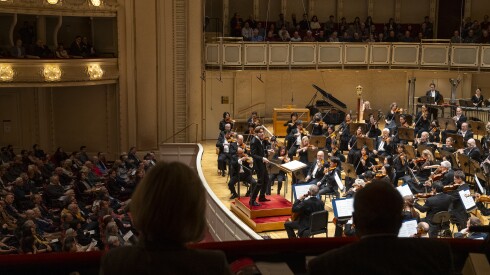
The Chicago Symphony Orchestra’s “America 250″ programming will incorporate cultural diversity through a staging of “Lincoln Portrait & Ellington Harlem,” featuring Duke Ellington’s love letter to the iconic Black neighborhood and Aaron Copland’s tribute to Abraham Lincoln. The latter will be narrated by Chicago actor Harry Lennix.
Tyler Pasciak LaRiviere/Sun-Times
With a lineup that includes works by George Gershwin, Charles Ives and John Williams, the Chicago Symphony Orchestra’s “America 250” programming primarily reflects traditionally celebrated American classical music. But the CSO will also add some cultural diversity through its staging of “Lincoln Portrait & Ellington Harlem,” featuring Duke Ellington’s love letter to the iconic Black neighborhood and Aaron Copland’s tribute to Abraham Lincoln.
The latter will be narrated by Harry Lennix, a Chicago actor known for his advocacy for Black artists. Performances of “Liberty” (Symphony No. 5)” by Wynton Marsalis’ Jazz at Lincoln Center Orchestra and spirituals by the Apostolic Church of God Sanctuary Choir also contribute to the lineup of diverse voices.
“Everybody has a role to play in the history of this country,” said Cristina Rocca, CSO’s vice president of artistic administration. “Diversity should always be celebrated. I hope that people will see the importance of this celebration and to get to know more about American music, which is so rich in its breadth and variety of styles.”
For Claire Rice, of Arts Alliance Illinois, the state’s NEA programming will offer an inclusive view of American history.
“The ways in which folks are interpreting that 250 mandate are demonstrative of the richness and diversity of the cultural fabric of the state,” said Rice, who is the executive director of the arts advocacy organization. “Illinois was never going to be a state where it was only one kind of grant for America 250.”
But the NEA grants have come with controversy. Last year, the federal arts funding group clawed back grants promised to arts organizations across the country amid an ideological shift. It changed its guidelines, requiring grantseekers to certify that they do not operate diversity, equity and inclusion programs that violate federal anti-discrimination laws, and eliminating “Challenge America” grants that went to smaller arts groups that focus on underserved communities.

Jacob Tate, an artist with Firebird Community Arts, touches a memorial for Paul Hardwick, a Black waiter at the Palmer House Hotel who was fatally shot while being chased by a mob of white men, during a walking tour organized by the Chicago Race Riot of 1919 Commemoration Project in the Loop. The walking tour is highlighted on a downloadable passport as part of the Illinois America 250 initiative.
Pat Nabong/Sun-Times
The shift in federal funding impacted organizations’ ability to do everything from offering free programming to touring their shows.
“There are pockets of the country in which no private funding is going to support the arts,” said Erin Harkey, executive director of Americans for the Arts, a national advocacy organization. “Public funding is really about access and participation. So a loss in those funds is really significant.”
Trump’s attempt to eliminate the NEA budget altogether was thwarted by a bipartisan vote from Congress, which funded the agency for $207 million for 2026. After a rocky period, advocates said the recent confirmation of NEA Chair Mary Anne Carter, who served in the role during Trump’s first administration, has stabilized the agency.
Organizations should be encouraged to keep applying, Harkey said.
“Continuing to engage with the National Endowment for the Arts and not making assumptions about what will be funded and what will not is an important thing to do,” Harkey said.
Ballads for Trump’s National Garden of American Heroes
Changes in federal guidelines have forced organizations to adapt their programming. Last year, the Sones de Mexico Ensemble sought NEA funding to support performances of corridos, or traditional Mexican ballads that often present heroic tales.
After being denied twice, the Mexican folk music group and educational organization altered its programming to pitch corridos about eight figures in Trump’s forthcoming National Garden of American Heroes: Muhammad Ali, Roberto Clemente, Dorothy Day, Joseph H. De Castro, Amelia Earhart, Mary Fields, Woody Guthrie and Abraham Lincoln. The grant was approved.
The ensemble has plans to perform the corridos at the Chicago History Museum in June.

“I’m trying to roll with the punches,” Juan Dies, co-founder of the Sones de Mexico Ensemble, said. “I’m trying to adapt. My organization is not political. We have an artistic mission to promote greater appreciation of Mexican music and culture, and I feel like we can carry that on under these guidelines.”
Arthur Maiorella for the Sun-Times
“I wanted to have some Latino representation,” said Juan Dies, executive director of the Sones de Mexico Ensemble. “I wanted to have some men and women represented. I wanted to have African Americans represented. And I wanted to show the versatility of corridos. Why not have these songs accepted?”
Dies said he supports NEA staffers and will continue to apply for funding.
“I’m trying to roll with the punches,” he said. “I’m trying to adapt. My organization is not political. We have an artistic mission to promote greater appreciation of Mexican music and culture, and I feel like we can carry that on under these guidelines.”
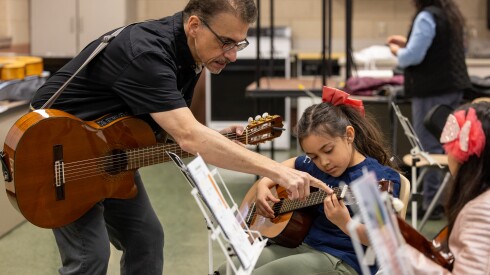
Likewise, the Illinois America 250 initiative — which did not receive state or federal funding — aims to similarly uplift the contributions of different cultures, with special emphasis on African Americans, indigenous communities and immigrants. A downloadable passport encourages tourism to such diverse landmarks as the Black Hawk State Historic Site in Rock Island, the National Museum of Mexican Art in Pilsen, and the Owen Lovejoy Homestead, which is an Underground Railroad site in Princeton.
The passport also educates visitors about the Chicago Race Riot of 1919 Commemoration Project. Markers throughout the city memorialize Black and white residents killed during attacks by white mobs during the violent week. The project was co-founded by Peter Cole, a history professor at Western Illinois University.
Reflecting on America’s 250th anniversary, Cole said he believes in celebrating both the aspirations of the Declaration of Independence, while also acknowledging the darker parts of the nation’s history.
“It’s not to rub everybody’s face in the fact that America is terrible,” he said. “It’s actually evidence that America has gotten better over time. Most Americans are smart enough to be able to distinguish between horrible things of the past, and that we shouldn’t have done them, but that we are not the same people now as we might have been then.”