There were dabke dancers, a juggler and peals of laughter near the school mangled by Israeli airstrikes in Gaza City’s Sheikh Radwan neighborhood.
The Abd Al-Rahman Bin Awf School is no more. Its tattered remnants now serve as a makeshift shelter for displaced Palestinians.
Still, there is ample reason to celebrate.
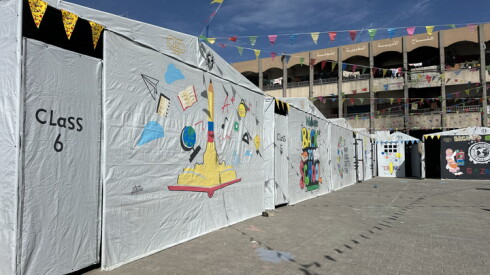
A new school, funded by and named after the Chicago clothing and accessories line Wear The Peace, opened its doors two weeks ago on the former campus’ courtyard.
A video recorded during the May 3 inaugural festivities shows the youngest students clamoring to sit on wooden benches as if they were vying for a spot on a plush, jeweled throne. Staring at the dry-erase board, they are in heaven in a place that has often felt like hell.
The boys and girls in the Gaza Strip, where literacy rates have hovered close to 98% in recent years, have desperately wanted to return to school since Israel damaged or obliterated most of their learning spaces in the last three years, said Murad Nofal, the co-founder of Wear The Peace.

The decade-old Northwest Side company, which fashions itself a “peace brand” offering “clothing with a purpose,” donates all sales profits to humanitarian aid efforts in war-torn and/or poverty-stricken countries, including Venezuela, Syria, Chad, Lebanon and Sudan.
Uplifting people in Gaza has been particularly important to Nofal and his business partner, Mustafa Mabruk, both children of Palestinian refugees.
Wear The Peace partnered with the youth-led organization The Future of Congo to build its first educational facility — a terra-cotta-colored schoolhouse with white window frames — in the Democratic Republic of the Congo last year.
The Wear The Peace School in Gaza was constructed in collaboration with the Bridgeview-based nonprofit Pious Projects with more modest materials.
The minimalist nylon-tented design wasn’t by choice.
Israel restricts the entry of cement, steel and other construction supplies into the region it flattened — killing nearly 73,000 Palestinians — after the Oct. 7 Hamas attack.
But the devastation and imposed constraints haven’t stopped the resilience and creativity of the surviving Palestinians, who are determined to rebuild amid the fragile ceasefire.
One man, Al Jazeera recently reported, has been mixing human hair as a binding agent to the mud he’s been using, along with the debris from his home, to erect a bare-bones dwelling unit.
And just last week, two sisters were named winners of a United Nations prize for their eco-friendly brainchild: Non-bearing bricks created with the rubble that has blanketed Gaza.
Nofal and Mabruk told me The Wear The Peace School is a symbol of that rise-from-the-ashes fortitude.
“From the beginning of our brand, we have always talked about making a change in communities around the world, and over the last few years, we have been blessed to do just that,” said Mabruk, 30.
“I hope this (school) will help inspire the children of Gaza and give them hope for a better future.”

In addition to financing the $50,000 construction expenses, Wear The Peace is covering the costs of school supplies and salaries of roughly a dozen teachers.
The 11-classroom school has been operating six days a week in two three-day shifts to accommodate the 900 K-10th grade students who have registered so far.
A five-day week would be ideal, Nofal, 30, said. But a truncated schedule is better than not having any formal in-person schooling, which remains a reality for roughly 420,000 children in Gaza, according to a report released by UNICEF last month.
When I first wrote about Wear The Peace over two years ago, Violet Affleck, the eldest daughter of actors Ben Affleck and Jennifer Garner, boosted the company’s visibility — and the ire of the crowd repelled by pro-Palestinian advocacy — when she was pictured wearing the company’s black “Freedom Melon” crewneck.
The desire to ease the suffering of Palestinians and speak out against Israel’s actions — described as genocidal by leading experts and a U.N. commission of inquiry — has only grown. Wear The Peace raised $200,000 for Gaza in early 2024 shortly after launching its “Palestine Collections.” Since then, the collections garnered more than $2.6 million for food distribution, water, evacuations for medical surgeries outside Gaza and other relief initiatives.
Nofal finds it “cool to see” the outpouring of support for Palestinians. Empathy, he said, sometimes means standing up.
In the last line of the late Palestinian author and poet Mahmoud Darwish’s poem, “Think of Others” the narrator presses readers to strive to be “a candle in the dark” when contemplating the hardships of others who are “far away.”
Wear The Peace’s mission embodies that plea, shining a light that illuminates in more ways than one.
Rummana Hussain is a columnist and leads the opinion coverage at the Sun-Times.