A battle over credit card transaction fees continues after a federal appeals court on Friday sent the case about a new Illinois law seeking to limit so-called swipe fees back to District Court.
When customers use credit cards, businesses typically pay credit card companies an interchange fee on each transaction, including sales tax and workers’ tips, that ranges from about 2% to 4%.
In 2024, Illinois passed a first-in-the-nation law to end credit card fees on sales tax and tips that businesses pay. The Interchange Fee Prohibition Act was set to take effect July 1. But banking associations sued the state. A federal judge upheld parts of the law in February, but the plaintiffs appealed.
Oral arguments were scheduled for Wednesday but were canceled when the 7th Circuit U.S. Court of Appeals sent the case back last week to a lower court.
“This is standard operating procedure given the credit card companies’ attempt to insert a new issue at the appellate level,” Rob Karr, CEO of the Illinois Retail Merchants Association, said in a statement on Friday.
The plaintiffs, including the Illinois Bankers Association, said in a statement on Friday, “We welcome the opportunity to resume our legal challenge to the Illinois Interchange Fee Prohibition Act in district court.” They argued it “conflicts with federal law, and recent regulatory actions only reaffirm that fact.”
The case was sent back to consider a recent order from the U.S. Office of the Comptroller of the Currency — part of the U.S. Department of the Treasury. In April, the OCC’s order exempted national banks from the law but not Illinois credit unions and community banks.
“Banks and credit card companies will stop at nothing to protect their ability to charge outrageous swipe fees, going so far as to recruit the Trump administration to block an Illinois law that was recently upheld by a federal judge,” Karr said in an April statement.
The Electronic Payments Coalition, which represents Visa, Mastercard and banks, applauded the OCC’s order in a statement. The lobby group called for Illinois to repeal the law, saying it “introduces significant uncertainty in the marketplace, where some credit and debit cards may work and others may not.”
It’s unclear whether the law will go into effect as scheduled.
Ben Jackson, executive vice president of the Illinois Bankers Association, said the law will disrupt customer transactions, cause confusion and burden small businesses with upgrading payment systems.
Karr, of the Illinois Retail Merchants Association, said there will be “chaos” only if credit card companies and banks “intentionally” cause it.
He said credit card companies can comply with the law since they already manage different taxes in every state. “They have to do all of that. It’s moving a percentage from one line to another line,” Karr said.
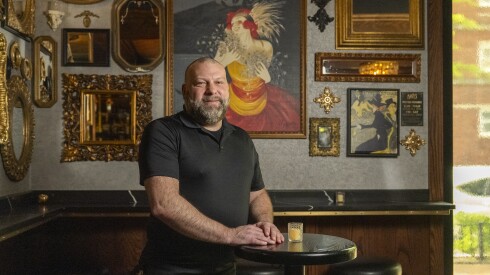
If the law takes effect, 2Bears Tavern Group, which owns five North Side bars, doesn’t expect to change its payment system because it already delineates fee information clearly.
“The law could be implemented without issue, delay or cost,” Mark Robertson, 2Bears’ president, said.
‘The money is not ours’
As the legal battle over the law continues, many small businesses deal with credit card fees every day.
Minyoli, a family-owned Taiwanese restaurant in Andersonville, stopped letting customers split the bill with multiple credit cards. The business gets charged a percentage of the bill, as well as a flat fee for each swipe.
“With already razor-thin margins in the restaurant business, swipe fees have a huge financial impact,” Minyoli General Manager X Wang said. “Since almost 100% of our transactions are credit card based, this essentially becomes a permanent cost for the restaurant.”
Swipe fees are yet another challenge for Potash Markets, which struggles with soaring inflation and stiff competition from supermarket giants. The 75-year-old family business has three grocery stores in the Gold Coast.
Swipe fees are “a hindrance that adds to the cost of doing business. It factors into the prices we charge,” Art Potash, owner of Potash Markets, said. “If more customers knew we are paying fees on taxes and it contributes to the cost of their groceries, I think they’d be in favor of the law.”
Potash said it’s unfair retailers pay credit card fees on sales tax that goes to the state.
“We’re doing something for the state of Illinois. We’re collecting the tax for them. It’s not our money,” he said. “We do the right thing and get penalized. It makes sense that Illinois would want to make it right.”
As more customers use credit cards, swipe fees are a growing expense for business owners.
A decade ago, credit card payments were less than half of the transactions at 2Bears, which owns Marty’s Martini Bar in Andersonville. Today, credit card payments are nearly 99% of sales, Robertson said. This year, 2Bears expects to pay more than $200,000 in credit card fees.

Businesses often pay credit card fees on workers’ tips. They’re allowed to deduct the fees from workers’ tips, though 2Bears doesn’t do that.
“The money is not ours. We are just the conduit to other parties, our employees and the government,” Robertson said.
But he points out with wages for tipped workers rising rapidly, businesses like his may have to consider deducting swipe fees from tips.
Credit card fees are “essentially totally uncontrollable other than passing them on to customers or not accepting card payments,” Robertson said. “More and more businesses are choosing to pass on those costs to customers by charging a fee at checkout.”
Robertson emphasized that high inflation has been unrelenting since the COVID-19 pandemic. Meanwhile, customers seem to be cutting back on spending.
Those pressures, combined with “a regulatory environment in Chicago that is decidedly unfriendly to small businesses in the last several years, makes for a less than optimistic view for the economy locally,” Robertson said.
Illinois’ swipe fee law “was one of the few positives that have come out of state and local government for the hospitality industry in the last six years,” he said.
Many small businesses like 2Bears are “reaching a breaking point with inflationary pressures,” Robertson said. “This law is attempting to draw a line in the sand around these costs.”