About a week before her death on June 9, 1995, while she was getting dressed for a church service, Pastor Wilma Jean Johnson stopped her son Brandon, the sixth of her 10 children, as he was about to leave the family home.
She had something he needed to know.
Pastor Johnson’s health had been in decline for some time as she battled congestive heart failure and related complications. Perhaps she knew her time was short. Or maybe it was a mother’s irrepressible intuition about her child.
“I want you to take care of yourself,” her son, Chicago Mayor Brandon Johnson, recalled her saying in a wide-ranging conversation with the Sun-Times late last week about his faith, “evolving” spirituality and how they shape his life as a father, partner and public servant.
“She said, ‘Don’t worry about your father, don’t worry about your brothers and sisters; I need you to take care of yourself because I see you standing before thousands of people one day, and you are going to have incredible influence on thousands and thousands of people,’” he said. “And that was it.”
It was the last encounter Johnson had with his mother. He was a 19-year-old college freshman, home briefly for a Sunday afternoon visit. She was barely 50. Four years earlier, she had collapsed and was diagnosed with a heart condition, and just kept going. Until she couldn’t.
“I think it was just the prophetic words of my mother,” Johnson, who turned 51 in March, said as he prepared to travel to Vatican City to meet Pope Leo XIV in a private audience Thursday. “I mean, she never said I’d be mayor of Chicago,” he laughed. “But in that moment it was clear that whatever it was that my father’s mission was, mine would be a little different.”
Johnson’s father, the Rev. Andrew Johnson, is an ordained minister in the Church of God in Christ, the largest Pentecostal denomination in the United States. For many years with his wife, Wilma Jean, he pastored Community Center Christian Ministries in Elgin and occasionally foster-parented even more children. To help make ends meet for his large family, he also worked at Elgin Mental Health Center, serving patients on the night shift until he lost his position after being accused — falsely, according to his family — of falling asleep on the job. Money was often tight. The family pulled together to support each other in myriad ways.
There was an expectation, explicit and implicit, that someday Brandon Johnson would take over the family “business,” stepping up to shepherd the church.
After Wilma Jean’s death, her son didn’t heed her words. At least not immediately.
“I ended up leaving school and taking some classes at the community college and came home to help dad and to be of support with my siblings,” he said. “You can try so hard for something to happen or materialize. And it just seems like no matter how hard you try, things don’t quite ever really settle.”
“And I think once I got married [in 1998] and really begin to feel this call to not just take care of myself, but really begin to spend time in prayer, thinking about when that mirror is put up against you and God begins to show you who you are — how do I truly fulfill the purpose that God has in my life that [is] gonna ultimately bring him glory?” Johnson said. “I just began to pursue that calling and that purpose. And I think as I became closer and closer to fulfilling that purpose … it really began to just resonate that there are multiple ways in which you can do ministry. And mine would be through public education and public advocacy that would inevitably lead to me running one of the largest economies in the entire world.”
A connection with the Holy Spirit
That conversation with his mother, Johnson said, is one of the times he felt he’d had an encounter with the Holy Spirit. It’s not a common topic for most politicians to explore publicly, but Johnson consistently has spoken openly about his spiritual life and beliefs since entering the public square.
It’s something he has in common with the Chicagoan he’s expected to meet with in the Vatican Apostolic Library Thursday: Pope Leo.
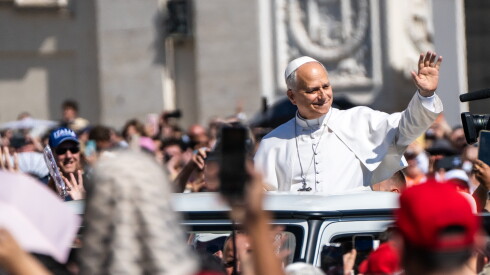
“What doors does the Spirit open?” Leo said Sunday — known as “Pentecost Sunday” to Roman Catholics and many other Christians. Celebrated 50 days after Easter, Pentecost commemorates the Holy Spirit descending on Jesus’ apostles and other followers in a great wind and “tongues of fire” in Jerusalem, according to the biblical account in the Book of Acts, enabling them to preach the gospel to the world.
“The Holy Spirit opens the door of our heart, helping us to overcome resistance, selfishness, mistrust and prejudice, while enabling us to live as children of God and brothers and sisters to one another,” the pope said.
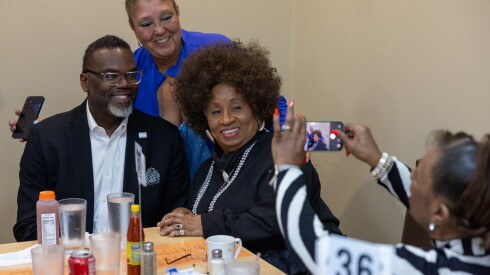
Speaking Sunday during a send-off event at Peach’s Restaurant in Bronzeville on the South Side, Johnson, who is leading a delegation of Chicago business, civic, education, and faith leaders to the Vatican, wished those gathered “Happy Pentecost!”
“I need your prayers,” Johnson continued. “Our city, our state, our country, our world — we need prayer, but I also know that even if we walk by faith, prayer without works is [dead], but we are alive and well in Chicago, aren’t we? So, we’re going to take that good word, connect with the pope, and we know that everything dope — including the pope — comes from the greatest city in the world, the city of Chicago.”
It’s a great political line, surely. But it’s also a serious spiritual statement.
When 133 cardinals gathered in the Vatican’s Sistine Chapel in May 2025 for a conclave to elect the successor to Pope Francis — who turned out to be Cardinal Robert Prevost of Dolton — they began by asking the Holy Spirit to guide them. “Veni Creator Spiritus,” they sang in Latin, meaning “Come, creator Spirit.”
Life as a Pentecostal
As a lifelong Pentecostal Christian, Johnson is well acquainted with the Holy Spirit. Generally speaking, Pentecostals believe in the ongoing, supernatural presence of the “third person” of the Trinity (i.e. “Father, Son, and Holy Spirit/Holy Ghost”) and that it actively participates in and can shape the daily lives of Christians even today. Sometimes known as the “baptism of the spirit” or “second baptism,” many Pentecostals believe it to be an experience separate from salvation, one often accompanied by “speaking in tongues” or other “gifts of the spirit” such as prophecy and healing.
Johnson vividly remembers what he describes as his first “encounter” with the Holy Spirit when he was in grade school.
“It was pretty early in my life — around 9 or 10 years old,” he began. “It was customary for us to spend time on the altar, to really seek God’s presence and his spirit to be that comforting force that the Bible promises us, that the Holy Spirit will never leave us or forsake us and will be with us always, even to the end of the age.
“I think I just learned early in life that if you seek you’ll find, and I had a desire to want to live a life that would be acceptable in the eyesight of God. To be of service, I think is probably the best way I can describe it,” he continued. “And I think I learned and discovered early … that there was a specific plan and purpose that God had for my life. And that was to be a life of service to humanity. And that’s when I really felt God’s presence in his Holy Spirit, you know, really comfort me and confirm that this was what I was supposed to do.”
Does he remember how it felt, that first encounter with the Holy Spirit on the altar as a child?
“I remember feeling just protected and safe and that I was as OK as I’ve ever felt in my life,” he said.
Moments of a spiritual presence
Are there other moments when he’s felt a similar spiritual presence in his life?
“Yes — I could think of the birth of my children,” he said, referring to Owen, Ethan and Braedyn whom he shares with his wife of 28 years, Stacie Rencher Johnson.
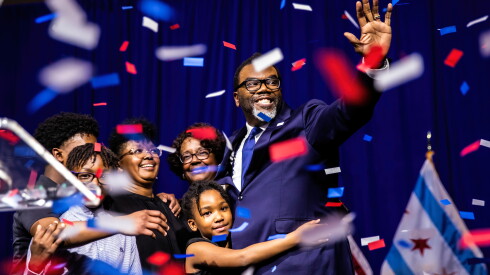
“I knew God was there on the altar with my wife and knew that God was there in Room 309 when the door closed and I had 30 seventh graders staring at me in the face and I had not said a word before one of the kids began to rebel against the class norms that I didn’t even get a chance to establish. I knew God was there,” he said, chuckling as he recalled his first day teaching at Jenner Academy Elementary in Cabrini-Green nearly 20 years ago.
“I could think of difficult times: When my mother passed away, I knew God and his presence was there. When [I heard] the news about my father, who is in a second or third phase of Alzheimer’s. … And how every, every now and then, he’ll just give us a little glimmer, and you can just … you see dad. He just sort of peeks out. And he just kind of — for a quick moment — he has a memory and is present,” he said. “Sometimes you believe, you want to believe because you’re desperate, and to hear someone else say that no, that is a real experience — that’s how I know that God is present.”
How does the mayor describe himself spiritually now?
“Evolving,” he said. “I mean, constantly growing in my faith as this incredible journey of this faith walk is to believe in the things that have not yet been seen. … And I’m evolving as a husband, which is the best way to model my life after Christ, to love my wife as Christ loves the church. And then, of course, as a parent, to not provoke my children to wrath.”
And how’s that going?
“I wanna know where the scripture is about children not provoking their parents to wrath!” he said, laughing again.
“And then finally, to love your neighbor as yourself. That’s a constant evolution. I think it means not to live in fear. I believe that’s why some people struggle with that — when you live in fear. … The many times in the Bible where it says, ‘do not be afraid,’ that’s a regular command. And I believe that the fear of the unknown, the fear of others or something else or the fear of losing is why I believe that people struggle to love their neighbor.”
Earlier this week, Johnson delivered the commencement address at Kenwood Academy High School, where his eldest child, son Owen, who turns 19 in the autumn, was a graduating senior.
What does Johnson want his children to know — about God, faith, spiritual life — that he didn’t know when he was younger?
“That they never, ever question how much God loves them,” he said. “I just want them to know that it doesn’t matter what they do, that his love will never end. And I say that because I want them to know that as their father, as their parent, that they can always trust me and come to me no matter what. I’m never going to judge them, and that’s what I want them to know.
“I want them to know that they don’t have to be afraid, and to know that no matter what, they can always come to me. But even if I don’t measure up because I’m human, that there’s a God that loves you no matter what.”