Replacing or altering controversial monuments is not new for the city of Chicago. Think of the two statues of Christopher Columbus, removed permanently in 2020, or the Haymarket Police Memorial Statue, which officials have moved over a half-dozen times.
Another marker, the Balbo Monument, has fueled debate for at least eight decades and still stands in the shadow of Soldier Field. Controversial past aside, it has other problems to worry about.
“This monument needs a lot of work,” Andrzej Dajnowski said while reviewing the Balbo Monument in Burnham Park on a recent Friday. Dajnowski is a world-renowned sculpture conservator who has refurbished many monuments and artworks in Chicago, including the Art Institute lions in 2022.
The centerpiece of the Balbo Monument is an ancient Roman column made of breccia, an ornamental stone used frequently in Roman architecture. It sits atop a large travertine base with marble components in between, and it’s not in good shape.

“When you get up there, you will see that there are many tiny cracks that you don’t see,” Dajnowski said, pointing to damages from top to bottom. “Freeze and thaw damage did all of this.”
The column spent about 2,000 years in a lush Mediterranean climate and its last 90 years outdoors in Chicago — or what one might call “the opposite.”
So, what should be done? In 2022, a city task force recommended the Balbo Monument be moved to storage. Some say the major feat of aviation it commemorates is enough to keep the monument around. But if the subject’s role as a key political leader in Fascist Italy is a disqualifier, is the monument’s other identity as an ancient Roman artifact enough to preserve it?
More than just a commemoration
Italian dictator Benito Mussolini gifted the Balbo Monument to the city during the 1933-1934 “A Century of Progress” World’s Fair. It commemorates a historic transatlantic flight by Italian Air Marshal Italo Balbo, who led a squadron of 24 Savoia-Marchetti seaplanes from Italy to a spectacular landing on Chicago’s lakefront.
Balbo was a sensation when he arrived in 1933, so in 1934, Mussolini sent the city an ancient Roman column. It was placed in front of the Italian Pavilion at the World’s Fair, which had been extended for a second year.
The fanfare meant a lot to Chicago’s Italian immigrant population at the time, according to author Don Fiore, who wrote a 2023 book about Balbo’s flight. Fiore said prejudice and stereotypes about the Italian community were commonplace at the time.
“The immigrants who came here, they were really the lowest of the low in the eyes of American society,” said Fiore, whose own father attended Balbo’s landing on the Chicago lakefront. “But Balbo, he gave them such enormous pride.”

General Italo Balbo’s plane skimming the water of Lake Michigan before a large crowd at the Century of Progress International Exposition in Chicago, Illinois, July 1933. Balbo, official air minister of Italy under Benito Mussolini, organized and led the Italian air armada in a formation flight from Rome to Chicago to New York and back to Rome. The formation flight consisted of 24 Savoia-Marchetti-S.55X hydroplanes, which landed in Chicago on July 14, 1933.
Chicago Daily News, Inc./DN-0011316, Chicago Sun-Times/Chicago Daily News collection, Chicago History Museum
The man for which the monument is named was full of contradictions. Balbo, a world-famous aviator, would later oppose antisemitism and urge Mussolini not to ally with the Nazis, according to his biographer Claudio Segré. But Balbo also led brutal, punitive expeditions against socialist sympathizers during the Fascist Party’s early Blackshirt days and served as one of four principal architects of Mussolini’s March on Rome, which swept the eventual-dictator into power.
Author David Hanna, who wrote a book about Balbo’s flight to the World’s Fair and the rise of fascism, said there is no evidence that Balbo directly participated in some of the more heinous crimes of Italy’s early Fascist era — including sexual violence against fascism’s opponents, the murder of a prominent critic, and, later, the regime’s use of chemical weapons on civilians in Ethiopia — but Balbo ultimately hitched his star to Mussolini to advance his career.
“He was an enabler,” Hanna said. “There’s no way that he didn’t know this stuff was going on.”
After Chicago, Mussolini made Balbo colonial governor of Libya, where Balbo positioned himself as a more compassionate modernizer following the “horrific” actions of his predecessor, according to University of New England professor Ali Abdullatif Ahmida, author of “Genocide in Libya: Shar, a Hidden Colonial History.”
“This fascist state was genocidal, and Balbo is just trying to give it a spin and a positive image,” Ahmida said. “It’s like putting lipstick on a pig. The pig is going to be a pig no matter what.”
In the run-up to World War II, Balbo disagreed with Mussolini’s turn toward Hitler and told him as much, but he never risked his position to break with the regime. Balbo biographer Claudio Segré compared fascism at that time to a “slowly sinking ship” and Balbo “chose to stay aboard, bail, and from time to time shout advice to a deaf captain.”
At the start of the war in 1940, while serving as supreme commander of Italian forces in North Africa, Balbo and his plane were shot down by friendly fire, killing him a year after Mussolini allied with Hitler.
What to do with the monument
For some, the history of the monument itself is more ripe for discovery than one man’s controversial past.
“[The monument] was a promotion, of course,” said Onur Öztürk, a specialist in Roman architecture and a professor of art history at Columbia College Chicago. “They wanted to really push this idea that with the Fascist regime, Italy really turned things around.”
Öztürk, who is writing a book about the monument, said the gift served multiple purposes. It was a reminder of the technological achievement of Italy’s flight to Chicago, but also a tourism ad and a piece of propaganda. Evidence of Chicago’s obsession with Greco-Roman architecture was already everywhere — see Soldier Field (1924), the Chicago Cultural Center (1897) or the Field Museum (1921) — and Mussolini wanted viewers of the column to link the Fascist era with the Roman era.

“[It’s] basically suggesting that […] you have these amazing structures in Chicago, but here’s the real thing,” Öztürk said. “And by the way, you can keep it.”
Opinions on what to do with the monument vary widely. Some see displaying a monument named for a fascist and gifted by a fascist as an embarrassment, including Edward Muir, a professor of history and Italian at Northwestern University.
“It should be taken down,” Muir said. “I don’t think it has any part to be in a public park in Chicago.”
Others care less about the Balbo Monument than they do about Balbo Drive, formerly 7th Street, which Mayor Edward Kelly named for Balbo in 1933.
“A street name is an honor,” said Bill Savage, a professor of instruction in the English department at Northwestern University who’s writing a book about Chicago’s grid system.
Savage points to a notable example of Chicago renaming a street after the honoree became politically toxic: Before it was Ida B. Wells Drive, Congress Parkway was named for John Tyler.
“The 10th president of the United States, who was a traitor, who joined the Confederacy and was a member of the Confederate House of Representatives before he died,” Savage said. “In 1868, after the Civil War, there’s no record of exactly why the name was changed, but we erased Tyler and put in Congress.”

When the Balbo Monument was first installed, it was a point of pride for many in the Italian community. Today, Ron Onesti, president of Chicago’s Joint Civic Committee of Italian Americans, sees the monument as a relic and a celebration of an aeronautic feat. He would like to see it preserved and the area around it turned into an exhibit.
“There’s nobody here that says Mussolini was a good person. Nobody here saying fascism was good. […] And there’s also nobody here saying we should keep this monument as a monument to fascism, as a remembrance of Mussolini,” Onesti said. “That’s not what this is.”
Some take issue, at a minimum, with the lack of related signage, including the Ethiopian Community Association of Chicago. Balbo was governing Libya in 1935 when Fascist Italy started a brutal war with Ethiopia, where historians say Italy used chemical weapons on civilians. In a written statement, the group said, “The continued public honoring of a figure closely associated with that regime, particularly without clear historical context, raises serious concerns about how this past is remembered and represented.”
The city has taken steps toward contextualizing its monuments.
Years ago, the park district wrote contextual information for Chicago monuments but decided to put the information on its website to reduce visual clutter, according to Julia Bachrach, who worked on the project during her long career at the Chicago Park District.
The district also approached local museums in the 1990s to see if they would be interested in taking the monument, she said, but they declined because it did not fit in their collections.
Bachrach herself prefers leaving controversial monuments where they are and reinterpreting them.
“I just wouldn’t want to say anything that would spur vandalism,” she said. “I don’t feel like destroying art is the answer.”
Chicago’s Department of Cultural Affairs and Special Events put out a report in 2022 that recommended moving the Balbo Monument into storage. Asked whether the city is planning to follow that recommendation — now four years old and from a previous mayoral administration — the Chicago Park District said in a written statement that there are no plans for removal as the district is focused on a number of other, related projects.
Those projects include the Monument Response Project, launched in April, which stages artistic events at controversial monuments with the goal of reimagining public narratives. Another is the Sculptural Diversification Project, which is commissioning new art to better reflect the “diversity, history, and cultural narratives of our community.”
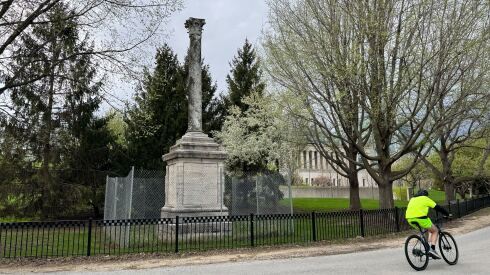
But as for relocation or restoration, no decision is a decision in itself.
Dajnowski recommends a restoration of the Balbo Monument and the installation of a glass shelter, similar to Chagall’s “Four Seasons” artwork downtown. He admits the project would likely cost many hundreds of thousands of dollars but would be easier and safer than trying to move it.
For Dajnowski, the Balbo Monument is worth preserving, and its continued exposure to the elements puts it at risk of “catastrophic failure.”
Does he think it can withstand 10 more Chicago winters?
“Perhaps, but I wouldn’t push it much farther,” Dajnowski said.
Justin Bull is a producer for Curious City.
More about our question-asker

Larry Arroyo gives ghost and cemetery tours for Chicago Cemetery Crawlers and Chicago Hauntings. He occasionally tells customers about the haunted nature of the Field Museum, but laments that he can’t take people inside at night because it’s closed. So he takes them to the Balbo Monument instead.
“It’s such a little forgotten, shady past of Chicago with convoluted history,” Arroyo said, “Like, it’s cool, but it’s uncool.”
Larry wondered why, when people were protesting the statue of Christopher Columbus in Grant Park, Balbo was largely spared from public ire.
“I just think that this should be preserved, but shouldn’t be preserved here,” Arroyo said, referencing the ancient Roman column at the center of the tribute. “This would be better off in one of the museums to talk about its complicated history, instead of just kind of hidden away from everyone, with bushes, fences and a camera on it the whole time.”