A teenaged and closeted Kenny Dillon, the one who endured teasing and taunting growing up in Hegewisch in the 1970s, clung to this truth: He knew he could always leave.
Dillon did bolt from Chicago’s farthest southeastern industrial enclave — where four generations before him had settled after leaving Poland — landing eventually as a hairstylist in Puerto Vallarta, then known as Mexico’s gay beach capital.
But family ties drew him back, and a dozen years ago, Dillon set down roots close to where his great-great-grandparents owned a tavern and his mother still lives. Then love struck, the lasting kind.
Dillon and his boyfriend, David McCormick, 38, built a home together in Hegewisch, with flowers and a swing, and then a salon. They converted an old barbershop tucked among houses on a little side street into All American Style, as they call their business, decking it out in vintage family photos and midcentury decor.
Could Dillon’s younger self have imagined himself so happy here? Among millworkers and city workers and church-going families at the quiet edge of the city?
“No, not at all,” Dillon says at 64.
“When I moved back,” he explains, “I was not moving back and going to be the same person, you know what I mean? I was going to be moved back as me.”

Queer life has bloomed on Chicago’s Far Southeast Side, which has seen some of the steepest growth in the number of same-sex households over the last two decades, according to a WBEZ/Chicago Sun-Times analysis of new U.S. census data.
In a city whose population of same-sex households has increased by about 72%, the numbers have more than doubled between 2005 and 2024 in the southeastern cluster of mostly Latino, Black and working-class communities the census lumps together: South Shore, South Chicago, East Side, Hegewisch and South Deering.
Almost 2% of all households, or 977 couples, are same sex, according to 2024 census data. That’s the fourth-highest percentage in the city, out of 18 census clusters defined in Chicago, behind more visibly LGBTQ+ communities around Edgewater, Lake View or Lincoln Square, and it bests the city’s average.
Even the LGBTQ+ people living on the Far Southeast Side marveled at the news.
And yet, the dozen Far Southeast Side city dwellers who spoke with the Sun-Times and WBEZ all quickly arrived at similar motives driving the trend. Above all was the low cost of living, particularly compared to the North Side’s pricey lakefront gayborhoods or to queer-friendly Hyde Park. The same lake and public beaches stretch south past the palatial apartments of South Shore or the little houses of the East Side, where folks easily slip across the state border for cheap Indiana groceries and gas.
From Hegewisch to South Shore, people say they chose to return to the neighborhoods where they grew up to steep in their culture, but as their whole selves.
They also mentioned how Chicago generally has become a “refuge for a lot of people” who’ve moved here after watching their rights vanish in other states, as LGBTQ+ advocate and podcaster Anna DeShawn calls it.
While telling, the census findings aren’t a comprehensive count of all LGBTQ+ people. Single-person households, regardless of how they reported their sexual or gender identity, are not included. Nor are people who identify as queer in mixed-gender couples. The census also limits its household counts by large clusters, without pinpointing locations, and doesn’t specify races or ages.
Markers of gay life on the Far Southeast Side
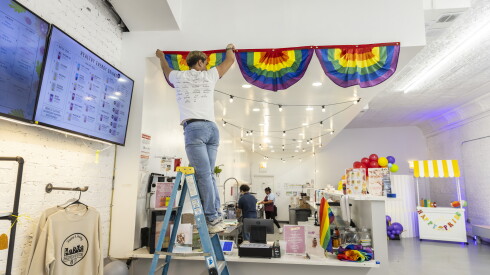
Visible signs of queer or gay life are relatively new in the farthest southeast corner of the city, which has traditionally skewed conservative. Eastern Europeans and Latinos, heavily Catholic, migrated to Hegewisch, the East Side and their surroundings for the jobs.
Isis Bazaldua has seen the new but is also familiar with the old. The 27-year-old lives with their spouse and dog in a house on the East Side, where they grew up.
“We’ve had this history of ruggedness,” Bazaldua says, “and still have that generation of the steel mill workers who were very, like, machismos, and we also have the very large Hispanic population, which is also very machista, like, very set-in-stone gender roles, and again, a heavily Catholic community as well. Yeah, no one’s coming out over there.”
The seventh grade version of Bazaldua wasn’t trying to come out back then, but others revealed their secret of being bisexual. Sick of others also being taunted and threatened, their 20-something self assembled pals from the group they helped found, Bridges//Puentes: Justice Collective, which was already protesting in the Southeast, and launched a Pride celebration close to home. Southeast Side Pride is now in its sixth year.
“A lot of the churches followed what the current pope would say, which growing up was, ‘Gay is a sin,’ ‘You’re going to hell,’ and that being kind of just reflected in the community because it’s people’s belief systems,” Bazaldua says. “So I really didn’t think I would stay or like I could stay and be able to have my identity be a very core feature of myself like I do now.”
So they did their part in making the Southeast Side what they hoped it could be, seeking to “really change the narrative of coming out and make it a celebration and not something people are scared of. I’m tired of … having to go outside of the Southeast [Side], all the way to North Side to just be able to celebrate and come out and be with people who are of the same orientation.”

A Black and queer legacy in South Shore
But gay and lesbian history runs deep in South Shore, the largest of the communities in the census’ Far Southeast Side cluster. Historically, South Shore was an aspirational destination for Black people, especially the Jackson Park Highlands area.
“Black queer people have always been here, whether you knew it or not,” DeShawn, the LGBTQ+ activist, says. “If you didn’t know there was a good reason why. It was meant to be a secret for a reason so people can feel safe.”
Several years before the 1969 Stonewall riots in New York sparked what many consider the opening salvo of homosexual and transgender Americans’ fight for civil rights, the Jeffery Pub opened near 71st and Jeffery Boulevard.
After most of South Shore’s white residents cleared out in the 1960s, its landlords are said to have welcomed single gay men who threw spectacular parties into their spacious, vintage apartments. Nearby Jackson Park was known, sometimes by a vulgar epithet, as a gay cruising and hookup spot, particularly its Wooded Island.
There’d be no Chicago Pride Parade on the North Side — that still draws tens of thousands this last Sunday of June — until 1970. The “Boystown” that would grow up around Belmont and Halsted as the country’s first gay designated neighborhood, albeit a relatively white, cisgender and male one, still was years in the future.
The Jeffery Pub remains a pivotal gathering spot — an anchor or community hub — hosting poetry jams and open mic nights. City officials marked its historical significance in 2024, painting the East 71st Street crosswalk with the 11 colors of a trans-inclusive Pride flag.
“If the community was there enough for somebody to say, ‘Hey, we need a pub,’ that means the community was here all along,” says Dr. Maya Green, a public health doctor raised in a South Shore church, and grand marshal of the 2025 Chicago Pride Parade. It’s “one of the longest-remaining Black-owned LGBTQ spaces,” she adds with pride, and it sits in South Shore.
Green, 48, expanded her Onyx Health Collective clinics to an East 73rd Street location last June — one of the new social services attempting to meet LGBTQ+ patients where they live, instead of forcing them to travel to the North Side or to do without.
Green’s practice seeks to close gaps in healthcare, not just for stereotypical or standard HIV testing or hormone treatment, but also for conditions like diabetes and cancer that disproportionately harm Black people.
“A person in the LGBTQ community is a person, and that comes along with all the things that people experience — birth, growth, life, death, the whole cycle of life … so creating a space where people can come and show up in their authentic whole self is always what’s needed,” Green says, amid artwork inspired by mud cloth from Mali, and prints of Bisa Butler quilts on the center’s walls.
“From the time you walk in the door, we want the vibe to say, ‘Hey, we recognize you, it’s OK to come home.’”
But the exterior is plain, with just a graphic hinting at what’s inside, Green says. All for patients’ privacy.

Dr. Maya Green last year expanded her clinics to South Shore. She says they want to be intentional about care provided for the LGBTQ+ community and to address diseases that disproportionately affect Black people: “From the time you walk in the door, we want the vibe to say, ‘Hey, we recognize you, it’s okay to come home.’”
Manuel Martinez/WBEZ
A few miles from Green’s clinic, Brave Space Alliance offers more services for the LGBTQ+ community: in South Shore, temporary housing for homeless youth.
The influx of other social services in and around South Shore appears to follow promotions of Black leaders at several queer support organizations, says Nikki Patin, the new CEO of the Black- and trans-founded organization.
“Black, queer, gay, LGBTQ folks have always existed in Chicago,” says Patin, who spent their early childhood in South Deering. “We are not new. People are just living, and part of living is also like how we’re gathering, how we’re documenting, how we’re sharing … how we’re building culture with each other.”
That’s the point of Pride South Side, a free festival at the DuSable Museum in nearby Washington Park on July 5. It caps off Black Pride Week, says its co-founder Adrienne Irmer.
“I think culturally everything that has been going since [President Donald Trump’s] first term — folks are craving proximity to their culture and living in communities that better reflect their backgrounds,” Irmer says.
Moving beyond ‘gayborhoods’
Once upon a time, queer people may have felt safest living in “gayborhoods,” where they could band together in sexual identity, and lessen homophobic run-ins.
And as a young lesbian, filmmaker Yvonne Welbon decamped from the “gorgeous” South Shore of her childhood for a doctorate and for adventures abroad. But by the early 2000s, she says, “I needed to be around some Black people. Just community support. People are so kind. Everybody “ma’ams” me, but people always say, “Good morning, and it’s just a really lovely community.”
She bought a home and moved back.
So did many of her friends, movers and shakers in LGBTQ+ and civic circles. Activist Vernita Gray also lived here with her wife, the first same sex-couple to marry in Illinois in 2013.
When it came time to launch the brick-and-mortar home of Sisters in Cinema, an extensive archive of films by Black women and gender non-confirming people that Welbon founded, they chose East 75th Street. Welbon took part in South Shore Remembers, a walking app funded by the city to collect oral histories about the area’s heritage, and hosts a queer history series called When Past Meets Power.
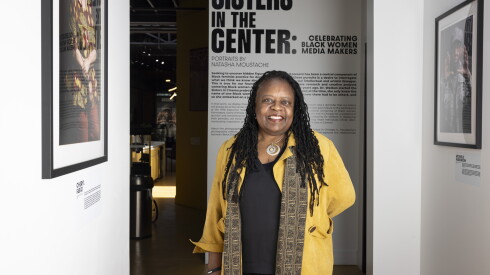
Yvonne Welbon, founder and CEO of Sisters in Cinema, chose to return to South Shore, where she grew up, after living elsewhere. “I just think there’s something here that encourages our spirit and encourages us to be, you know, the activists, the artist, the leaders in and to be out doing it.”
Manuel Martinez/WBEZ
“We came to the same conclusion that you all did, that there’s a large LGBT history in South Shore,” Welbon says. “There’s something in the water — no, it didn’t make me gay, but I just think there’s something here that encourages our spirit and encourages us to be the activists, the artist, the leaders in and to be out doing it.”
This spirit also is leading young queer entrepreneurs to open businesses in South Shore like Urban Luxe Cafe on 79th Street that hosts LGBTQ+-friendly spoken word nights, says Darius Caffey, founder of The Closet Unlocked.
There still aren’t many concrete LGBTQ+ signs, like flags, in these neighborhoods. The prevailing attitude toward inclusive spaces skews more to if-you-know-you-know.
Caffey, 31, says he’s seen “a stronger presence of queer, trans and nonbinary culture across South Shore and the South Side. People want to move to spaces where they feel comfortable.”
Hegewisch hosts an historic Pride celebration
In the early days of his smoothie shop, Hegewisch Nutrition, Jesse Diaz didn’t think he could discuss his private life with his customers. Nothing about boyfriends, partners, any of it.
But Diaz also knew that the only way for such a specialty business to succeed, particularly in this kind of quiet neighborhood where he’d spent early childhood years, plenty of people would have to pop by.
The way to entice people to show up was to build community. So he’d open up.
“We knew we weren’t going to get customers if it was just health products, so we focused on a lot of community events,” says Diaz, 33. That’s what inspired him to take on an unusual location for his shop.

The town’s former movie theater is a cavernous yet cheery rectangle with a wall of mirrors and giant display windows opening onto Baltimore Avenue, the big commercial street through “town,” as Diaz puts it.
It became a primo local third space: meetings hosted by the 10th Ward alderperson, a portrait studio for local high school seniors, a pop-up for neighbors to sell their handmade candles, a theater for kids’ band recitals or exercise classes.
A venue for drag shows and brunches? In Hegewisch?
“It was a big deal for me because it was like publicly posting on community groups that are not the friendliest sometimes … and I knew I was gonna have to eat a little bit of what would come back to me, from people messaging nasty stuff,” Diaz says. But also, the local police parked their rainbow-wrapped Pride car out front.
The drag show begat a collaboration with the Bridges/Puentes crew — Bazaldua included — to host Southeast Side Pride in 2024 as a parade, the first such event on Hegewisch soil.
“I was shaking the whole time, especially because it was, like, nerve-wracking, but also I couldn’t believe it,” Diaz says. “I’m not gonna cry, but I couldn’t believe that was happening here.”
A good mile on a Friday evening, starting and ending at his smoothie shop, doing a loop around Mann Park.
Again, Diaz was part of making Hegewisch history.
“We did get a little bit of backlash, but I was like, OK, 99% is probably good people here in this town, and I’m not going to let 1% scare me away from having the events that I want to have, and so from there it led to more.”
This year’s celebration moved to the East Side, a 5K run around the new Colibri Coffee at 106th and Ewing, with cupcakes and a photo booth.
“People who are choosing to stay, they want to see their community better, where they grew up,” Diaz says.
“Those are like key influencers, that are making queer people say, ‘I think I can make home here.’”
Contributing: Araceli Gomez-Aldana