A faded Mediterranean Revival-styled pergola that is the main feature of a North Lawndale garden, created 120 years ago by Sears, Roebuck & Co., is now being restored.
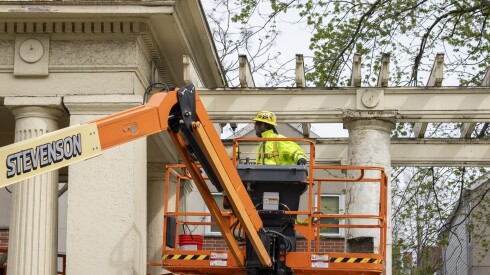
Work began Friday on the 100-foot long pergola at 3330 W. Arthington St. The structure is the centerpiece of the nearly 2-acre garden built in 1907 as a rest spot for employees at what was then Sears’ sprawling campus headquarters.
“People are going to be amazed by the work,” the Rev. Reshorna Fitzpatrick, chairperson of Friends of Sears Sunken Garden’s board, said. “The work is going to happen pretty fast, and it’s actually going to be pretty beautiful.”
The $1 million restoration is being funded by a grant from the Richard H. Driehaus Foundation.
The project is the first step in a larger effort to revive the entire garden, an idea launched by the North Lawndale Community Coordinating Council’s Greening, Open Space, Water, Soil and Sustainability committee in 2021.
The completed project promises to bring new life and attention to one of the city’s best small public green spaces.

It’s also part of what has been a turnabout for this portion of North Lawndale since Sears left its campus for the Sears Tower a half-century ago.
Most of the landmark Sears buildings are now being reused, although its big administration building at 3333 W. Arthington St. sits vacant.
Meanwhile, Sears no longer owns its Downtown tower, having decamped the skyscraper in the 1990s for a big new corporate campus in Hoffman Estates — that was demolished in 2024 for a data center.
The Sears Sunken Garden pergola is an off-white open-air structure composed of 20 classically-designed concrete columns set below a red clay tile roof.
An interior footpath runs through the length of the pergola. There are wood porticos with Doric columns at each end of the structure.
The restoration starts with workers taking paint samples from the structure as a prelude to hunting down historically correct colors, followed by concrete patching.
“This will take a few days. Then, it’s a few months of heavy lifting” that includes replacing the pergola’s roof tiles and wood trusses, while repairing its concrete columns, the project’s principal in charge, architect Andrea Terry of Arda Design, said.
“I think the weakest links are places where the birds and the raccoons have made little holes so there’s water getting in,” she said. “We need it to be sturdy and have staying power, but to still retain the architecture and the features that were meant to be. So it will have less holes in it. It will look cleaner and brighter.”
Berglund Construction and Terra Engineering are also working on the project.
Fitzpatrick said the Friends of Sears Sunken Garden group is looking to raise at least another $4.5 million to remake the green space surrounding the pergola.
A plan by renowned Dutch designer Piet Oudolf — a creator of Millennium Park’s Lurie Garden — and Chicago landscape architect Chris Gent would give the garden new plantings, accessible paths and a reflecting pool.
The garden would be less Victorian than the one created by Sears’ campus architects Nimmons & Fellows more than a century ago for company employees to eat lunch, catch a few warm breezes or listen to live music.
The revived garden would be “contemporary, naturalistic — less decorative than in the past,” Oudolf told me in 2023.
Weather permitting, the pergola work should be completed this summer, Fitzpatrick said.
“It must have been so peaceful,” she said of the garden’s early years.
“You come and you sit down and enjoy the beautiful sun and this beautiful space,” Fitzpatrick said. “How refreshing that must have been. We want to create that same experience for the families, people in the city and the people who come to tour the space.”