Inside his family’s cozy Beverly living room, Charles Joseph Smith takes a seat at the shiny black piano and, without consulting sheet music, begins a commanding performance of Chopin’s “Fantaisie-Impromptu.”
The 55-year-old native Chicagoan is a virtuoso player, completely at ease at the keys. He’s also a prolific composer, with an enormous catalog of 600 original works, ranging from heartfelt classical piano solos to a fully formed sci-fi opera featuring aliens from Mars.

Anyone who has spent time around Chicago’s DIY music scene likely recognizes Smith as a mainstay on the dancefloor of venues like The Hideout or Cafe Mustache, where he often sells his homemade cassettes and sometimes performs his own music. But as a Black artist with autism, Smith has struggled to have his work heard beyond that ephemeral world.
Now, his first widely available release, timed to align with World Autism Awareness Day, marks a major recognition of his talents.
Chicago-based Sooper Records will drop Smith’s double album on April 3. It features 10 eclectic tracks on “Collected Works,” plus two iterations of his opera, “War of the Martian Ghosts.” The label will also make Smith’s self-published autobiography, “The 88 Keys that Opened Doors,” widely available for the first time.
Together, the package aims to give Smith his flowers, which many in Chicago’s scrappy, underground music world say is overdue. That scene has provided Smith refuge, he said, to be among “people doing strange things, performance art, strange music, strange vibe and free-form dancing.”
As Smith finishes the Chopin, his elderly mother, Emma, is near tears. The piece is her favorite. And this moment, when her son’s artistry is on the cusp of wider recognition, feels like the long exhale their household has been waiting for.
“It’s taken a long time to get to a point like this,” Emma Smith said. “Where his talent is going to be available. People will know his music.”

A young boy with something to say
Charles Joseph Smith was born in 1970 on Chicago’s South Side. As a young child, he did not speak for several years. His worried parents took him to a series of doctors, who eventually concluded that Smith was selectively mute.
In an era when autism was understudied and widely stigmatized, it took years for the Smith family to fully understand and embrace their son’s diagnosis: autism spectrum disorder. But in that murkiness, Smith found clarity in music.
As an 8-year-old, Smith tagged along to his older brother’s piano lesson. Despite never having touched the keys, the younger Smith sibling began to play with prodigious precision. Quickly surpassing his brother, Smith grew confident in his abilities.
“I had a Mozart mentality. I realized if Mozart could do this, maybe I could do that,” said Smith, who is dressed on this day in a purple cable knit sweater, thick rim glasses, jeans and a well-worn pair of loafers.
His mother recalled how, as her son was growing up, well-meaning psychologists would tell her and her husband, a late mathematician, that their son “might be able to make some beads or something like that.”
“My husband and I were saying, we’re going to all these parents meetings, counseling sessions and you mean, all that’s going to happen is he is going to be making beads? We could feel that he had something more than that in him,” Emma Smith said.
“I think the music was the key to bringing him out of wherever his mind was. And it made him feel, like Rev. Jesse Jackson said, like he was somebody.”

As a teenager, Smith finally saw autism represented in the broader culture. Temple Grandin’s 1986 memoir about living with autism and Dustin Hoffman’s 1988 performance in “Rain Man” helped him feel seen.
“I now realized people are no longer keeping it secret,” Smith said. “They just realized it’s pervasive, it’s everywhere. At that point, I didn’t realize my gift of composing and piano was likely due to Asperger’s [a form of autism].”
Finding his groove
As the album’s extensive liner notes point out, Smith exists somewhere between a classically trained virtuoso and an experimental outsider artist. His sound mirrors both what you may hear in storied classical music halls, but also tiny dive bars or free basement shows.
After college at Roosevelt University, Smith earned a doctorate in music from the University of Illinois at Urbana-Champaign. During his studies, he performed as a concert pianist in Italy, Germany, France and Hungary. In 2000, Smith earned an honorable mention from the French Piano Institute in Paris. But outside the structure of school, he found it hard to sustain momentum as a professional musician.
Back home in Chicago, he found work as an accompanist for a local vocal coach at the Fine Arts Building and in South Side churches. But he also threw himself into his own body of work. In addition to the classical giants — Mozart, Beethoven, Chopin — Smith is inspired by the likes of Billy Joel, Paul Simon, Leontyne Price and his first musical love, Debby Boone’s “You Light Up My Life.”
“It lifts you, it makes you feel like you can get through even the worst tribulation,” Smith said.
All that inspiration — from classical to soaring pop ballads — is reflected on “Collected Works,” on which each track is a surprising, delightful departure from the one before it. None of it seems to go together, yet somehow it does, and it’s all the product of a singular, prolific mind.
Where “Love Theme” is a traditional classical piano piece, the punchy “Beats for Katie S.” features whistles and a spinningly fast pace. Two rare songs showcase Smith’s voice, “My Days Are Not Over For Me” and the operatic “The Five Louises.”
Smith’s giant catalog was pared down to these 10 tracks by Glenn Curran, who cofounded Sooper in 2016, alongside fellow musicians Nnamdi Ogbonnaya and Sen Morimoto. In 2024, the label purchased 64 unique CDs of Smith’s music spanning across 30 years — and Curran began curating, eventually licensing the songs that appear on the album.
“I just started to take the tracks that really moved me and that also represented all of the different things that Charles could do, and then continued to narrow it down from there,” Curran said. “Which is kind of an impossible task, but I did my best.”
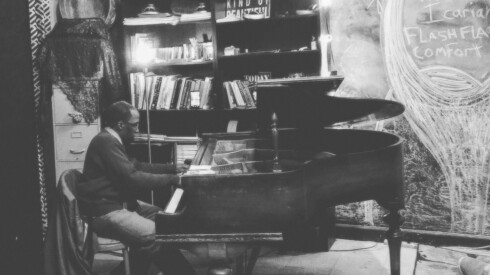
The new album is the second time Curran and the Sooper team have worked with Smith. The first was in 2017, when the label invited Smith to record some of his piano works in the studio. After recording a couple dozen pieces in just one or two takes, Smith unexpectedly launched into “War of the Martian Ghosts,” wowing the recording team with a “thundering, atonal, through-composed work of solo piano.”
After performing the work live at The Hideout for a sold-out crowd, Smith developed the piano piece into a full sci-fi opera during the COVID-19 pandemic, creating a formal score and script. Smith hopes someday the opera will come to life as a fully staged production.
The Smith project is Sooper’s first retrospective. Presented in the handmade spirit in which it was created, listeners can hear pops, static and crackles.
“I wanted to present the archive of the artist as I found it,” Curran said. “That was the goal. I was looking at it as an archival re-release, or a retrospective collection of this artist and his really massive body of work.”
It’s a look back, sure. But, it’s also an introduction to a Chicago musician who many once assumed had little to say.
Courtney Kueppers is an arts and culture reporter at WBEZ.