Ever since the Obama Presidential Center began rising out the historic grounds of Jackson Park, its Museum Tower — the campus’ most visible structure — became a riddlesome, what-the-heck-is-this kind of a building.
And there was a reason for this.
In a city of tall, glassy skyscrapers, the Museum Tower is shrouded in granite and virtually windowless.
While the best of Chicago’s parks buildings attempt to blend in with their landscapes, the stocky, square-jawed 225-foot building at 6101 S. Stony Island Ave. can be seen from almost a mile away. It sticks out like an elephant in the tall grass.
The $850 million presidential center — the most expensive built, so far — opens on June 19.
Designed by New York City’s Tod Williams Billie Tsien Architects, the center is a five-building complex. Two of the structures — the Forum and a new Chicago Public Library branch — sit just footsteps south of the tower beneath rolling parkland designed by New York landscape architects Michael Van Valkenburgh Associates.
A 437-car parking garage hides under the park. The freestanding building Home Court, an athletic facility designed by architecture firm Moody Nolan, is located on the south end of the campus near 62nd Street. There is also a garden pavilion, named for former U.S. House Speaker Nancy Pelosi, south of the library branch.
But it’s the presidential center’s Museum Tower that has drawn the most attention —and derision. After plans for the campus were made public almost a dozen years ago, the structure was compared to everything from a maximum security prison to a big garbage can.
I even got in on the act last year, writing that the tower “looks funereal enough to fit in at … Oak Woods Cemetery at 67th and Cottage Grove.”
Certainly, the tower has its faults, namely that putting the equivalent of a 20-story building in a public park, particularly designed by Frederick Law Olmsted, is just wrong. Almost like wanting to bump-out the attic of a classic Chicago bungalow.
Yet here’s a paradox for you: During my visit to the center last week, I lamented the parkland that it had been built-upon, but I was impressed by the result.
Up close, the tower is quite striking, sculptural — very much a monument as much as it is a building. And that’s meant in a good way.
Standing in the main plaza, which is a granite landscaped courtyard that is also shared by the Forum and library, the tower’s odd angles, beveled edges and blockiness start to make sense visually. The building’s south-facing main elevation basks in bright sunlight, revealing intriguing textures, details and shadows.
The Obama Center’s tower is far from being a mausoleum. Along with its companion buildings, the plaza and redesigned park space turned a pleasant but quiet corner of Jackson Park into one of the best urban spaces in the city, maybe second only to Millennium Park.
Shades of that were apparent during my visit. There were a couple hundred people touring the center sparkling with chatter, tugging each others’ elbows and pointing, eager to explore the area’s interior and exterior spaces.
Young folk took selfies in the plaza with that big tower as the backdrop.
“Each time I’ve been here — I’ve been here frequently — it’s changed,” Tod Williams said as he and design partner Billie Tsien walked the campus with me. “It becomes more alive, and with more people, and it feels like a space for people. It also feels like it’s democratic space. It’s space where we can move about freely, wherever you want. I find it incredibly hopeful.”
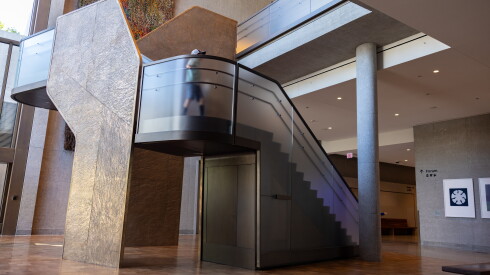
The tower’s unusual shape is inspired by the look of four hands coming together, Williams said.
Tsien said building’s form was also inspired by a rock the architects found in Ethiopia.
“In a dusty box on the floor of a souvenir store in Aksum in the Tigray section of Ethiopia,” she said. “It fits in the palm of your hand. The letters carved are unintelligible — maybe Amharic? Not sure if it was 100 years old or 10 days old, but it was mysterious and felt as if it carried a message.”
Despite its height, there are only eight floors in the Museum Tower, plus a lower level. Williams and Tsien take good advantage of that room to create generously-sized exhibition spaces dedicated to Obama’s presidency and the times and history that both shaped and led to it.
There’s a full-size replica of Obama’s Oval Office on the fourth floor. Another exhibit, Yes We Can, located on the second floor, uses video and objects to relive Obama’s successful 2008 presidential campaign.
William and Tsien nicely accommodate the center’s rich art collection, featuring the work of 30 top-flight artists, including Julie Mehretu’s Uprising of the Sun, a large vertical exterior stained glass visible on the north side of the tower, to Mark Bradford’s colorful site plan-like “City of the Big Shoulders” on the building’s third floor atrium.
The tower had almost no exterior windows in order to keep sunlight from shining onto the art and into the exhibition spaces.
The center’s non-ticketed public portions are a revelation, with comfortable lounge and cafe spaces in the tower, Forum and library with lots of warm tones, wood and natural light through a few strategically-placed windows on the tower’s north and east sides and garden level.
The Forum, a multifunction building featuring an auditorium, rooms and cafe space, is the tower’s worthy next-door neighbor. The two buildings are connected below ground — not a bad thing during the winter months.
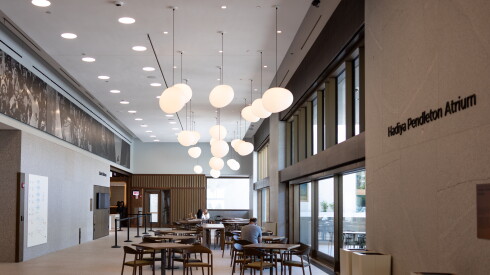
One of the Forum’s standout spaces is the glassy and sunlit Hadiya Pendleton Atrium located inside the building’s entrance, near Tafari’s Kitchen, a restaurant in the facility. Pendleton was a Chicago high school student who was shot to death eight days after performing as a majorette during Obama’s second inauguration in 2013.
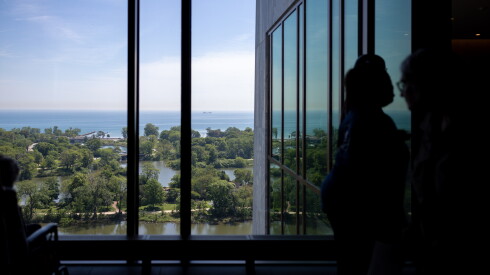
One of the center’s best moments can be experienced in the expansive Nelson Mandela Sky Room, with its floor-to-ceiling windows that offer views of not of Chicago’s skyline but the vast expanses of the the city’s South Side.
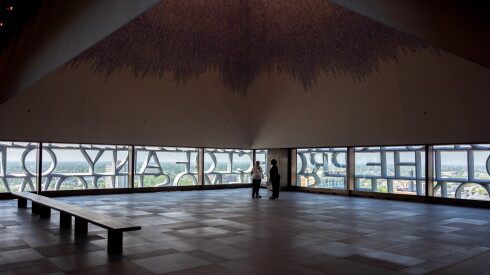
It’s a part of Chicago that has been too often overlooked, undervalued and counted out. But from the skyroom, the buildings, parks, infrastructure boulevards and people of the South Side — from Woodlawn to as far south and west as the eye can reach — must be seen and considered.
That the neighborhood are viewed through the large concrete letters that compose the words of Obama’s 2015 speech “You Are America,” commemorating the 50th anniversary of the Selma to Montgomery marches, makes it all the more fitting.
Van Valkenburgh’s landscapes include pathways, a wetland walk, fruit and vegetable garden — a pet project of Michelle Obama — a playground and an elliptical Great Lawn.
And replacing multilane Cornell Drive with a promenade and green space that will allow park patrons to walk right up to the edge of the Jackson Park lagoon is a master stroke.
The landscapes compliment the Obama Center’s buildings without being in service to them. The grounds are free to be, just like a normal park.
“How do we make this a place that people are going to want to come to, where they want to hang out?” Michael Van Valkenburgh Associates Principal Matthew Bird said. “We’ve got picnic areas with grills and tables, and it wants to be a place for the community to come in on a day to day basis. I mean, it should be a part of the neighborhood.”
The Daley Center’s Picasso was unloved by many when it was unveiled in 1967. One alderman wanted to replace the sculpture with a statue of Cubs great Ernie Banks.
But over time, the audacious, untitled sculpture became a beloved symbol of Chicago — once we got to know it. The Obama Center is worthy of the same consideration.