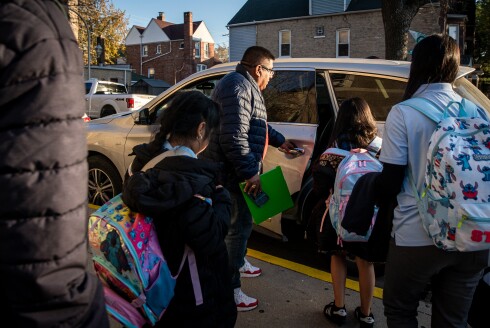
Alma’s 11-year-old boys had difficult questions for her after their school, Jungman Elementary in Pilsen, went on lockdown because federal immigration agents were nearby.
Her fifth graders remember being rushed back into their classrooms during dismissal on a day in late October as teachers ran out of the building to make sure no one was left outside. Afterwards, they wanted to know if it was safe to go back to school.
“I didn’t know what to say,” said Alma, who asked to be identified by only her first name because she is an immigrant and fears being targeted. “I told them that they are going to be safe inside the school, and they just have to be ready if it happens again.”

Alma has also prepared her twins in case a federal agent questions their American citizenship. If anyone asks where you’re from, she told them, you should answer that you were born in Chicago.
“I don’t think kids need to be going through this,” she said.
As President Donald Trump’s mass deportation campaign surged in Chicago last fall, Chicago Public Schools officials fielded an influx of calls for support from schools due to immigration enforcement activity near their buildings, records show.

The presence of federal agents forced students inside during recess, canceled some after-school activities, disrupted learning and at times created chaos. Students, both from immigrant families and their peers, say the heightened environment left them looking over their shoulders and unable to concentrate on schoolwork, frequently glancing at classroom doors or worrying about family members.
It also placed an unprecedented burden on school principals and district officials, who had to ensure timely communication with families without sowing fear or spreading rumors. Community members say coordination with CPS was difficult at first and eventually improved, but the district still faces a big challenge if widespread enforcement returns.
“I don’t think we are where we need to be,” said Patrick Brosnan, executive director of the Brighton Park Neighborhood Council, a nonprofit on the Southwest Side that works closely with schools. He credits the school district for making adjustments to confront what he calls a “bananas” situation. At the same time, he said the school district and the city still needs to share information more freely and promptly.
“There is no blueprint for this, but we are going through it,” added Yesenia Lopez, a CPS board member whose heavily Latino district on the city’s Southwest Side has been a hotspot for enforcement operations. “Things keep escalating based on what we’ve seen out in other states and we’re going to have to continue to act quickly as a district.”
Widespread disruption when federal agents came near Chicago schools
When Trump’s Chicago-area deportation campaign was at its peak last fall, schools reported federal immigration agents staging in school parking lots, showing up at elementary school soccer games, and detaining people on school grounds or where students could see them.
On Oct. 3, students had to stay inside when federal agents threw tear gas on the street near Funston Elementary in Logan Square.
Though the exact number of times federal activity disrupted schools isn’t known, it’s clear the effect was widespread. The Sun-Times and WBEZ compiled the most comprehensive accounting to date by reviewing district briefings for school board members and records of letters CPS sent to families informing them about federal activity near their schools.
CPS received nearly 200 calls for support from 109 schools between Oct. 20, when it opened a command center to centralize calls for assistance, through mid-December, according to CPS documents obtained through an open records request.
That’s likely an underestimate of how often agents came near schools, as principals often acted without reaching out to the central office and the command center launched more than a month into the deportation campaign.
CPS officials did not agree to an interview, but said in a statement that federal activity on school grounds is extremely rare and the district has mostly responded to reports of activity near school buildings. Over the last year, there have been no known instances of enforcement activity inside a CPS school.
Still, schools called the command center for help nearly every day in October and early November. On some days, CPS fielded dozens of calls.
For example, when federal agents flooded the North and Northwest sides on Oct. 24, the command center got 37 calls from schools seeking help — the most recorded by the district this fall.
At least 10 schools thought the situation this fall posed enough of a safety risk to staff and students that they went on lockdown, according to a log of messages the district sent to parents. That means they kept students indoors and secured the doors.
North-Grand High School in Humboldt Park went on lockdown in early September after receiving reports of several suspected law enforcement vehicles in the parking lot of an adjacent shopping center. CPS officials couldn’t verify who the vehicles belonged to, but students assumed federal immigration agents were using them.

When suspected law enforcement vehicles showed up in a parking lot near North-Grand High School in Humboldt Park, the school went on lockdown. Some students are glad their schools take measures like this to keep them safe, but they can put children and teens in a state of high alert.
Tyler Pasciak LaRiviere/Sun-Times
“A lot of kids were freaked out,” said Carrie, a 16-year-old student at North-Grand. We’re not using her real name because some of her family members are immigrants without legal status in the U.S.
That day the North-Grand junior sent panicked texts to her relatives, telling them to avoid the school. She started to cry when she didn’t get a response, worried that she’d sent the warning too late.
“I was texting my mother that I loved her so much,” she said.
After the lockdown, Carrie decided to stay home from school for a few days. Coming back meant working through her anxieties.
But the experience left a mark. She’s still on high alert while she’s in class.
“I look more at the door, I pay attention to who is at the doorway, who is leaving, who is in my classroom and who could be walking the halls,” Carrie said. “I memorized some of my friend’s footstep patterns.”
It’s not uncommon for fears about the presence of immigration agents to weigh heavily on children’s minds, psychologists say. They may become more emotional, distrust authority and have trouble sleeping.
“We may be asking them to take their history exam during the ninth period when their mind is worried about the commute home,” said Claudio Rivera, a pediatric psychologist and an assistant professor at the University of Chicago. “That’s not allowing them to focus on the learning opportunities that’s in front of them.”
The exact number of schools that went on lockdown during the fall is likely higher as the district doesn’t comprehensively track them.
In October, for example, Brosnan told Chalkbeat Chicago that about 30 schools on the Southwest Side alone went on lockdown because of enforcement activity. Lopez, whose district includes Brighton Park, said that’s partly because federal agents frequently stalked the Home Depot in neighboring Back of the Yards, which is surrounded by several schools.

At Lane Tech High School in the North Center neighborhood, junior Julia Markut said her peers were surprised when in October a loudspeaker message alerted them of federal immigration enforcement activity nearby. She watched in shock as one of her friends broke down in tears.
Her friend said: “I don’t know how I’ll be able to get home, I have to call my parents,” Markut said. “It was sort of dehumanizing to see her experiencing that.”
Soon the loudspeaker alerts were coming multiple times a week, making the situation almost “normalized,” Markut said. The school started encouraging students, many of whom like to go out for lunch, to stay inside. It opened classrooms where students who are afraid to leave can find refuge.
But Julia thinks it shouldn’t have to be this way.
“This fear shouldn’t be incorporated into our routines,” she said.
The Department of Homeland Security did not respond to multiple requests to answer specific questions about federal activity around Chicago schools. The agency has said its agents do not target schools.
Schools had to develop communications playbook around federal activity
The unpredictability of immigration enforcement actions made it difficult for CPS to figure out how and when to tell families about activity near schools.
Kia Banks, president of the Chicago Principals & Administrators Association, the union that represents CPS principals, said in the past schools initiated lockdowns following a set protocol, usually in response to something like a shooting, and coordinated with the Chicago Police Department and the school district.
But that protocol was turned on its head when federal agents repeatedly came near schools. Community organizations and schools were alerting CPS, rather than the other way around, and coordinating with the district to get communication out to parents could take hours. So, especially in the early days of the federal immigration operation, many Chicago principals made their own calls.
“There is no playbook for how to manage this level of an emergency,” Banks said. “You are burdened with the responsibility of protecting your school community and you do that any way you know how.”
Chris Graves, principal at Jordan Elementary School in Rogers Park, knows how that felt.
In his community, parents were finding out about immigration enforcement through their own networks or by listening to the whistles from neighborhood spotters. Waiting two hours to get permission from CPS to notify families about federal immigration agents in the area was too long, he said. He learned families preferred if the school acknowledged the situation in real time, even if it was to say that the sighting of agents was not confirmed.
“That helped create a lot of sense of calm, because families saw that we were constantly messaging something,” Graves said.
The district eventually gave school leaders clearer guidance about how to handle immigration enforcement activity near their buildings. Introduced in October, it instructs school leaders to bring students and staff inside and secure doors if federal activity is happening on the same block. If it’s further away, they should monitor the activity. That’s something community members and rapid response teams can help with, Lopez noted.
School board members and principals say communication improved once schools had a single hotline to call and the district gave school leaders the go-ahead to use their own judgment to act quickly.
Steps like this have helped students like eighth grader Dennise Marioni at Gunsaulus Scholastic Academy. Parents said the Brighton Park school kept students indoors multiple times last fall, but Marioni said clear communication from the school kept her calm. In addition, staff often set up a perimeter around the school during dismissal or arrival to monitor for federal agents.
“They’re keeping us safe,” Marioni said.
CPS noted in a statement that district staff and school leaders worked to “make rapid, real-time decisions in response to evolving conditions outside school campuses.” The district trained staff on how to respond to enforcement campaigns in the spring of 2025, and repeated the training in the fall when actions ramped up. CPS has also provided guidance to staff on what to do if a student’s parent or guardian is detained during the school day.
“The District acknowledges that these circumstances placed extraordinary demands on principals and central office staff, who worked diligently to keep students safe while also communicating accurately and responsibly with families,” a CPS spokesperson wrote in an email.
Lopez said while CPS did make great strides during an unprecedented event, the district could be more proactive in preparing for the possible return of widespread enforcement in the spring.

She and Brosnan would like to see the district temporarily expand the Safe Passage program, which helps students get to and from school safely, and make sure its command center hotline won’t crash if it receives more calls than in the fall.
Lopez would also like the district to seriously consider offering remote learning to students who are afraid to attend school during enforcement operations — something the district has said it would need state approval to do.
There is a renewed sense of urgency to make sure schools feel prepared after escalating events in Minnesota last month. There, federal agents detained a 5-year-old boy on the way home from school and deployed chemical irritants and tackled several people at a high school in south Minneapolis. Closer to home, masked federal agents scanned the face of a 16-year-old outside an Aurora high school, according to court records, which can give agents access to sensitive personal information.
The Trump administration also has told federal agents that they have broad powers to arrest people without warrants and enter homes with a warrant that hasn’t been signed by a judge. That’s left Chicago principals wanting more guidance from the district if federal agents apply that logic to schools.
Mary Urban, a special education teacher at North-Grand High School, said teachers have tried not to let the situation affect their classrooms, but it’s been difficult to ignore. Urban was teaching a unit on the U.S. Constitution in the fall when immigration enforcement ramped up.
“Every time we would look at the Bill of Rights, there was a question mark, saying, ‘Well, but do I really have these rights?’” Urban said. “There was this sense of sadness, of trauma, but also injustice because young people understand what’s happening in the world around them.”
More from the Disrupted Series