Trumpets with a Civil War–era vintage. A piano dating to George Washington’s second term. A parlor tune by a signer of the Declaration of Independence.
No, these relics aren’t behind glass at the Smithsonian. From May 7 to 10, all will be featured prominently in up-close-and-personal concerts by the Newberry Consort, a local period music ensemble, across multiple venues around Chicago.

Like so many of the group’s projects, “Revolution!” — a collection of tunes written or circulated in the U.S. between 1776 and 1865, the close of the Civil War — came about not just through practice, but fastidious musical sleuthing. More than a dozen contributors are credited in the concert program as researchers, arrangers and language coaches.
And lest you think their interpretation is strictly colonial, music from African-American, Sephardic, Mohican and Choctaw traditions appear across the program, as do abolition songs, musical parodies, military band tunes and light music.
“The music, to the extent that we can, represents as many viewpoints as we could fit into an hour and 45 minutes, including intermission,” said Consort artistic director Liza Malamut.
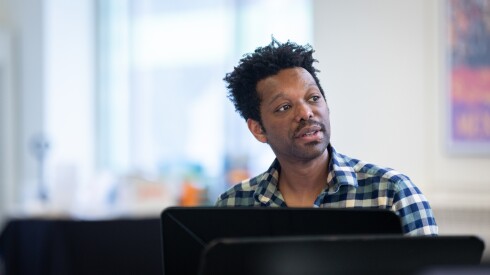
Among them is a contemporary one. For the first time in its history, the Newberry Consort is premiering a new work. Composer and bass-baritone Jonathan Woody’s “When Shall America” leans on an arsenal of 17th- and 18th-century musical styles to accompany the words of three prominent, if undersung, Americans: Phillis Wheatley, a Black female poet; Lemuel Haynes, the first Black American to be ordained as a minister; and Samson Occom, the first Native American to write an English-language memoir.
Together, their words represent “Americans whose freedom was not guaranteed at the time of the Declaration of Independence,” writes Woody in his program note.
Malamut and her colleagues planned “Revolution!” to coincide with the national America 250 commemorations this year. But as the National Endowment of the Arts narrowed its eligibility for semiquincentennial grants, the group assumed its application would be rejected out of hand.
Instead, to the artists’ surprise, the Consort received $20,000 to support “Revolution!” — the ensemble’s first allotment from the NEA. (In all, 20 Illinois groups received $660,000 for programming that will mostly unfold this summer.)
“We were really forthright about what the project was,” Malamut said, “so, I have to say, we were surprised and gratified.”
Figuring out what to say for America 250 — if anything — is a daunting task for an arts organization. When asked what kind of America the Consort sought to depict in “Revolution!”, Malamut described the group’s vision as “a complicated tapestry.”
“In addition to just enjoying the music, I’d love people to be thinking about what makes us, us,” she said.
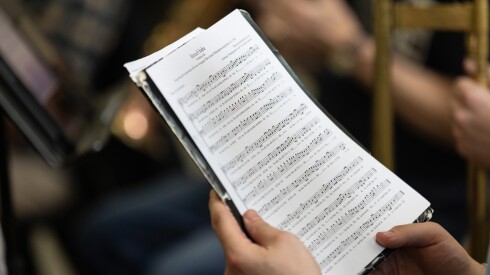
One standout part is a selection of three hymns that commemorate the Indian Removal Act of 1830 and the uprooting of the Choctaw tribe, despite their efforts to receive, rather than reject, Presbyterian missionaries in their communities.
The hymns were unearthed by research into the Choctaw hymnal by local Baroque violinist Brandi Berry Benson, who teaches Native American music at Northwestern University.
“The reason they did that is because they wanted to learn English, so that they could negotiate with the government,” Benson said.
She’s spent the past few years researching the music of not just her own tribal tradition — Benson is a Chickasaw citizen — but those of the Choctaw and the other nations forcibly removed from their ancestral lands during the Trail of Tears.
To commemorate the tragedy, Benson picked three hymns: “Meditation on Death,” typically sung at a loved one’s grave; “Give me Christ, or else I die,” said to have been sung on the Trail of Tears; and “Wayfaring Stranger,” a variation on the Appalachian tune of the same name.
“That’s what makes it really remarkable,” she said. “The Choctaws had a huge influence over the early American hymn that emerged as a result.”
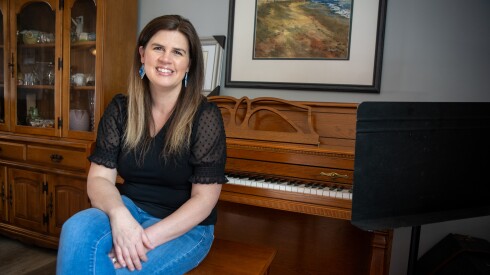
Benson arranged “Wayfaring Stranger” to prominently feature a violin, a nod to the Choctaw fiddle tradition. She included the same arrangement in last year’s “The Story of Pa I Sha,” a narrated instrumental work inspired by the stories of her Choctaw ancestors.
The concert also features historical brass instruments, such as keyed bugles. One of the keyed bugle’s foremost exponents is the Syracuse, N.Y.–based Jeff Stockham, joining the Consort for these performances. His expertise in period American brass instruments has even landed him cameos in the 2012 Steven Spielberg movie “Lincoln,” Netflix’s “House of Cards” and HBO’s “The Gilded Age.”
An avid collector, Stockham estimates he’s amassed well above 300 instruments, scouring everything from antique shops to eBay.
“My favorite instrument is the next one,” he told WBEZ.
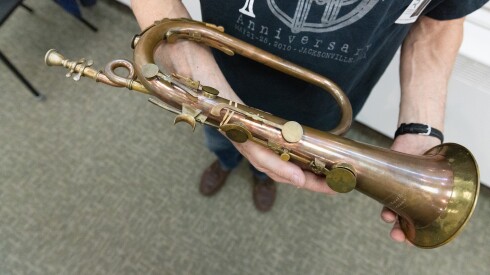
In its 19th century heydey, the keyed bugle was an exciting alternative to the keyless natural horn. It inspired the proliferation of regional brass bands all over the country.
Stockham describes the keyed bugle as “a little bit warmer and a little paler” than modern brass instruments. They’re also much much more temperamental and harder to tune.
For the Consort performances, he’ll play music for keyed bugle that was popular in the early 19th-century United States. One of them, the “Wood Up Quickstep” by Joseph Holloway, refers to “wooding up” a steamboat burner — in the same way we “gas up” when we refuel our cars. The piece was a signature of the bugle virtuoso Edward “Ned” Kendall, who formed the Boston Brass Band in the 1830s.