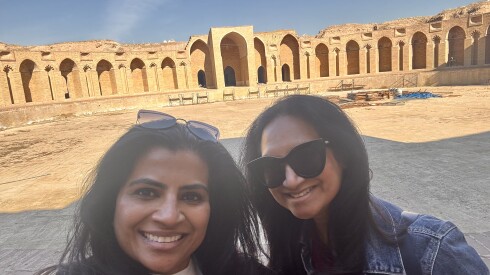
Mahdi Ali Raheem’s smile seemed to stretch as wide as the arches of the buildings surrounding the open-air courtyard where we stood inside the sand-colored, 800-year-old Al-Mustansiriya University in Baghdad.
Delighted to hear that some American visitors, including me, my younger sister and a friend, were from the Chicago area, he excitedly recollected his time in the city over 15 years ago when he participated in an antiquities conservation training program at the Field Museum.
“Don’t go to the South Side,” the Iraq National Museum curator said he was continually warned of the neighborhoods to avoid during his free time.
“I didn’t listen. I went every day, and I loved it,” said Raheem, who likely never heard of the term “Chiraq” but spoke with the familiarity of someone whose community members and their spaces have been disparagingly painted with a broad brush.
Like Raheem, our group of 33 also shrugged off “Do Not Travel” advisories of all sorts before flying into Iraq last month for an educational tour organized by Feryal Salem, an associate professor of Arabic and Islamic studies at the Uptown-based American Islamic College.
Any apprehension over traveling to a country that had been through several wars within the last few decades dissipated when we sailed over the tranquil Tigris River, sipped hot beverages alongside hookah-smoking locals and accepted the first of many prayer beads offered at the shrines of prominent Muslim figures.

We saw signs of renewal in the residential construction sprouting throughout central Iraq like crops offering sustenance and stability after a harrowing thunderstorm.
In the oil-rich region, where I noticed an abundance of abaya-clad women with lip fillers and Ferris wheels, the young are forging ahead with the hope that their daily inconveniences will remain limited to traffic jams, power outages and the wrong kebab order.
While a significant number of Iraqis weren’t around to witness America’s Global War on Terror campaign firsthand — over half the population is under 25 — they don’t have to search too far for scars.
My gaze, during our bus rides, often lingered on the renovated Firdos Square where Saddam Hussein’s statue was famously toppled in 2003 and then used as a jingoistic mascot by most American media outlets and politicians following the U.S.-led invasion of Iraq.
Many natives who loathed Hussein, including the Kurds and Shias who bore the brunt under his brutal regime, initially welcomed the troops sent in by George W. Bush.
But they soon found that “happiness was a mistake,” said Yasser Al-Kufi, an Iraqi tour guide who assisted Salem during our seven-city journey.

Al-Kufi did some time as an infant with his mother at a women’s prison where inmates took turns bouncing him on their laps. The two were snatched up as proxies when Al-Kufi’s father was forced to flee overseas after more than a dozen of his friends — fellow dissidents — were hanged when Saddam Hussein ruled the country.
Hussein’s name still makes 29-year-old Al-Kufi recoil. He also can’t forgive the U.S. government for its false weapons of mass destruction allegations and the ensuing war that left the country vulnerable to more sectarian violence.
That harsh reality is encapsulated in portraits along a highway of men killed fighting the Islamic State group roughly a decade ago and snapshots hanging in the iconic Shabandar Cafe, where the longtime owner’s four sons and a grandson were killed after a car bomb went off outside the establishment in 2007.
Hypnotizing beauty
To counter the devastation, Iraq’s kaleidoscopic mosques provide a sensory form of resistance, hypnotizing onlookers with their indescribable beauty.
The ruins in Babylon, particularly the nearly 3,000-year-old basalt statue of a lion trampling a man, similarly scream out, “you can’t break us.”

Perseverance in the face of adversity is intrinsic to Shias who make up the bulk of the pilgrims trekking to Najaf and Karbala to pay their respects to Prophet Muhammad’s son-in-law, Ali ibn Abi Talib, and Ali’s sons, Abbas and Hussein, who were killed in the Battle of Karbala.
Navigating the sea of humanity and security checkpoints inside these holy men’s shrines was challenging but worth the spiritual fulfillment.
Getting lost in the crowd also proved a bonding experience for our crew, which included a Fordham University professor I remember watching duel with Bill Maher on TV post-9/11 and relatives of two former Chicago Tribune reporters I know.
Sadly, one of our fellow adventurers, 78-year-old Zia-ur-Rahman Khan, died less than two weeks ago, after he and his wife, Sameera, made a pit stop in their native Pakistan.
It was Khan who guided some Pakistani aunties and uncles on a mile-plus hike in Najaf before they stumbled on a hole-in-the-wall that served the South Asian food they were craving.
The retired physician’s culinary expedition — and our entire trip — are reminders that if we try, we can find the comfort of familiarity wherever we go.
Rummana Hussain is a columnist and leads the opinion coverage at the Sun-Times.