KYBARTAI AND VILNIUS, Lithuania — Rimas Rimkus is patching some asphalt at the end of his driveway on a narrow lane off the main drag of J. Basanavičiaus Street in the town of Kybartai.
He invites visitors into his fenced backyard, adorned with a decorative wishing well, swinging love seat, mini greenhouse and rows of young strawberry plants.
His adult son, Danielius, joins him as he unlocks the high fence’s back gate to show what’s next-door.
Russia.
Just beyond a small field is a border post in Kaliningrad, a 5,800-square-mile piece of Russia that’s home to 1 million Russians and possibly 100 tactical nuclear warheads.
Though it was a peaceful April morning, other times the father and son say the air is filled with the sound of rifle shots. Sometimes their house shakes from a detonation.
Lithuania also has a 422-mile border with Russia’s ally Belarus, from which Russia launched its invasion of Ukraine in February 2022.
Lithuanians call this area their “dangerous neighborhood.”
“If war starts, I think we’d all be bombarded,” Danielius Rimkus says. “It’s their decision if they want war or not. We’re just here waiting.”

|
Ashlee Rezin/Sun-Times

|
Ashlee Rezin/Sun-Times

|
Ashlee Rezin/Sun-Times

|
Ashlee Rezin/Sun-Times

|
Ashlee Rezin/Sun-Times

|
Ashlee Rezin/Sun-Times

|
Ashlee Rezin/Sun-Times

|
Ashlee Rezin/Sun-Times

|
Ashlee Rezin/Sun-Times

|
Ashlee Rezin/Sun-Times

|
Ashlee Rezin/Sun-Times


Lithuania joined NATO in 2004, and polls show an overwhelming 90% of Lithuanians support the defensive alliance. They want Americans to support it, too.
President Donald Trump has made numerous threats to pull out of the alliance, even though Lithuania has pledged to spend nearly 5.4% of its gross domestic product on defense this year, the highest percentage in Europe.
Romas Šunokas, 65, Kybartai’s town administrator, has lived in the area his entire life. Šunokas supports NATO and the Lithuanian government’s moves to strengthen its borders.
“I hope that the Russian side will see that Lithuanians are preparing,” he says through a translator.
While he prefers to stay out of politics and focus on local constituent concerns, Šunokas knows that NATO’s Article 5 — which says an attack against one member is an attack against all — provides protection for Lithuania.
At the same time, he says Kybartai is doing its own work to prepare, like teaching schoolchildren about drones and holding evacuation drills.
“We are connected with this land, and we will protect it because this is where we grew up, this is where we are raising our children. It matters to us,” he says.

Defending the gap
Having NATO’s shield is also important because of the Suwalki Gap, a 65-mile strip of land that’s the border between Lithuania and its NATO ally Poland.
The gap, with Kaliningrad to the west and Belarus to the east, is the Achilles’ heel of NATO. It’s where the West believes Russian President Vladimir Putin would go if he were to militarily test NATO. By controlling the gap, Russia could prevent NATO land troops from reaching Lithuania, Latvia and Estonia.
Lithuanian Foreign Minister Kęstutis Budrys says Lithuania is trying to create enough of a deterrence that Putin never gets that far.
“The effective deterrence will be when the troops will be at the very front line, when they will be visible to Russians and to their allies, the Belarussians, and there will be no doubt that they would be employed from the very first minute if our defense requires it,” he says.
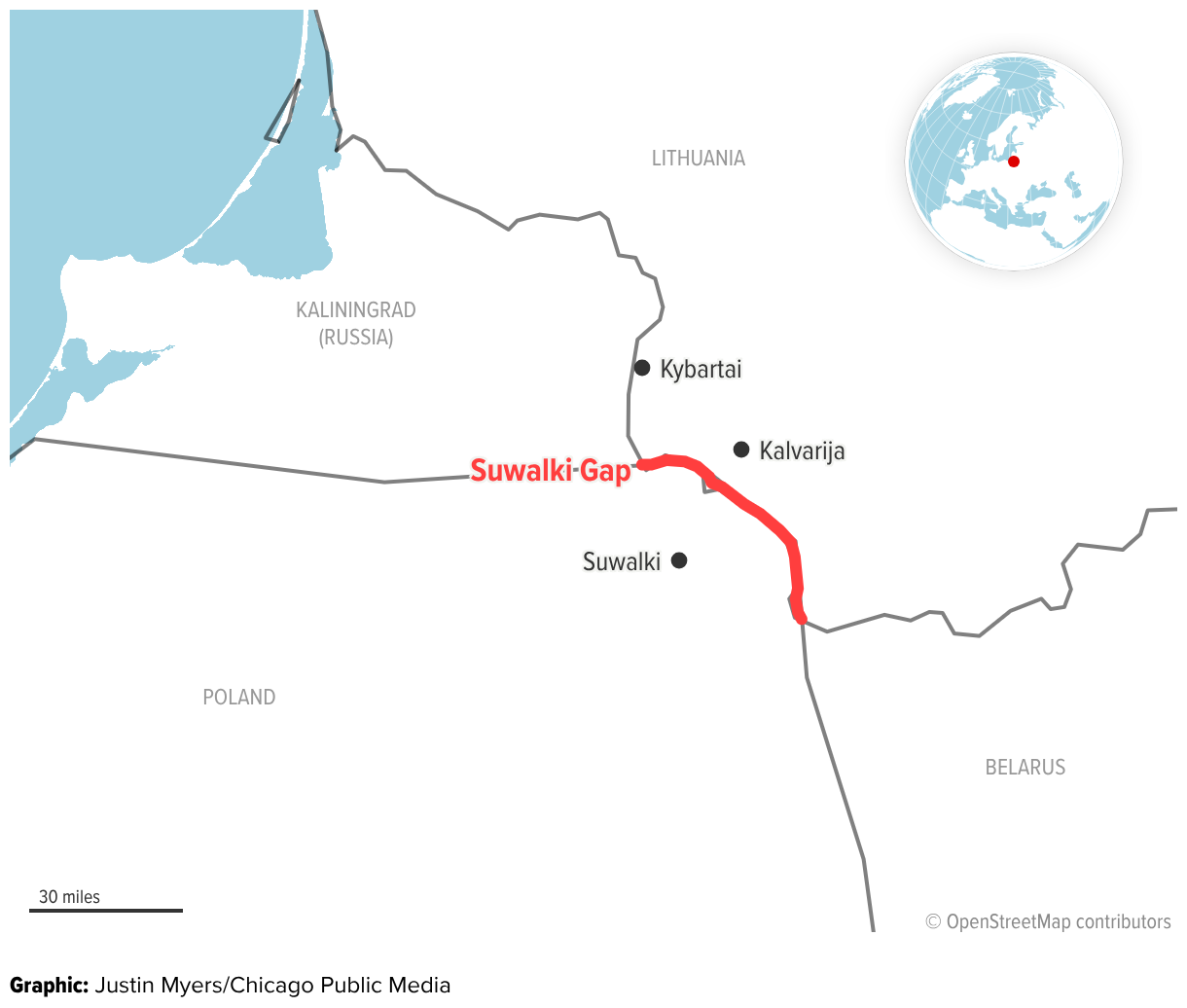
Lithuania has invited 5,000 German soldiers to stay permanently by 2027 and has regularly hosted about 1,000 U.S. troops, though the size and timing of the next U.S. rotation is under review. Lithuania has 23,000 active-duty armed forces and an extensive civil defense infrastructure.
At a NATO summit in July, most European leaders tiptoed around Trump, who has repeatedly threatened to invade NATO territory Greenland and complained that Europe should be funding more of its own defense.
Budrys says the silver lining to Trump’s disparagement of NATO is that other European countries are spending more on defense.
“We are so grateful for the United States, keeping their forces in Lithuania and other Baltic states,” Budrys says. “It’s not symbolic. This is very practical.”


|
Ashlee Rezin/Sun-Times

|
Ashlee Rezin/Sun-Times

|
Ashlee Rezin/Sun-Times

|
Ashlee Rezin/Sun-Times

|
Ashlee Rezin/Sun-Times


Lithuania’s parliament, the Seimas, voted in the spring to establish a military training ground on 56 square miles of forested land near Kapčiamiestis, close to the Belarussian end of the Suwalki Gap. Military drills are expected to begin in 2028, and the site will be able to accommodate 3,500 to 4,000 troops, mostly Lithuanian forces.
Civilians are also stepping up. More than 19,000 men and women have joined the Lithuanian Riflemen’s Union, a group founded in 1919 and reestablished after the country’s independence to help with disaster relief and community resilience. They get training in drones, cyber defense, medical support, logistics and engineering to assist the armed forces if needed.
Lithuania’s goal, defense experts say, is to repel an invasion for 10 to 15 days until NATO troops could arrive.
NATO tensions hover over people at a Sunday flea market in Kalvarija, a short distance from the Suwalki Gap.
Seller Jūratė Maksimavičienė, 61, says she hopes NATO doesn’t crumble.
“I’m afraid for the future of NATO and Trump deciding to leave,” she says. “It would be good if they vote Trump out. Only Americans can do that. We can’t do that.”

|
Ashlee Rezin/Sun-Times

|
Ashlee Rezin/Sun-Times

|
Ashlee Rezin/Sun-Times

|
Ashlee Rezin/Sun-Times

|
Ashlee Rezin/Sun-Times


Watching Ukraine
The lessons from nearby Ukraine are obvious, and the country’s blue-and-yellow flag flies everywhere in Lithuania.
“We know what they [Russians] do in occupied territories,” says Žygimantas Pavilionis, a member of parliament for the center-right Homeland Union party, who was Lithuania’s ambassador to the U.S. and Mexico from 2010 to 2015.
Pavilionis says while he’s dismayed by the Trump administration’s friendliness toward Russia and Belarus, he hopes the U.S. never pulls its support from NATO and Lithuania.
He called Lithuanians “the Americans of the East,” standing for democratic values at a time of rising authoritarianism. The country has sent troops to U.S.-run wars in Iraq and Afghanistan and has offered to help stabilize the Strait of Hormuz.
Pavilionis wants Ukraine to win, then share its military expertise to “show very clearly to the Russians, ‘Don’t even start to move.'”
Ukraine recently signed an agreement with Lithuania to launch a joint defense program to develop new military technologies, like the drones Ukraine has become known for.

Andrius Tapinas, founder of nonprofit online news channel Laisvės TV (“Freedom TV”), has helped crowdfund assistance for Ukraine since 2022.
The fight is personal for Tapinas, 49, whose grandmother was exiled to Siberia by the Soviets with his mother, then a 1-year-old.
His father, Laimonas Tapinas, was chairman of the board of Lithuanian Radio and Television in January 1991, when Soviet troops stormed newly independent Lithuania and seized the public broadcaster’s offices.
Tapinas remembers his dad coming home — injured after a Soviet soldier bashed him with a rifle — getting first aid and heading back out to help.
“I think that pretty much sums up why we are, and I like to be, among the first who would like to help Ukraine,” he says.
“I’m quite envious of Americans because you take liberty for granted. We cannot take our liberty for granted. And we need to know that the price of freedom in our country is eternal vigilance. It’s been like that for 300 years.”
The threats can feel relentless and some don’t involve tanks or troops. Lithuania’s President Gitanas Nausėda last week said intelligence assessments point to Russia planning potential attacks on critical infrastructure in the Baltic countries or Poland.
Belarus has sent thousands of migrants from the Middle East and North Africa — with false promises of jobs in the EU — to Lithuania, beginning in 2021. The aim was to destabilize Lithuania, which had to scramble to secure its border.
People in Belarus also launched hundreds of mysterious weather balloons into Lithuania last year. The balloons forced the closure of Vilnius’ airport more than two dozen times.
And an undersea telecommunications cable between Lithuania and Sweden was severed in 2024, an incident that raised questions about foreign involvement.

Vilmantas Vitkauskas heads the National Crisis Information Centre in Vilnius. The center, created in 2023, is tasked with identifying threats and coordinating responses.
Operating from a Soviet-era government building, the center monitors Lithuania’s border using video surveillance, seismic sensors and drones. The data is analyzed using software by Palantir Technologies.
“We can detect steps when somebody is approaching the border,” Vitkauskas says.
Lithuania is pushing an internal concept of “total defense,” which means everyone plans for the unthinkable.
Public buildings have signs marking underground shelters, and new construction projects include safe spaces. Schools teach children how to recognize disinformation campaigns on social media, and businesses plan for continuity in an emergency.
“Every citizen needs to feel their role and part in our national defense,” Vitkauskas says. “It’s not just thinking of being able to shoot or use a weapon in order to defend your country, but are there other duties that people have to take care of? You know, take care of your family, your neighbors, how to prepare resources in order to help your military to fight the enemies.”
He says Lithuania wants preparation, not panic.
“We don’t necessarily think that there will be a full-scale military invasion and occupation as such. It could be something in between,” he says.
Foreign sabotage often happens via screens, propaganda expert Vytautas Matulevičius says.
Lithuanians are good at spotting disinformation, but he says they aren’t immune to a “fear offensive” campaign that tries to make them feel unprotected.
“Russia is waging cognitive warfare against us to achieve its political goals,” Matulevičius says. “Division of the West, division between the states of the alliance — NATO or European Union — in order that we fight with each other and forget who the real adversary is.”
Countering that strategy on TikTok, Instagram, Telegram and other platforms is a priority for Lithuania and other frontline NATO countries. European law allows governments to act against blatant digital disinformation, violent speech or banned symbols.

|
Ashlee Rezin/Sun-Times

|
Ashlee Rezin/Sun-Times


Vilnius-based startup Repsense uses artificial intelligence to monitor and analyze social media videos to see what’s being pushed by disinformation accounts. The company’s clients include the Lithuanian government, the European Parliament and other government and private entities.
Malign narratives often start on social media, then bubble up to podcasters and mainstream media, Liudvikas Andriulis, chief commercial officer at Repsense, says.
In September, Repsense deployed its technology during Moldova’s parliamentary elections to help authorities identify and take down nearly half a million Russian accounts that were disseminating propaganda, pushing false messages like Moldova is overrun by gay foreigners or it’s doomed to poverty, Andriulis says.
He says videos encouraging people to feel hopeless about voting or that lie about news events are most concerning, and it’s a lesson for Americans.
“No one wants their elections to be interfered with,” he says. “On both sides of the Atlantic, we understand that election integrity, the democratic process, the ability to choose and win elections fair and square is very important. The problem now is that TikTok is basically placing a TV in everyone’s head.”
Vitkauskas says the Lithuanian government’s response to propaganda depends on the content, source and context.
If the narrative misses the mark, the response is nothing. If disinformation is percolating online, the center might flag it for academicians or journalists to debunk. If it’s taking hold, government institutions might step up and publicly react.
“If it’s a really significant incident, we might have even our state officials at the highest level, whether it will be the prime minister or president or speaker of the parliament, address the issue and explain to the population what has happened,” he says.
Vitkauskas says Lithuanian schools also teach students critical thinking.
“If you are informed and you prepare,” he says, “it means that you are safe.”

About this series

Chicago Sun-Times investigative reporter Stephanie Zimmermann and photo editor Ashlee Rezin traveled to Lithuania for two weeks in April as the Pulitzer Center’s 2026 Richard C. Longworth Media fellows. Their aim was to shed light on a region with strong Chicago ties and an increasingly important role on the world stage.
A member of the European Union and NATO since 2004, Lithuania is a paradox. Its economic growth is in Europe’s top 25%, and it has six tech unicorns, startups valued at more than $1 billion. Yet the country of 2.8 million people is located at one of Europe’s most vulnerable spots for military defense.
Zimmermann interviewed more than 50 people for the six-story series, from a former president and a current foreign minister to ordinary Lithuanians living at a time of both promise and peril.
Coming soon
- Thursday: Why most Lithuanians support NATO and what Lithuania is doing to protect itself from threats
- Friday: Chicago and Lithuania are linked in their love of basketball
- Saturday: An interview with former President Valdas Adamkus
- Sunday: From furniture-making to tech, Lithuania’s economy is thriving, with six unicorn companies