More than 40 years ago, Raymond Law wanted to stop using heroin but saw few options around Chicago as he sought treatment.
It wasn’t until he discovered a residential program through the Gateway Foundation that allowed him to stay for 18 months that he was able to overcome the heroin addiction. The program also helped him get a job, open a bank account and move into his own apartment. Now 43 years sober, Law has spent his career since helping others recover. He currently works for the organization that helped him navigate his path and is involved in a West Side community effort to curb the opioid crisis.
“I have such a joy watching people recover and get back on their feet,” Law says. “It’s part of what helps me to continue … to service other people and when I do that, that helps to service me also.”
Over the decades, Law has seen treatment access grow and a shift to a less punitive approach through harm reduction and away from complete abstinence. He’s also seen wide distribution of Narcan, the medication that can reverse an opioid overdose. Law and other experts say these changes could be behind a sharp decline in opioid-related deaths in Chicago, the state and across the nation.
A new report, “Pain in the Nation: The Epidemics of Alcohol, Drug, and Suicide Deaths,” details the drastic decrease in opioid overdose deaths from 2023 to 2024, the most recent available data. Those deaths decreased by 36% in Illinois. Deaths tied to highly potent synthetic opioids, which include fentanyl, decreased even more — 38% — across the state. Separately, Cook County and Chicago reported a major drop in opioid-related deaths, plummeting 37% from 2023 to 2024, according to new data from the Cook County Department of Public Health.
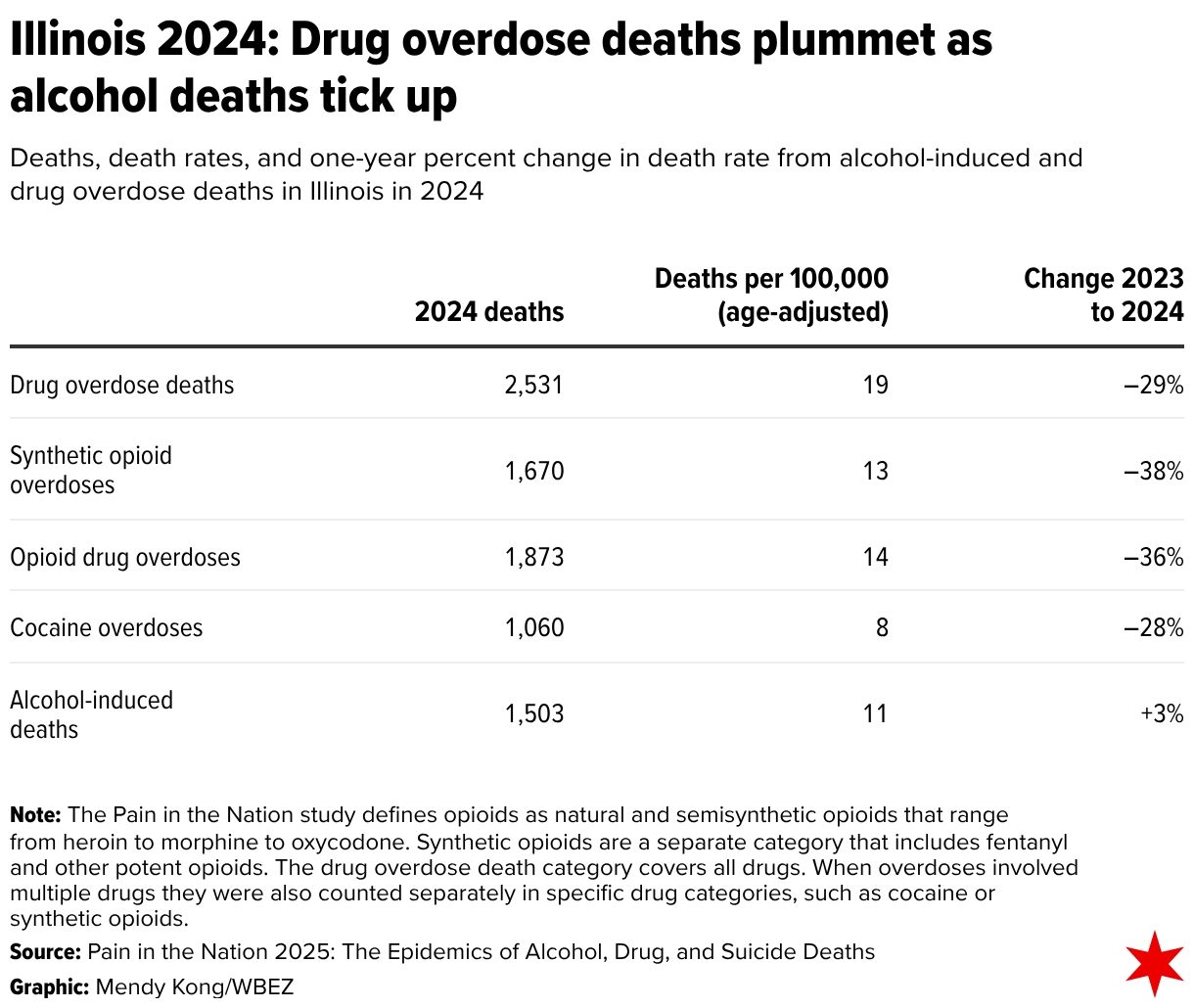
Both national categories also saw a 10% decrease in opioid overdose deaths in the previous year, between 2022 to 2023. Opioids can range from prescription opioids like morphine, codeine, hydrocodone and oxycodone, while synthetic opioids, like fentanyl, are a separate category that are considered “extremely potent opioids.”
Illinois also saw suicides drop by 9%, the report found. But alcohol-induced deaths increased slightly by about 3% during the time period. Overall, Illinois saw an 18% decrease in the number of deaths tied to alcohol, drug and suicide.
Nationally, that combined rate fell by 16%. It’s the first time there has been a significant decrease across the combined three metrics since the Centers for Disease Control and Prevention started to collect this data in the late 1990s, said Dr. J. Nadine Gracia, the president and CEO of Trust for America’s Health, the Washington, D.C.-based nonprofit that published the Pain in the Nation report.
Gracia sees the decrease as a sign that prevention — along with decades of investments in gathering data that show where overdoses are happening, which help local health departments know where to direct resources — have worked.
“What is really important to understand is that that continued progress isn’t guaranteed unless we continue to really sustain that investment in these programs, in these policies and in these services for communities across the country,” Gracia cautioned.
Earlier this year, substance use and mental health programs faced funding whiplash after the Trump administration issued letters indicating it was cutting $2 billion for these types of programs. But the administration reversed course within 24 hours. And community groups in Illinois are still waiting for the distribution of funds from multi-state settlements with pharmaceutical companies.
A shifting landscape
The big drop in opioid overdose deaths in Cook County and Chicago in 2024 follows a decrease in 2023, “which is terrific,” said Dr. Rachel Rubin, senior medical officer for the Cook County Department of Public Health.
She attributes those drops to increased awareness of how drugs can be more potent if laced with fentanyl or xylazine, an animal tranquilizer. The county distributes strips to test for these substances along with naloxone, a medication that can reverse an opioid overdose.
Narcan, the nasal spray version of naloxone, has been more broadly embraced than when it was delivered using a needle, said Ann Brekke, with Chicago-based Thresholds, a large provider of recovery services. Narcan was approved by the FDA for non-prescription use in 2023. The messaging around Narcan changed in recent years around Chicago, Brekke said.

They have found it more effective to focus on broader language, emphasizing how administering Narcan can help someone else. Previously, people felt targeted when approached about learning to use the spray, she said.
“We see Narcan as a way of really opening the door towards more engagement” Brekke said. “Narcan is just the beginning of the relationship, not the end.”
The next step can be seeking help for a relative or asking how to get into a detox program, she said.
Thresholds is also now offering trainings at Chicago senior buildings to reach older Black men who have been an overlooked population in the opioid crisis, Brekke said. In Chicago, 55- to 64-year-olds accounted for a majority of the opioid-involved overdose deaths in 2024, according to data from Cook County. In contrast, 35- to 44-year-olds made up the largest group of opioid-related deaths in suburban Cook County.
Across Cook County, Black individuals continue to have a higher opioid-involved mortality rate than white and Hispanic residents. The data also showed that nearly 92% of the opioid overdose deaths in Chicago involved fentanyl.
Law said the shift to harm reduction approaches has been particularly helpful in meeting people where they are, especially if it involves an older person. That allows for wins when substance use is reduced, rather than seeking complete abstinence.
“It has something to do with how long they’ve been out there with the same behavior, day in and day out for years,” Law said. “So here we come as treatment professionals, and we’re trying to assist you with promoting some kind of change in your thinking, your attitude and your behavior. Well, you cannot expect for that to happen overnight — because it’s not.”
Funds needed for staff, other services
But funding for substance abuse programs remains an ongoing concern, Rubin said. The public health department had been using federal COVID-19 relief funds, but they will expire in September.
“We have to be looking for additional funding sources to continue this work at the same level,” Rubin said.
One of the biggest challenges is being able to support a staff large enough to handle the demand for services, said Jeremy Klemanski, president and CEO of the Gateway Foundation, which runs treatment programs and offers mental health counseling. Beyond creating programs, they need staff to answer phone calls and provide counseling, he said.
Illinois is among the states expected to get at least $1.6 billion from multistate settlements with pharmaceutical companies as a result of the opioid crisis. Klemanski said Illinois, like other states, could do more to get those funds out faster to help save more lives.
“Whenever there’s new money, there’s a lot of work that has to be done in terms of how it’s going to be administered, how is it going to get out of communities, how are we going to safeguard and make sure it’s being used properly,” he said.

Law said the settlement funds should go toward allowing more people to get into treatment programs and accessing mental health services. Because of the prevalence of fentanyl in many drugs, individuals often have to remain for long periods in a detox program before they are considered medically stable.
Cook County has so far used the money received from settlement funds for things such as Narcan distribution and to pay for recovery coaches at Provident Hospital and community health centers in the suburbs.
But people often also need help getting housing, food and other basics to stay in recovery, Law said.
“It would assist people in knowing that they’re able to go from one level of care to the next,” Law said. “And that they’re going to get help, and they don’t have to worry about being put back on the street because there’s no funding to assist them.”