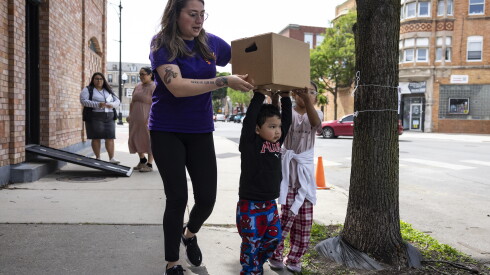
Small hands helped load five boxes of food into the trunk of Irene Salinas Torres’ van.
“I carried this one,” one child proudly said in Spanish.
Salinas Torres and her family had stopped by a nonprofit in Pilsen for its monthly food distribution this spring, soon after thousands were expected to lose access to the federal Supplemental Nutrition Assistance Program because of expanded work rules and other new restrictions passed by Congress last summer. The mother of five had received $450 in SNAP benefits each month until about March.
“We limit ourselves from many things,” said Salinas Torres in Spanish. She lost SNAP because her household income had increased once an older son started working. “We just buy the essentials, what you need to eat that day. We don’t get the luxury to buy extra.”
Over the last year, the SNAP program in Illinois has declined by 16%. By June, the number of SNAP recipients had fallen to nearly 1.6 million, down from nearly 1.9 million last year, according to the Illinois Department of Human Services. That’s the lowest number receiving food assistance in the state since 2009.
Those who remain are a vulnerable population. Nearly 97% of the people still receiving SNAP were exempted from the expanded work rules because they meet certain requirements, such as living with a physical or mental condition or having a child who is 13 years or younger, according to the state.
The Illinois Department of Human Services, which administers the program locally, estimates 148,000 people lost SNAP because of the work requirements. State officials had initially estimated 400,000 people would lose benefits. Illinois SNAP recipients have fared better than in states that have slashed their programs. Arizona has seen a 50% decrease in SNAP recipients.
This month marked one year since President Donald Trump signed into law H.R. 1, a massive tax and spending plan that imposed these changes to SNAP and also aims to dramatically shift the costs of the program to states. Since then, SNAP enrollment has fallen faster nationally than the government anticipated, with states reducing caseloads as they look ahead to growing cost burdens, said Ty Jones Cox, vice president of food assistance at the Center on Budget and Policy Priorities, a Washington, D.C.-based policy institute.
“SNAP is in the middle of the steepest, fastest decline in participation in decades, and it’s not because the need is any lower,” Jones Cox said, noting enrollment had not dropped this quickly since 1997, during earlier reforms to the food assistance program.
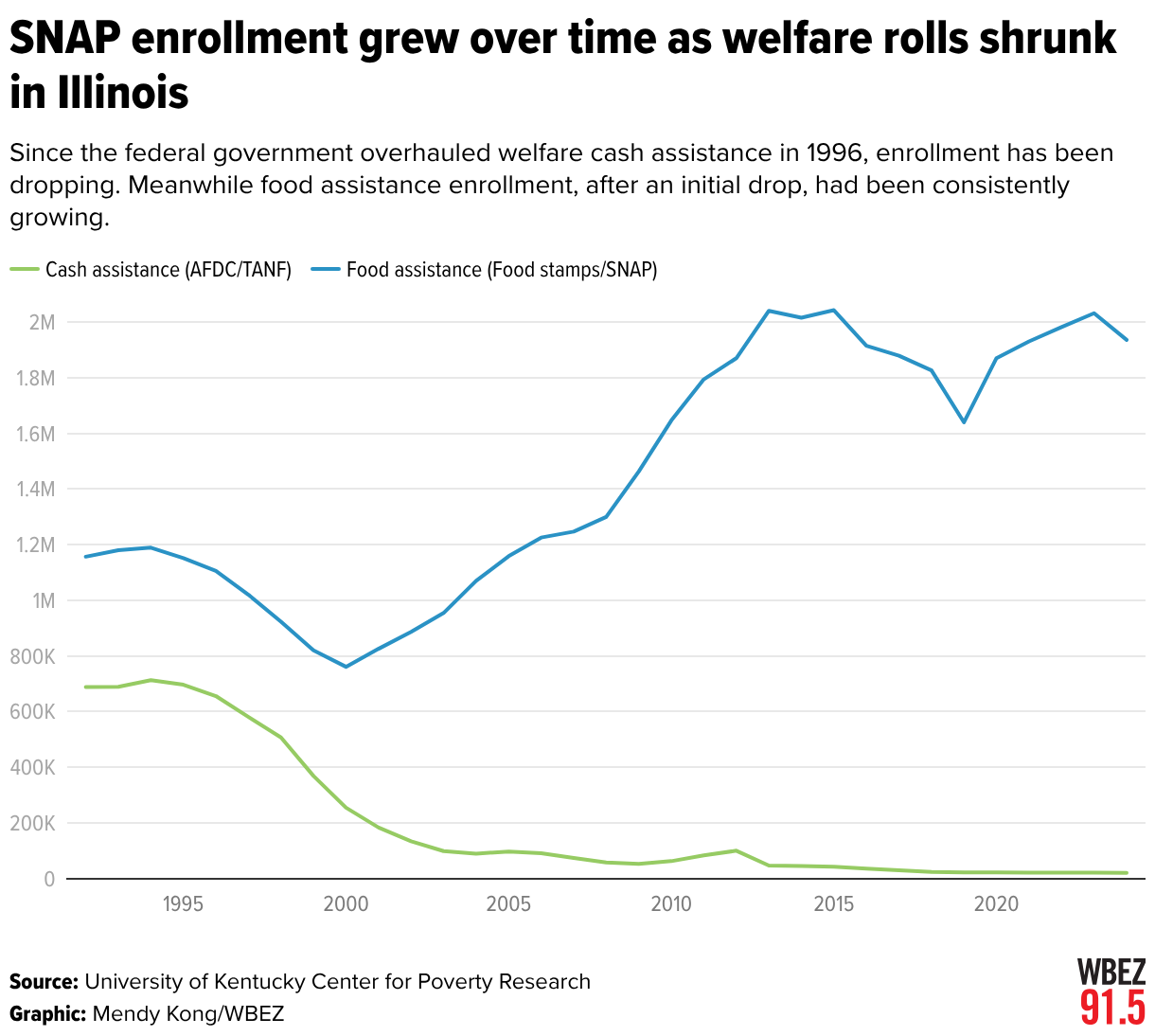
In Illinois, SNAP enrollment had been trending consistently upwards since the early 2000s as a cash assistance program called Temporary Assistance for Needy Families shrank dramatically after welfare reform in 1996. SNAP became one of the main safety-net programs many low-income households depended on, said James Ziliak, the founding director of the University of Kentucky Center for Poverty Research.
In Chicago, there are growing signs food insecurity this year is trickling down to residents. Save A Lot discount grocery stores cited cuts to SNAP as one reason it is closing stores. On the West Side, one food pantry is seeing an uptick in lines for food, and online food pantry orders are up. Groups that work with people with physical and mental health disabilities are spending long days helping clients get SNAP benefits restored.
For people like Salinas Torres, the need for food hasn’t gone away. It was her first time at the food pantry hosted by the nonprofit El Hogar Del Niño Child and Family Center, and it was a relief. She had recently taken herself to the hospital after feeling so stressed out about her household’s finances.
“I feel pressured wondering if we are going to make it today or not,” she said in Spanish. “When they told me about this pantry, I thought it’s a way for me to not worry for at least a week.”
A contracting safety net
It was only a few years ago, during the COVID pandemic, that SNAP benefits were expanded — and people’s idea of how the government should support residents widened, said Carolyn Barnes, an associate professor at the University of Chicago Crown Family School of Social Work, Policy and Practice.
“In the last five years, the safety net, as low-income families know it has, seesawed,” Barnes said. “It went from being super accessible and generous in an unprecedented fashion, to now being incredibly difficult to access and vulnerable to more cuts.”
This pattern — expansion followed by contraction — has been happening for decades, Barnes said. One difference now is how quickly SNAP reforms, embedded in H.R. 1, happened compared to welfare reform efforts in the 1990s.
“A lot of states didn’t know the potential impact of a lot of these [SNAP] administrative changes,” Barnes said. “So a lot of this feels rushed … and less like [a] concerted, planned out 20-year campaign that led up to welfare reform.”
In 1996, then-President Bill Clinton, a Democrat, signed into law changes to welfare reform that were meant to reduce dependency on government aid and push people into the workforce, according to an analysis from the Brookings Institution, a Washington, D.C., public policy nonprofit.
But many interpreted the reform as an attack on Black women, Barnes said.
“The welfare queen rhetoric that [President Ronald] Reagan popularized,” Barnes said, “this was about self-sufficiency, familial responsibility, dads need to be involved in caring for their kids.”
The reform targeted the welfare program that became TANF. It provides financial assistance for a finite period to pregnant women and families to pay for food, shelter and utilities.
One year after that reform, TANF enrollment in Illinois decreased by about 12%, according to data from the University of Kentucky Center for Poverty Research. Over the long-term, the rates fell through the floor.
Families on TANF had been automatically enrolled in SNAP before welfare reform, but that changed after 1996. In places like Illinois, that led to a drop in food assistance enrollment, from 1.1 million people in 1995 to 760,472 people five years later, according to center data.
That could be caused in part by families on TANF leaving both programs, Ziliak said. In the years after, only about half of those eligible for food assistance were enrolled, he said, so there was a push to get people signed up. From 2004 to 2024, there were always more than 1 million people receiving food assistance in Illinois, with spikes to 2 million in 2013 and in 2023.
Meanwhile, TANF numbers continued to plummet. By 2024 — three decades after welfare reform — there were only 20,022 Illinois residents enrolled. Participation since the Clinton era decreased by 96%.
“What we do know is that, from what we can pick up from surveys, is that their overall family incomes fell after welfare reform,” Ziliak said.
States face costly financial burden
In this first year of SNAP reform, the state of Illinois has tried to keep as many people on the food assistance program as possible, in contrast to other states that have scrambled to comply by making it more difficult for households to stay eligible.
But embedded in H.R. 1 are new cost-sharing requirements for states that will put increasing financial pressure on Illinois and other states.
To start, Illinois officials estimate one provision amounts to approximately $80 million annually in new administration costs.
There is also a major penalty looming. Starting in fiscal year 2029, or fall 2028, Illinois could be on the hook for up to $550 million annually in new costs, based on current enrollment, according to an analysis by the Civic Federation. Illinois, along with advocates and other states subject to this penalty, are pushing for those penalties to be delayed to 2030.
The penalty is for a so-called SNAP “error rate” that is considered high. That rate is calculated off a small sampling of cases and is used to measure benefit overpayment or underpayment, according to the Illinois Department of Human Services. The measurement has existed for decades but has never before been used to shift costs to states. The Trump administration says it’s using it to push for greater accuracy and efficiency.
States with a rate above 6% will have to pay for a portion of SNAP benefits. Illinois’ most recent rate was nearly 15%, according to the U.S. Department of Agriculture. State officials shared efforts to drive that percentage down, including tech improvements and adding caseworkers, but in a statement it dismissed the Trump administration’s stated goals, calling this a “penalty scheme” that is being used to “squeeze billions of dollars from state taxpayers.”
The pressure to reduce the error rate appears to be driving some of the drastic changes in enrollment in places like Arizona, where officials are requiring more documentation to get food assistance, The New York Times reported.

Food pantries becoming primary source for food
In West Garfield Park, a line wrapped around the Above and Beyond Food Pantry in May, right after benefit cutoffs began. At least two people were among those who lost SNAP benefits. One man said he now stops at the pantry three to four times a week.
Above and Beyond has seen an 11% increase in the number of individuals seeking food compared to this time last year, said Ken Cozzi, the executive director. It’s hard to tell if the demand is due exclusively to the changes in SNAP, but they’ve heard from many people doing what they can to stretch any money and funds they get.
The pantry stands out because it’s already open six days a week. And with pantries bracing for more need due to the SNAP changes, Cozzi said it’s hard to see how they could expand even more.
“They are taking out an entire level of benefits for many people where now it is strictly food pantries … nothing else in between,” Cozzi said.
In West Town, boxes filled with oatmeal, rice and tuna were stacked on pallets inside Nourishing Hope’s headquarters. The boxes were part of online orders, which has seen demand grow by about 130% to 140% since SNAP changes were announced last year, said Natia Barnett, senior program expansion manager for the nonprofit that also runs food pantries.
For the last three years, Nourishing Hope has partnered with community organizations to distribute more food to neighborhoods, Barnett said. People place online orders that are picked up in community hubs, and demand has grown there, too. El Hogar joined the program in May and plans to expand.

Need for food and support remains
Broad exemptions in Illinois have minimized the number of people the state anticipated would lose food assistance this summer, but social workers locally are seeing people struggling to keep their benefits.
Workers at the Association House of Chicago in Humboldt Park started to hear from their clients in May when they suddenly found themselves without benefits.
That “forced people with disabilities to go back and fight for something that they should have kept getting anyway,” said Maggie Hettman, who works in the behavioral health division. “And a lot of our people have mental health issues. You can understand that threw them into a spiral … people with physical disabilities sometimes can’t go on their own, sit at the DHS office for hours.”
And that has meant case workers must spend time going to doctor’s appointments with their clients to get paperwork to prove an exemption or days spent at a DHS office, said Mary Gonzalez, who works in the community support treatment team. Others who got benefits restored found they now receive less than before, Gonzalez and Hettman said.
Other clients are stuck in a paradox of trying to meet the work requirements while waiting to get the designation of being disabled so they can be exempt. There are about 60 people on a waiting list to get help applying for disability through the Social Security Administration, which could be a one- to two-year process, Hettman said.
“It’s just disappointing to see the population that needs the help the most not being able to access it,” Gonzalez said.
Some people have succeeded in getting their benefits restored.
Salinas Torres, the mother of five, was back on SNAP by June after her family’s household income was recalculated. She’s now receiving $800 a month.
“I feel better,” a relieved Salinas Torres said in Spanish.
But she still plans to use the monthly distribution at El Hogar to help her feed her family.