VILNIUS, Lithuania — Arena Vilnius, half the size of the United Center, feels bigger than it is when hometown heroes Rytas play against the Žalgiris basketball team from Kaunas.
Sections of cheering fans wave giant flags and shout songs of adoration to their teams. Huge stationary flamethrowers send pillars of fire into the air, warming anyone within 20 yards.
When the underdogs Rytas briefly lead at the end of the third quarter, during a Sunday night game in April, the exuberance of the Rytas dance team makes it seem like they might get a win.
Domantas Purvys, a local high school basketball fanatic, volunteers at the arena to get free floor-level access to the games. He says basketball “is part of our religion. It’s in our blood, basketball. It’s everything to us.”
Like many Lithuanians, Purvys also follows the NBA.
“I love Matas Buzelis,” he says of the rising Bulls star, who’s a cornerstone of the team’s rebuilding plans.
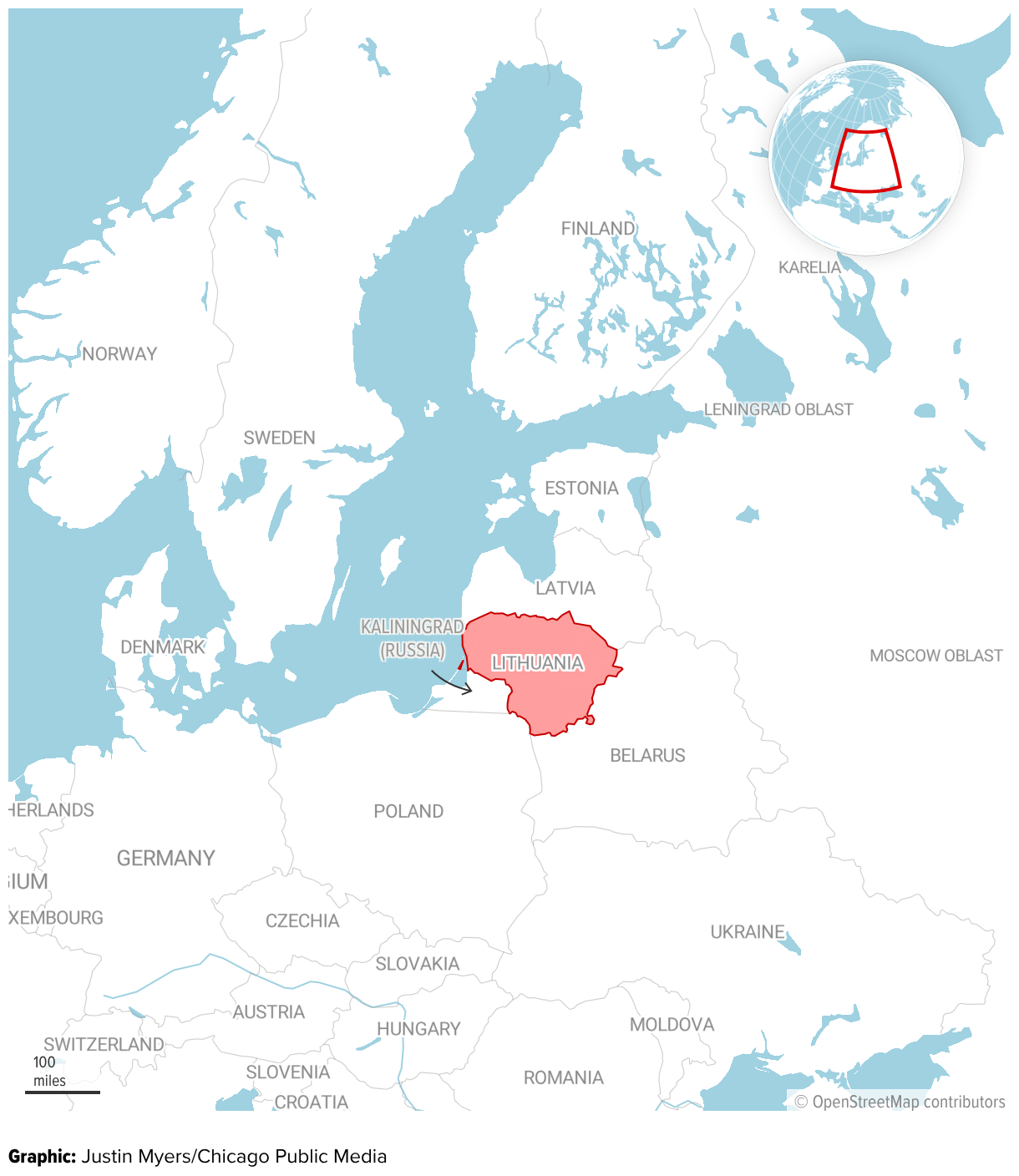
Born in Chicago to Lithuanian immigrants, Buzelis, 21, is beloved in the country of 2.8 million people.
He’s the latest accomplished basketball player with a Lithuanian name, along with Kasparas Jakučionis, who played for the University of Illinois before joining the Miami Heat and who’s now with the Milwaukee Bucks, and Domantas Sabonis, the Sacramento Kings star who’s the son of Lithuanian giant Arvydas Sabonis, formerly of the Portland Trail Blazers.
Buzelis, Jakučionis and Jonas Valančiūnas, formerly of the Denver Nuggets, are playing in the off-season for the Lithuanian national team, which has an exhibition game Aug. 23 in Vilnius against the reigning NCAA champs University of Michigan.

|
Ashlee Rezin/Sun-Times

|
Ashlee Rezin/Sun-Times

|
Ashlee Rezin/Sun-Times

|
Ashlee Rezin/Sun-Times

|
Ashlee Rezin/Sun-Times

|
Ashlee Rezin/Sun-Times

|
Ashlee Rezin/Sun-Times

|
Ashlee Rezin/Sun-Times

|
Ashlee Rezin/Sun-Times

|
Ashlee Rezin/Sun-Times

|
Ashlee Rezin/Sun-Times

|
Ashlee Rezin/Sun-Times

|
Ashlee Rezin/Sun-Times

|
Ashlee Rezin/Sun-Times


How such a tiny country came to produce such towering players can be traced, in part, back to Chicago.
In the mid-1930s, Lithuania wanted to improve its basketball standing in Europe. So it invited diaspora Lithuanians to help.
Two Chicagoans, Juozas Žukas and Konstantinas Savickas, came to Kaunas to play for and coach the Lithuanian national team. They were joined by Frank Lubin, a Californian who’d played for the University of California Los Angeles and helped the U.S. win Olympic gold for basketball in 1936.
In 1937, the scrappy Lithuanian national team, featuring three Chicago players and a Chicago player-coach, Feliksas Kriaučiūnas, won the EuroBasket tournament.
Lithuania repeated its win in 1939, once again with four Chicago-area players.
“It dates back to guys from Chicago going there to play for the national team,” Don Siliunas says. Siliunas is a radiologist who serves as president of the Lituanica Athletic Club at the Lithuanian World Center in Lemont, where Buzelis played in youth programs.

Mindaugas Balčiūnas, president of the Lithuanian Basketball Federation, says the expertise of American players helped put Lithuania on the map in the 1930s.
“These people who escaped to the United States, first of all, they went to Chicago, and many of them were connected to basketball and found their connection with the local community,” Balčiūnas says. “Chicago is one of the most important towns in the United States in terms of the Lithuanian community, in terms of help to Lithuanian basketball, and we really appreciate it.”
During the half-century occupation of Lithuania by the former Soviet Union, Lithuanian players made up a disproportionate number of the Soviets’ top players, including when four Lithuanian starters helped win a men’s gold medal at the 1988 Summer Olympics.
Four years later, Lithuania was a newly independent country when it competed in the 1992 Summer Olympics in Barcelona.
Underfunded and overshadowed by the American “Dream Team,” featuring Michael Jordan, Larry Bird and Magic Johnson, the Lithuanians got help from an unexpected source: Members of the Grateful Dead saw a newspaper article about their plight and funded the team’s trip to the Olympics.
American artist Greg Speirs designed yellow, green and red tie-dyed T-shirts with a dunking skeleton to fundraise for the team, attracting a worldwide spotlight to Lithuanian basketball. The team, which included NBA stars Arvydas Sabonis and Šarūnas Marčiulionis, took bronze by defeating the Unified Team, composed of Russian and other former Soviet states, a feat memorialized in the 2012 documentary film “The Other Dream Team.”

|
Bongarts/Getty Images

|
Ashlee Rezin/Sun-Times

|
Ashlee Rezin/Sun-Times

|
Ashlee Rezin/Sun-Times


Tie-dyed T-shirts with dunking skeletons are still a huge seller at the Lithuanian House of Basketball in Kaunas, Balčiūnas says. Even Denmark’s king and queen wanted a shirt when they visited Lithuania in January, he says.
The 1992 Olympic bronze medal helped unify Lithuania, Balčiūnas says.
“The single voice of us as a nation and a country was basketball, just to announce to the world that look, we are independent. We have our country. We have our identity,” he says.
As Lithuania’s population declined from emigration, Balčiūnas says he’s gotten creative to keep the sport and its recruiting efforts strong, especially because Lithuanian basketball receives significantly less funding from the International Basketball Federation than soccer gets from the International Federation of Association Football.
Balčiūnas and his staff look for promising youth players in the diaspora. He pulls out a 1911 baptismal certificate from a U.S. player’s great-grandparent, proving their Lithuanian roots.
“We have competitors, nations with 100 million people, and we still need to beat them,” Balčiūnas says. “That’s why communities of immigrants are very, very important.”
What Lithuania lacks in population, it makes up for in its reputation for strong preparation for the sport.
Nearly every town in the country, which is half the size of Illinois, has its own men’s team. A handful also have a professional women’s team.
Balčiūnas hopes interest in women’s basketball will grow when Lithuania co-hosts the EuroBasket Women 2027 tournament.
Lithuanian coaches are legally required to have at least a bachelor’s degree, and the country has several universities offering coaching studies.
“This is what we call our DNA of our basketball,” he says. “People who are coming here, spending one or two years, they are starting to understand how basketball integrates in your brain, in your thinking, in your daily habits and so on.”
Almantas Kiveris, press officer for the Žalgiris team, says Lithuania relied on American help in the beginning, but now it’s become a two-way street.
“Even under full Soviet occupation, basketball was the leading sport, and every newborn was — we joke — born with a basketball in their hands,” he says.
He points to Buzelis, playing for the Bulls and for Lithuania. “He was born in Chicago, but we still look at him as 100% Lithuanian.”
Žalgiris, the top team in Lithuania, routinely attracts former NBA players.
At a practice in April, several American players were running drills and scrimmaging, with an English-speaking assistant coach translating courtside.
At the Sanit Basketball Academy in Vilnius, 10- and 11-year-old boys are running drills on a weekday after school, each kid dribbling a basketball with his left hand while tossing and catching a little ball in his right.

|
Ashlee Rezin/Sun-Times

|
Ashlee Rezin/Sun-Times

|
Ashlee Rezin/Sun-Times

|
Ashlee Rezin/Sun-Times

|
Ashlee Rezin/Sun-Times

|
Ashlee Rezin/Sun-Times

|
Ashlee Rezin/Sun-Times


“I think all the parents dream that their kid will be the best,” Tomas Purlys, one of the coaches, says.
And in Lemont, kids from preschool through middle school are running and shooting during a weeknight practice for the Lituanica Basketball Academy.
Stepas Žilys, who moved to Illinois from Lithuania about 25 years ago, is the head coach.
He took Lituanica’s U-13 boys team to Vilnius in June to participate in the Buzelis Cup, an international youth tournament. The team had a decent showing, winning three of five games and taking sixth place out of 16 teams in their age group.
Most of the boys have a touch of Matas mania.
“They’re looking [at] how he’s dressing, how he moves, how he walks, what he says and things like that,” Žilys says. “Everybody wants to be the next Matas. Obviously, we’re not going to have many Matases, but hopefully, we still have some talent … at least college players.”


|
Ashlee Rezin/Sun-Times

|
Ashlee Rezin/Sun-Times

|
Ashlee Rezin/Sun-Times

|
Ashlee Rezin/Sun-Times


Siliūnas says playing basketball at the Lemont facility keeps youngsters connected with their roots.
“This is how you can keep the heritage going. I mean, we’re all Americans, basically, but we’re of Lithuanian descent, and so you have to make it special,” he says. “And one of the ways is you have friends and you’ve been playing sports forever, and it keeps you around. That’s sort of how I stay tied into the Lithuanian community.”
Coaches in Lemont and Lithuania say their style of play is less showboating and more team-oriented.
“Pass first to get the best shot available. It’s trying to involve every player on the team,” Kiveris, of the Žalgiris team, says. “And of course, good shooting from outside. We are really good three-point shooters.”
At the end of the Rytas-Žalgiris game in April, the triumphant Žalgiris fans serenade their team as the players on the court turn to face them.
Rusnė Juozainytė, a fan and volunteer at the arena, translates their song: “Thank you for your game, for your effort, for all the soul you’re giving to the game.”
Juozainytė says, “It’s a very beautiful thing to do.”

About this series

Chicago Sun-Times investigative reporter Stephanie Zimmermann and photo editor Ashlee Rezin traveled to Lithuania for two weeks in April as the Pulitzer Center’s 2026 Richard C. Longworth Media fellows. Their aim was to shed light on a region with strong Chicago ties and an increasingly important role on the world stage.
A member of the European Union and NATO since 2004, Lithuania is a paradox. Its economic growth is in Europe’s top 25%, and it has six tech unicorns, startups valued at more than $1 billion. Yet the country of 2.8 million people is located at one of Europe’s most vulnerable spots for military defense.
Zimmermann interviewed more than 50 people for the six-story series, from a former president and a current foreign minister to ordinary Lithuanians living at a time of both promise and peril.
Coming soon
- Wednesday: At 250, here’s what the U.S. can learn from Lithuania, a younger democracy aided by Chicagoans
- Thursday: Why most Lithuanians support NATO and what Lithuania is doing to protect itself from threats
- Friday: Chicago and Lithuania are linked in their love of basketball
- Saturday: An interview with former President Valdas Adamkus
- Sunday: From furniture-making to tech, Lithuania’s economy is thriving, with six unicorn companies