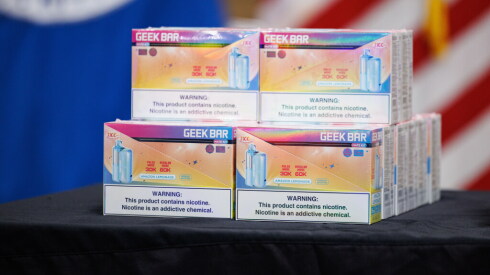
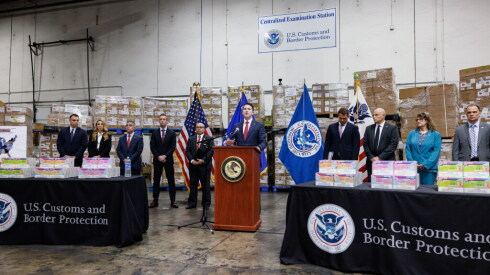
Surrounded by pallets filled with seized drones and vapes inside a Bensenville warehouse Tuesday, Justice Department officials touted more than $1 billion in recoveries they attributed to a federal trade fraud task force created less than one year ago.
But roughly half that figure came from a recent settlement in a years-old case involving tariff evasion.
The Justice Department’s Trade Fraud Task Force, launched last August, has surpassed $1 billion in civil and criminal recoveries, penalties, forfeitures and publicly charged losses tied to various trade schemes, Assistant Attorney General Colin McDonald announced.
About $550 million of those recoveries, however, came from a settlement reached in May between the Justice Department and California-based Perfectus Aluminum in a fraud case dating back to 2011.
Perfectus Aluminum and its affiliated companies were found guilty in 2021 of evading import duties on Chinese aluminum products by falsely declaring more than 2.2 million aluminum extrusions as finished aluminum pallets between 2011 and 2014.
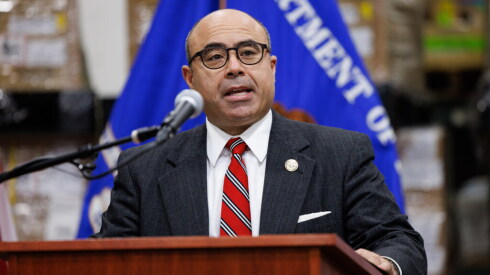
“That fantastic settlement embodies the work of this group here to bring together the collective resources to ensure that the American worker and American businesses are no longer being defrauded,” McDonald said, flanked by several federal officials, including U.S. Attorney Andrew Boutros.
The announcement was made at the U.S. Customs and Border Protection Centralized Examination Center, where thousands of goods intercepted from supply chains are redirected for further inspection or seizure.
“These schemes run the gamut, from the aluminum products to, let’s say, mattresses, to gold jewelry. Really, anything and everything that the American public would seek to purchase, there are foreign actors who are looking to exploit the money of America and then develop these schemes to send those products into the American economy,” McDonald said.
Federal officials said two Chicago cases involving gold jewelry importers helped put the Trade Fraud Task Force’s recovery number past $1 billion.
One indictment filed in Chicago charges Raj Kohli and Veena Kohli, who operate Surya International, with falsely claiming that imported gold jewelry originated in Singapore when it was from India and the United Arab Emirates.
Overall, Surya International declared a false country of origin on about 563 gold shipments brought in from 2020 through 2024. By making those false declarations, the company avoided paying more than $38 million in customs duties on roughly $693 million worth of imported jewelry, according to the feds.
In another case involved Narain Gulabani, owner of Barkha Wholesale, a Naperville-based gold jewelry importer and wholesaler. Gulabani is charged with falsely declaring that gold jewelry imported from 2016 through 2021 had been manufactured in Oman or Singapore. The feds claim it actually was made elsewhere.
The indictment alleges the scheme involved 242 shipments of gold jewelry valued at more than $240 million. The false declarations allowed Gulabani to avoid paying more than $13.6 million in customs duties.
“To this day, Chicago remains one of the largest and most significant inland ports in the United States, and a major domestic distribution hub, offering expansive venue for criminal and civil trade fraud matters,” Boutros said.
The vapes on display at Tuesday’s news conference were seized as part of an $80 million crackdown on illegal vape products imported into the U.S. The boxes of drones also on display were made with forced labor, according to the feds.