Helen King sits in her dining room in Chicago’s West Garfield Park neighborhood. She’s been living in the home for more than 50 years and chuckles at the couch and lampshades covered in plastic.
“Can you imagine that color if I didn’t have plastic on? All the kids and stuff,” she said.
King raised her children here with her late husband Harry. She takes pride that her couches are still their original shade of yellow.
“Alexa, play Ray Charles,” she said as she walked over to the kitchen.
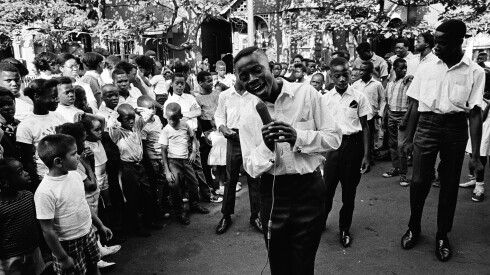
The music takes her back to summer parties organized by her block club. Neighbors gathered outside for some barbecue and good company.
“We all needed and wanted the same things,” King said of her block club. “We wanted success, and we wanted our kids to be safe.”
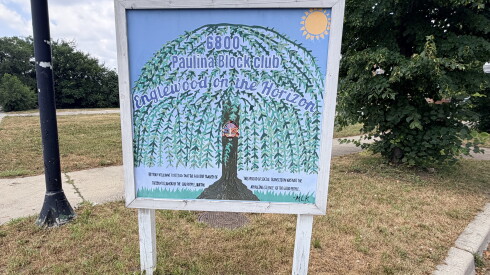
Today, you’ll still see evidence of block clubs in South and West Side neighborhoods: colorful signs, often wooden and hand-painted. They might be decorated with flowers and trees, and most tell readers what is allowed or not allowed on the block.
Block clubs are coalitions of neighbors who volunteer to improve the physical and social conditions of their block. That can range from planting flowers on the parkway to buying abandoned homes in order to increase the neighborhood’s market value. These clubs differ from homeowners associations because they are not legally mandated for residents to participate in or pay fees toward.
The history of block clubs in Chicago go back to the Great Migration. According to Amanda Seligman, author of “Chicago’s Block Clubs: How Neighbors Shape the City,” block clubs likely originated in Atlanta. In 1908, Lugenia Burns Hope started the Atlanta Neighborhood Union, where she and a team of mothers worked to bring education and health programs to African American families. It’s often credited as the roadmap for the Civil Rights movements and block clubs.
“[Block clubs] really grew to their mature form in Chicago, especially thanks to the work of the Chicago Urban League,” said Seligman, who is a professor of history and urban studies at the University of Wisconsin-Milwaukee.
During the early 20th century, over 6 million African Americans left the Jim Crow South for Northern cities like Chicago, Detroit and New York. The Chicago Urban League helped to provide financial and community support, including the formation of block clubs.

“They wanted to … cultivate local leadership skills and to improve the physical environment that African Americans were living in,” Seligman said. “And also to demonstrate to white organizations and leaders in Chicago that Black people would make good neighbors.”
After years of disinvestment and discriminatory housing practices, longtime West Garfield Park residents like King say the physical environment of neighborhoods and blocks affects the work of block clubs. Curious City sat down with King to learn how her block has changed throughout the decades.
Why Mrs. King stays
Helen King is a member of the Westside Block Club Association. When the association leader, Talei Thompson, started the block club, he was told to speak with neighbors and elders like King. She moved to Chicago in the 1950s from Jackson, Mississippi, when she was 19 with her sister and two brothers.
This conversation has been condensed and edited for clarity.
After you moved to Chicago, what happened?
I did get a job, and I kept a job until I eventually retired. I got married, and my husband and I was able to purchase our own home, something that we picked out, and I’m so pleased with it.
What were block clubs like when you first bought your home?
[Neighbors] come and knock on your door. We’d meet at each other’s home, once a month. We’d have little refreshments, and if we had issues or if we were planning anything, we would just discuss stuff that was important.
I kept track of the funds we took up, and [information] of the [city] offices [as secretary].
It starts with a small group and then it grows. Back in the day, we’d take the kids on trips and we’d have cookouts for the kids. We didn’t do an awful lot because we paid very little, $5 or something, nothing much. But it was just the idea that everybody owned their own home, so they wanted something.
If one had a problem, then the next had a problem. We worked together. We all needed and wanted the same things. We wanted success and we wanted our kids to be safe.

How do you think the neighborhood has changed?
We don’t have enough activities in our neighborhood. Back in the day, we had about five movies [theaters] from, say, Western [Avenue] all the way down on the West Side. Now we don’t have one movie [theater].
We had recreational facilities for teenagers. I used to take my boys to youth classes for the kids to play and jump and do whatever they wanted to do. I think [now], there’s one skating rink over here in a business area.
The kids could walk to school. They were small, they walked to school, didn’t have a problem, and we had stores. We don’t even have a grocery store in the neighborhood [now].
Back in the day, we had really good city workers, like garbage pickup. It was pleasant, it was different.
What do you think is behind these challenges on the block today?
It’s a lot of absentee landlords over here now. I doubt if I know three landlords over here. I used to know a lot of them and [their] kids.
Other landlords are dead and gone on and, like next door to me now, it’s empty. I’m about the oldest one over here.
What concerns you about the future ?
Drugs and guns are detrimental to society. You see so many young men walking around here — they are not as old as I am, but they’re walking with canes and walking worse than I am. They are our future.
How are you staying active with block clubs today?
I’m working with Mr. [Talei] Thompson [president of Westside Block Club Association]. You have to be ready and strong enough to be a leader and to talk to people and communicate with people. I like to know what’s going on in my neighborhood, if something comes up that I could help with or I could do.
Why do you stay on this block?
My husband was very active, and he worked hard. When he left his job, he would come home and do things in our home once we bought it. He did everything: dropping ceilings, putting carpet on the stairway in the basement. And my sons were right there with him learning to do these things.
I really appreciate it more now than I did, before he passed. When I come up the stairs holding on the rails because my legs are not as strong. I say, “Wow, Harry King, you did so many beautiful jobs.”
He painted the walls in the basement of an African group of passengers on a boat coming from Africa. You can see the sea, the water and the families. And I say, “Oh wow, what a guy he was.”
Jewél Jackson is an investigative, multimedia storyteller who independently reports on society, culture and youth.