Chicago Public Schools students will head back to class next week with backpacks full of new supplies, mostly requested by their school.
School supply lists can have families spending more than previous years, but with rising inflation some parents could be spending even more than they expected.
A Deloitte survey of Chicago K-12 parents found they planned to spend $794 per child on back-to-school items this year, up 7% year over year.
And rising costs could contribute to the figure. A report last month from Groundwork Collaborative and The Century Foundation found the price of typical school supplies increased by 7.7% over the past year. The average price of some items saw sharp increases year over year, like lunch boxes, which jumped by 26.8%, notebooks (up 23%) and index cards (22.2%), according to the report.
CPS parent Karen Mannerino remembers spending less than $100 on school supplies for all three of her kids.
Now, as two kids head into second and fifth grade at Wildwood Elementary and the oldest starts 11th grade at Lane Tech College Prep, she estimates spending about $300 total to complete each child’s supply list.
Mannerino said she started shopping in June and continued buying throughout the summer. In prior years, she purchased a box with the required school supplies sold by Wildwood. The box this year was $125 per kid.
“This year, I just felt like the box price was so much that I could probably get it cheaper if I bought it on my own,” she said.

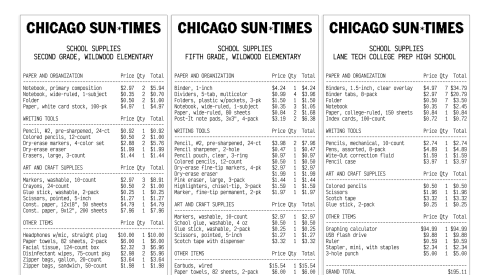
In an effort to see how much a CPS parent might spend this year, the Sun-Times pulled school supply lists for a dozen Chicago Public Schools. We checked the items’ prices across various stores to create an estimated total basket price, before taxes. The retailers were Target, Walmart, Amazon, Dollar General, Dollar Tree and Family Dollar.
We compared retailers to see which had the best deals on school supplies and chose the cheapest items. In most cases, the lowest priced item was the store brand, like Walmart’s Great Value, though some schools required parents to purchase specific brands like Kleenex and Ziploc.
A parent of a second grader at Wildwood in Forest Glen could spend $82.44; while a fifth grader’s list totaled $73.82.
A junior at Lane Tech in North Center came out to $195.11, with the priciest item being a Texas Instruments graphing calculator at $94.99.
If Mannerino purchased everything on her children’s school supply list, her total spend would be $351.37.
The sixth grade list for Buena Park’s Walt Disney Magnet School included some classroom cleaning supplies and a 50-pack of sheet protectors. We managed to find items for the list totaling $57.83.
Shopping for a kindergartner at Edwards Elementary in Archer Heights brought us to a total of $100.24. Most of the list was dedicated to classroom supplies, like Clorox wipes, Lysol spray and paper towels.
Using a ninth grade Morgan Park High School list, we rounded up an order that included eight plastic folders, graph paper and a Texas Instruments graphing calculator for a total of $141.13.
But these supply costs exclude school fees that many CPS parents are required to pay.
Mannerino’s high schooler has a $585 annual fee, and the fees for her younger kids are about $150 each.
There’s also back-to-school clothes, shoes and accessories, which Deloitte estimates will take up a family’s total school spending by about 54%.
But the economic uncertainty over the last year seems to have impacted consumer back to school shopping behavior.
Discretionary spending during the back to school season dropped for all income levels, JLL retail researcher Keisha Virtue said.
“Last year, we saw this huge shift towards shopping early, and now, it’s totally dispersed and … [parents are] waiting until they have the money to spend,” Keisha Virtue, retail researcher at JLL, said.
Virtue said discretionary spending also dropped across all income levels, during this year’s back-to-school shopping season.
The average parent is devoting 55.8% of their back-to-school budget to discretionary items, rather than necessities like for school supply lists. That’s down from 60% last year. For households earning between $50,000 and $150,000, discretionary spending dropped from 64.9% in 2024 to 55.8% in 2026. Households earning more than $150,000 also dropped their discretionary spending from 70.9% to 57.1% over the same period, the sharpest decline at 13.8 percentage points.
Financial strain led shoppers to bargain hunt more than in past years, according to JLL research.
Dollar stores broke into the top 10 for back-to-school retailers for the first time. While Walmart has been a mainstay for back-to school-shopping, the retailer surged in popularity this year, by 22.5 percentage points, to 77.3%. The top three retailers were Walmart, Target and Amazon, according to JLL.