PITTSBURGH — It’s no secret what the Cubs, clear buyers at the trade deadline, are shopping for this summer.
But they won’t be the only team seeking an upgrade. Do they have what it takes to persuade sellers to part with their pitchers?
‘‘It’s been a really good season so far for our system, position players in particular,’’ team president Jed Hoyer said a week ago. ‘‘We’ve had a lot of real breakouts, which has been good.
‘‘That isn’t talking about a desire to trade [away from that group], but it’s been really positive from a breakout standpoint, from a position-player performance standpoint. That’s super-important. That’s the future.’’
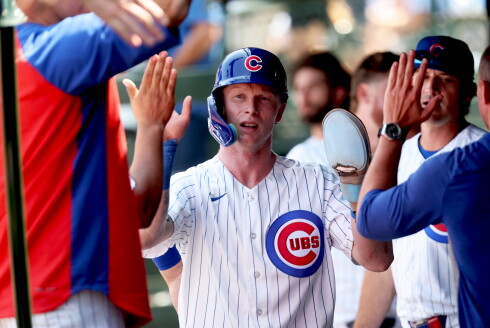
The Cubs called up one of those notable performers Friday, bringing their No. 11 prospect, utility player James Triantos, to the majors.
It was a nice reward for Triantos, the Cubs’ second-round draft choice five years ago, who has bounced back from a .684 OPS in 102 games last season at Triple-A Iowa to a .784 number in 88 games this season.
‘‘I learned a lot about myself last year,’’ Triantos said Friday. ‘‘You learn more about yourself when you fail than when you do well.
‘‘It could be a blessing in disguise. It isn’t how I wanted it to go last year. But I learned a lot, and now I’m a better player because of it.’’
If the idea is for Triantos — whom the Cubs are confident deploying as a second baseman, third baseman and left fielder — to impress any interested parties before the deadline Aug. 3, the opportunities will be minimal. That’s no surprise, given this is an entrenched position-player group chasing a place in the postseason.
‘‘There’s not a lot of playing time for this [roster] spot,’’ manager Craig Counsell said, ‘‘and that’s going to be the same situation for James. We’ll see what happens in this stretch of no days off, but [there’s] likely not going to be a lot of playing time.’’
Might we count Triantos among the candidates to head the other way in a potential deadline deal?
There has been speculation about another utility player, one with much more big-league experience, but Matt Shaw won’t have a chance to impress before the deadline. He still is working to get over the hump in his recovery from a sprained hand that has sidelined him since late last month.
Shaw’s roster spot has become a revolving door of young players. Outfielder Kevin Alcantara was sent down as Triantos came up, and that rotation will continue, Counsell said.
It was a strategy the Cubs used a year ago with Alcantara, catcher/designated hitter Moises Ballesteros and outfielder Owen Caissie, hoping to keep them from rusting on the big-league bench. But no trade involving any of those prospects materialized at the deadline last year, with Hoyer balking at the high price of pitching.
After a brief playoff run, Hoyer made that move in the winter, dealing Caissie for right-hander Edward Cabrera, whose extended absence with a hamstring injury has helped intensify the Cubs’ current pitching need.
Infielder Pedro Ramirez, who started the season among the Cubs’ top-rated prospects, has assumed a more permanent reserve role than might have been initially expected and has impressed in limited action.
‘‘There’s a lot to like,’’ Counsell said of Ramirez. ‘‘For a 22-year-old to come up and play sporadically and be on the bench and still be a contributor, it’s been fun to watch.’’
No farmhand has opened more eyes than outfielder Josiah Hartshorn, whose big season at Class A has him as the Cubs’ highest-rated prospect, just ahead of Double-A infielder Jefferson Rojas.
Might there be a greater urgency for Hoyer and the front office to be aggressive this summer? Or will the high price of pitching once more deter the Cubs from dealing away part of their future?
Most important: Do the Cubs even have the kinds of pieces it would take to swim in those waters?
‘‘The players that people were talking about as trade chips at this point, those are the players that next year may be impacting us,’’ Hoyer said. ‘‘You always have to keep that in mind. I think we have a lot of guys that can help us here pretty quickly.’’