Tiffany’s only baby was turning 2 when she decided that she couldn’t ignore a giant red flag: Her son had yet to utter a word, while other toddlers were putting together short sentences.
At her pediatrician’s urging, she was ready to have him evaluated to figure out what was going on.
What happened next gave her an early indication of what she would be up against as she tried to get her son support. Every clinic she called in the city had a long waiting list. It took a month to get an appointment and it was in northwest suburban Rolling Meadows, a nearly 40-mile drive from her South Side home.
When she finally got to meet with the psychiatrist on a video call a week later, she learned her son has autism.
“I didn’t really know what it meant at all and then there was a lot of sadness and grief,” Tiffany says now. She asked that her last name not be used to protect her son’s privacy.
But she told herself: “OK, we have to continue on, we have to figure this out and try to get him at his highest capacity, however that may look.”

Tiffany’s little boy is now 6. And he is part of a growing group of students in Chicago Public Schools who have autism and need special education — a new reality for the school district that has major academic and financial implications.
As of this spring, almost 83,000 students qualified for either an individualized education program, known as an IEP, or a 504 plan, which legally require school districts to provide students with specialized education services or to remove barriers to their learning.
That’s 26% of CPS students, up from 20% in 2019. It’s a national trend that’s more pronounced in Chicago.
The number of students with autism has doubled since 2019, according to CPS data obtained through an open records request. Many of these students require intensive classroom support and therapy and a growing number spend the majority of their day in separate classes.

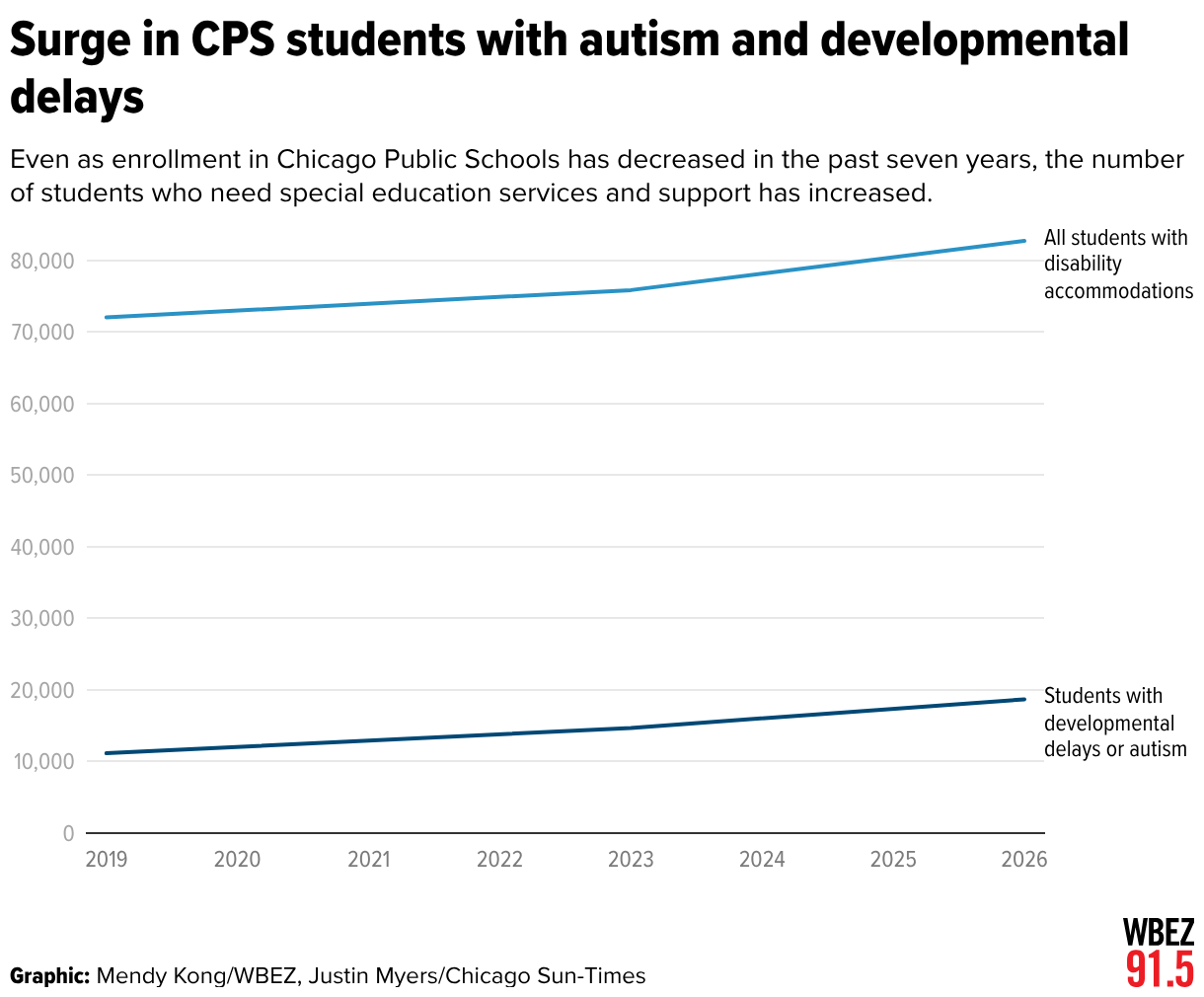
Chicago is not alone. More children across the country are being diagnosed with autism, a fact that experts attribute to a variety of reasons, including that pediatricians and parents are more aware of the early signs.
Children with disabilities need these services to reach their full potential and are legally entitled to them. More than 50 years ago, a landmark federal law promised that students with disabilities would get a “free and appropriate education” and would no longer be left to languish in separate settings where they were scarcely educated.
But, as the cost of providing special education rises, federal and state funding is not keeping up. And that’s putting a tremendous strain on CPS’ and other districts’ budgets.
CPS spent $1.8 billion on special education in 2026, almost twice what it did in 2019. At the same time, the gap between what state and federal funding covers and what CPS must pay has grown by an astronomical amount. CPS’ total budget is roughly $10 billion.

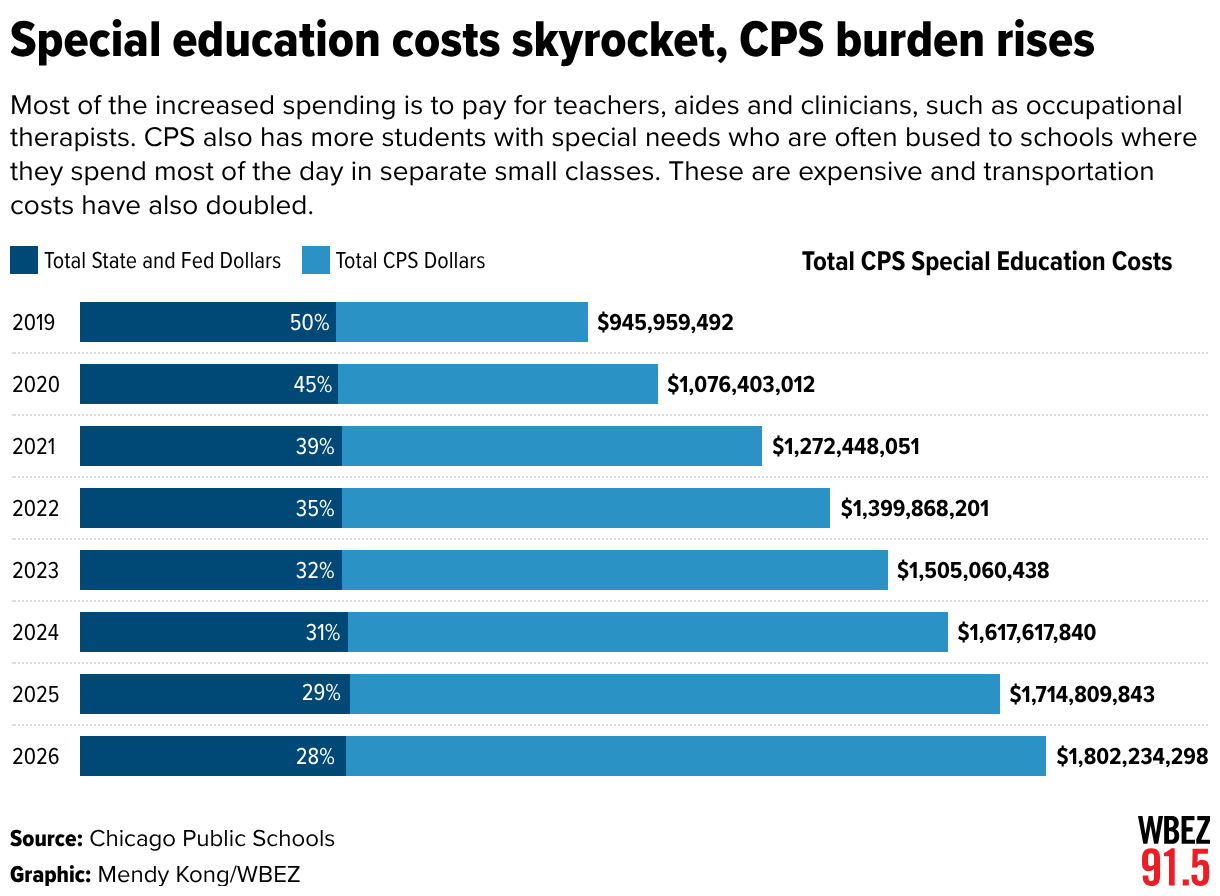
Most of that money pays for teachers, aides, social workers, psychologists and therapists. It’s the primary reason why CPS added 9,000 staffers over the past seven years, even as its enrollment dropped by 45,000 students.
When CPS officials announced 1,500 staff layoffs and other drastic measures to close the district’s $732 million deficit earlier this week, they stressed that they were actually adding more special education staff.
Joshua Long, chief of CPS’ office for students with disabilities, said CPS is in a difficult position.
“We all know that meeting our legal obligations is not optional, and so as student needs evolve, our staffing resources must evolve with them,” he said.
School-level teams are charged with writing a legally binding plan that outlines what individual students need to learn and administrators must provide those resources. Efforts in the past to give students less than what school teams called for resulted in parent complaints, lawsuits and state monitoring of CPS’ special education program.
“I don’t really spend any time thinking about how we can cut staff to students with disabilities in schools,” Long says. “What I really spend time thinking about is, ‘are we doing the right thing?’”
Special education trends converge at West Side elementary
Over the last eight years, Nash Elementary in Austin has seen an eye-popping increase in students with disabilities and staff to support them. It’s not that unusual.
When Marcie Byrd became principal in 2018, Nash was like most other small neighborhood schools on Chicago’s West Side. The school had been losing students for two decades, almost all of its students were Black and it had no bilingual program. About 30 of its students were in special education and less than 10 students were autistic.
Nash’s enrollment has inched up recently as Latino families moved into the area. Nash now has 267 students and 100 are getting special education services. Seven years ago, the school had a special education staff of just five. As of this spring, Nash had a team of 36 with nine special education teachers, 26 aides and a case manager.
“That is a different look for a school,” Byrd said in May. “My needs are very high.”
At first, CPS opened one self-contained classroom at Nash to educate students with autism, intellectual disabilities and severe sensory or mobility impairments. Students in self-contained classrooms typically spend most of the day separate from their non-disabled peers. Byrd now has three.
In recent years, schools like Nash with majority Black student populations were more likely than schools with mostly white or Latino students to have a significant increase in students with disabilities, according to a WBEZ analysis. This is partly because CPS often puts self-contained classes in schools with space due to low enrollment, which tend to be located in majority Black neighborhoods.
Byrd thinks it is also because more children in the area need the intensive support that’s offered in these classes.
On a Tuesday in May, Nash teacher Raquel Suhani led a lesson about camp with students who ranged in age from 7 to 9. Except for gym and art, the students spent all day in her classroom.
“Nature, water bottle, books,” she said, reading the words of the day.
One boy sat at a small table reading the words back perfectly and Suhani gave him a high five. Another boy repeated after Suhani, as she placed his hand over the written word so he knew what word he’d said out loud. It’s the same activity, she said, differentiated for each child’s abilities.
On this day, three special education aides guided students through worksheets while Suhani worked with a small group. A fourth aide accompanied a student to and from the nurse’s office.
Byrd watched intently. “I want to know everything that is happening in these classrooms,” she said. As the mom of a daughter who was in special education, she knows how hard it is to make sure these students are well-served and, to the best of her ability, she doesn’t want them wanting for anything.
With CPS facing a significant budget deficit, many schools have been told they will need to cut staff. But Long says any reduction of special education teachers is due to a decrease in students at individual schools who need support, not budget pressures.
Byrd said she is losing four staffers but none are special education positions. In fact, she’s getting four additional aides. It’s a relief. Byrd says she needs every member of her special education team.
“I might be a little pushy because they can’t really advocate for themselves,” she says of her students, “so we have to advocate for them.”
State and federal funding for special education falls short
In Illinois, schools get money for special education through the state’s overall funding formula for districts, with some additional funding for transportation and students who need services beyond what their public school can provide.
CPS says state special education funding is falling woefully short. And district leaders, school board members and unions are urgently calling on the state to increase funding. They want Gov. JB Pritzker or Democratic leaders to bring lawmakers in for a special session, but so far they have refused.
Pritzker’s office and state education officials say the state has stepped up its contributions to schools, primarily by putting $2.5 billion more into the education funding formula since Pritzker took office in 2019.
Still, two-thirds of school districts are well below the adequate funding level that the state promised to reach by next year. At the rate Pritzker is funneling money into the school funding formula, experts say it will take at least another decade.
The federal government also falls short. It provides about 10.5% of the average per-student cost for special education — way less than the 40% that Congress promised when the original law for students with disabilities was approved in 1975.
Nationally, so many school districts are struggling to provide special education that U.S. Education Secretary Linda McMahon recently toured the country to talk with school districts about it. She put $144 million more this past year into federal grants for special education and has asked Congress to provide an additional $500 million in next year’s budget.
“The suggestion that the Trump Administration isn’t providing meaningful support for students with disabilities is simply false,” a spokesperson wrote in a statement.
To reach the original promise to fund 40% of costs, the federal government would have to up its spending on special education by about $40 billion a year, according to Congressional Research Service figures cited by U.S. Sen. John Fetterman, who backed a bill last year to increase funding.
As a result, CPS relies on money from local taxpayers to ensure the district meets its legal obligations and students are properly served. It’s a necessity, but that limits what the district can spend on other aspects of education.
As needs grow, more CPS students educated in separate classrooms
Rush Medical Center on the Near West Side is inundated with calls from parents worried about their child’s development. Families usually have to wait months to get their child evaluated, says Cynthia Pierre, a clinical psychologist at Rush’s Autism Assessment, Research, Treatment & Services Center.
She knows parents, pediatricians and others “are really hungry to understand” why there are more autism diagnoses.
There’s not a simple answer. Research has shown that autism is often heritable and that genetic variations and mutations play a role. But children are also at higher risk if their parents are older, their mom has poor mental health during pregnancy or they are born prematurely, Pierre says.
Likely the biggest change, though, is that pediatricians and parents are more aware of autism and are keyed in when children fail to hit developmental milestones, she says.
“We’re getting better at diagnosing subtle presentations of autism younger, especially with girls who tend to be overlooked,” Pierre says. “That can maybe explain, to some degree, why we’re seeing kids come into the Chicago Public Schools with a diagnosis, as opposed to getting diagnosed later.”
CPS data bears this out: The rise in students in special education is most pronounced in preschool, kindergarten and first and second grades.
Jaunelle Pratt-Williams, a research scientist at NORC at the University of Chicago, a nonpartisan research organization, stresses that in the past, some disabilities were identified later, or not at all. So students remained in typical classrooms and did not receive the support they needed, often because their teachers lacked proper training and resources. When children get the right support earlier, it’s helpful for all students, she says.
“There’s a lot of research to support that strategic hiring of highly qualified educators makes a difference for students, and so, while it is expensive, there likely will be a positive outcome for students,” she says.
But as needs rise at certain grade levels, one CPS response is worrying advocates. CPS has opened many additional self-contained classrooms, which can provide students with added support, but are also more restrictive.

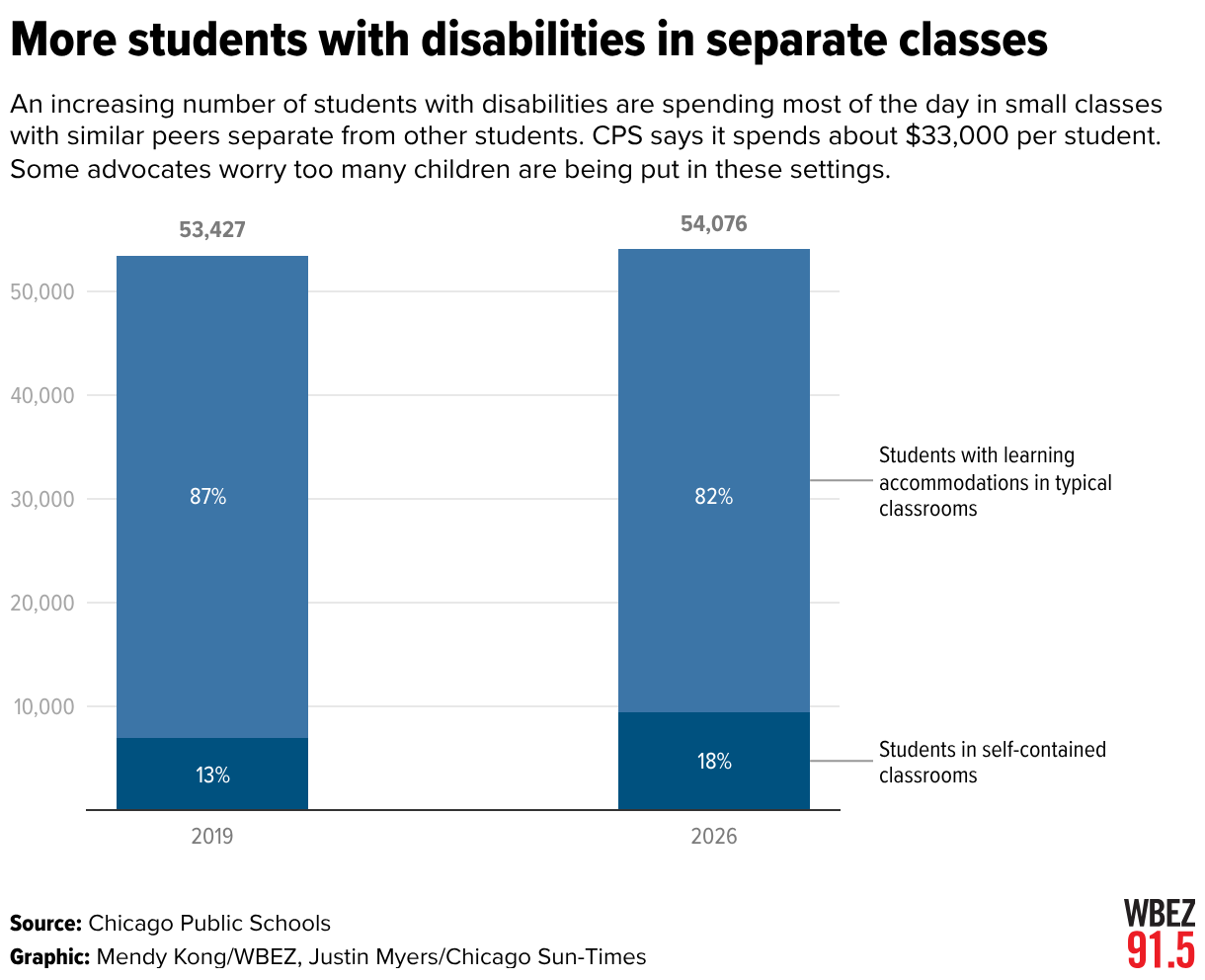
CPS added 60 last school year and is adding 60 more in the 2026-27 school year.
Barb Cohen, a legal advocate at Legal Council for Health Justice, which helps families access special education, says self-contained classes should mostly be for students with cognitive disabilities.
She worries some students with autism who don’t have a cognitive delay are being placed in separate classes because teachers and aides don’t know how to handle certain behaviors, such as meltdowns or communication issues. Self-contained classrooms typically span multiple grade levels, which can make it harder to hold students to the standards of their specific grade.
“It may not be what the kid needs. It may be what the teacher needs,” Cohen says. Especially “if the teacher doesn’t feel like they’re getting what they need to support this child” in a traditional setting.
Under federal law, students with disabilities are supposed to be placed in the least restrictive academic setting. Cohen says she’d like to see CPS provide specific training on how to work with children who are autistic, which could lessen placements in separate classes.
Overall, students with disabilities in CPS perform far worse than other students.

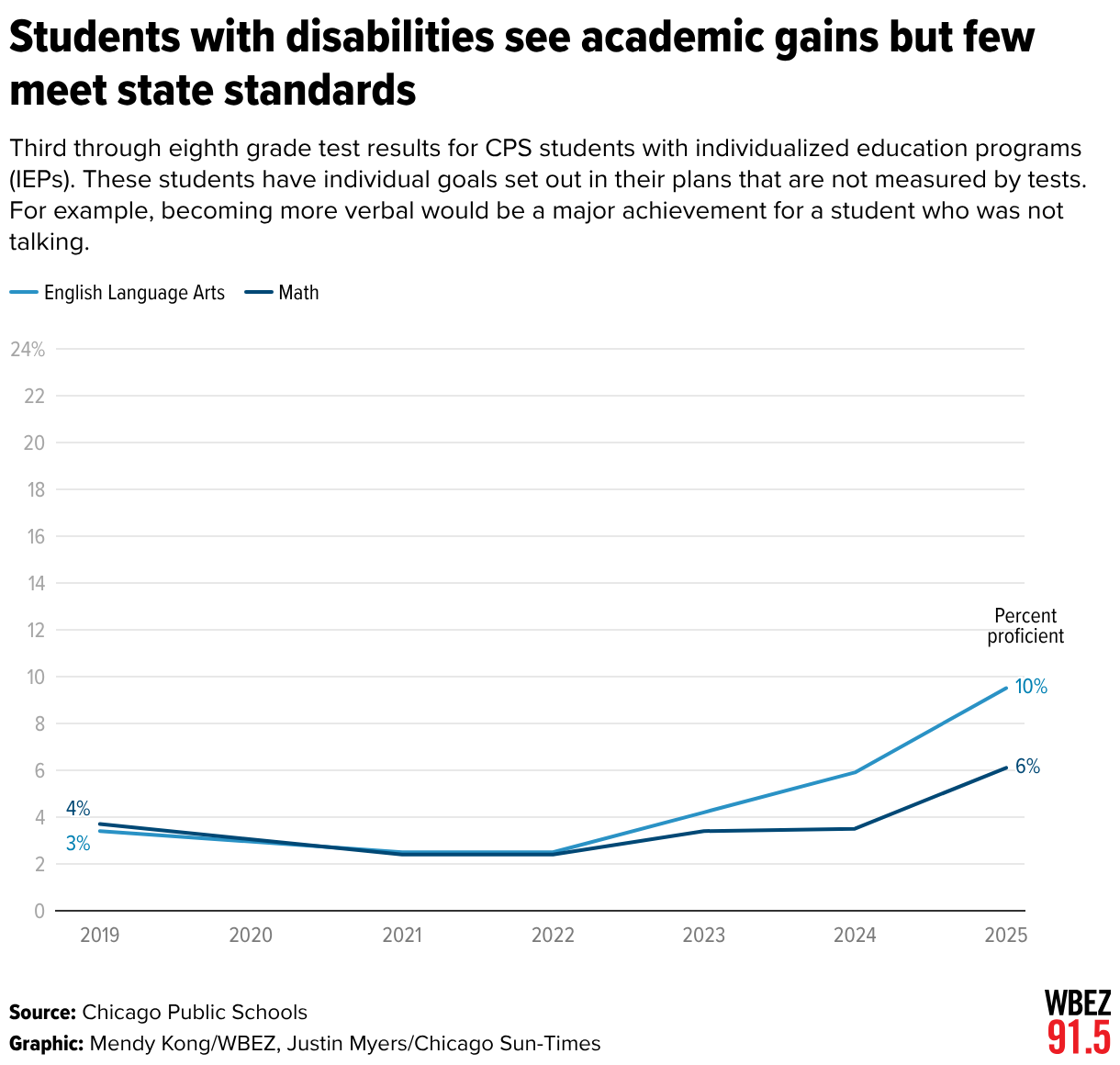
That’s true at Nash Elementary. But Principal Byrd is proud of what she is able to offer her students. Last school year, two students who were in self-contained classes started spending the majority of their school day in classrooms with non-disabled peers.
“For other students, that may not be possible,” Byrd says. “I want to see growth for all of the kids, whatever that growth looks like for each individual child. They may be fifth grade, but they may not be able to talk, so the goal is maybe we teach them how to talk. That is a big deal for them.”
CPS adds staff but many parents still see gaps in support
Despite the increase in special education staff, many CPS parents, teachers and advocates say it’s still too difficult to get students all the help they need. Hiring can be slow, and principals in low-income neighborhoods have an especially hard time filling vacancies for special education teachers and aides.
“The issue you run into is staffing,” said Michael Ahrens, a special education teacher at Funston Elementary in Logan Square. “We might all agree that it is the right thing to do, but if the budget doesn’t support the position, you might have to wait.”
Like Nash, Funston enrolls more special education students than it did in the past, and the school’s special education staff has doubled. Ahrens says that staff is necessary.
“No one is superfluous,” he says.
Parent Dana Bryant laughs at the notion that CPS has too much staff to work with special education students, as some people suggest.
Bryant’s 16-year-old daughter was diagnosed with autism as a toddler.
She quickly learned that she had to be super involved to get her daughter what she needed. Bryant first enrolled her daughter in a neighborhood school in a low-income area. One teacher was “phenomenal,” but Bryant felt the overall school was lacking. Eventually, Bryant got her daughter into a magnet school in a gentrified neighborhood.
There, she says, her daughter was able to get more time with the social worker and was in smaller classes where she was better supported.
“She was able to thrive both socially and academically,” Bryant says.
That’s partly because the community has more resources. The school rented out its parking lot for extra money. And when the school needed extra staff but didn’t have the budget, parents fundraised to cover the positions.
Bryant became so involved in advocating for her daughter, who now attends Westinghouse, a selective-enrollment high school, that she got a job at an autism organization in the suburbs. But last year she decided to start her own group for West Side parents called the 3D Legacy Alliance.
“When my daughter was young, I couldn’t find any support groups here,” she says. “I felt all alone. Now I just want to help parents and empower them.” Eventually, she hopes that will “empower the child.”
This unequal access to support at school is compounded by disparate access to additional resources in communities.
Tiffany, the Pullman mother, learned this the hard way. Once her toddler was identified as autistic, she signed up for the state’s early intervention program, which is supposed to serve children under 3 in their homes or daycares with support like speech and occupational therapy.
Tiffany says she got an initial letter saying her son qualified for services and had a phone call with a woman from the state, who said services could start soon.
“Then after that, it was radio silence,” she says. “It was a joke.”
Tiffany calls herself a “research type of person” so she got on the phone and scoured the Internet looking for private therapy options, but she couldn’t find anything near her home.
So, she again put her toddler in the car and drove him to the suburbs for a specialized preschool program and speech therapy.
“For hours, every day, that little boy sat in the car,” she says. “He’s a trooper.”
And Tiffany’s lucky. She has private insurance through her job and a car. The places where she took her son are out of reach for most parents in her neighborhood of Pullman, the vast majority of whom are low-income. Many suburban providers don’t take public health insurance like Medicaid and are inaccessible by public transit.
So when her son started kindergarten at a neighborhood school just a few blocks from her home, he was one of the few students that had such extensive outside help. Tiffany says she keeps that in mind when she thinks about whether she should insist that her son get more speech therapy or other help.
“I wish he could get more, but they have a lot of other kids. It is a funding issue,” she says. “It is literally out of his school’s hands.”