Since 2020, residents of Chicago’s Austin neighborhood have been waiting for the city to erect a gateway arch at the entrance of its Soul City Corridor, the stretch of Chicago Avenue from Austin Boulevard to Cicero Avenue.
They were thrilled when an artist, Bernard Williams, was selected and renderings were drawn up. And last year, Illinois designated a larger segment of Austin as Soul City, one of 15 official cultural districts in the state, paving the way for $200,000 in additional monies to boost the neighborhood.
But the gateway construction has stalled, leaving the burgeoning development of Black business, arts and culture unidentifiable to those driving from the west suburbs into the city. The delay over a single symbol illustrates how bureaucratic the process to create a cultural district in Illinois can be.

Years ago, as a college student living in Oak Park and working in neighboring Austin, Corey DooleyJohnson saw the stark difference between the affluent suburb and distressed city neighborhood, separated only by Austin Boulevard. In May, he wrote a LinkedIn post “Soul City Corridor-Still Waiting.”
Candace Dane Chambers/Sun-Times
Austin resident Corey DooleyJohnson is among those who have tried to speed things along. In May, he sprang into action, publishing the LinkedIn article “Soul City Corridor–Still Waiting,” which circulated among city officials and asked a “simple but urgent” question: “What comes next?”
Years ago, as a college student living in Oak Park and working in neighboring Austin, DooleyJohnson saw the stark difference between the affluent suburb and distressed city neighborhood, separated only by Austin Boulevard.
“I would look at the dividing line between Oak Park and Chicago every day,” said DooleyJohnson, 28, an artist and entrepreneur. “It was night and day. So to be able to have a gateway there says that we [now] care about the community.”
In July, Mayor Brandon Johnson and the city’s Department of Cultural Affairs and Special Events told the Sun-Times that the project was still in the works, but he didn’t provide a timeline.
“This is something that’s going to live in perpetuity,” said the mayor, an Austin resident who touted the corridor as a hallmark of his legacy. “That’s the hope, that every generation will see this as a symbol of the soul of Chicago. So we just want to make sure that depiction is something that accurately tells our story, but also speaks to our future.”
Soul City is technically bordered by North Avenue to the north, Madison Avenue to the south, Austin Avenue to the west and Cicero Avenue to the East. Though the City of Chicago has been slow to install the gateway, it has recently made investments into Austin, the third-most populous community area in Chicago, with the most Black residents.
Millions have been spent renovating Chicago Avenue and supporting the development of Black-owned businesses, mixed-income housing, health and workforce centers and arts organizations.
While appreciative of those efforts, residents are eager to see “Soul City” prominently displayed. They view the moniker as a symbol of pride that will help shift negative narratives about the area. And they say the completion of the gateway arch will show the city cares about the community and its advancement after decades of disinvestment.
“I think that’s what our community needs right now,” DooleyJohnson said. “Not only Black Chicago, but Black America needs a signal that we’re worth being invested in.”

‘People need to come back into the community’
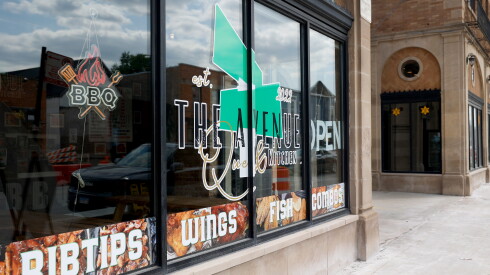
If you walk the Soul City Corridor today, you can hop between several Black-owned businesses, including the Avenue Que and Kitchen, Spill the Beans coffee shop, T&C Fitness Club and Forty Acres Fresh Market. They will soon be joined by a third outpost of the Shawn Michelle’s Homemade Ice Cream chain, a bar called Karaoke on The Ave! and Joseph’s Place Community Theater, thanks to support from a city grant program.
Spill the Beans co-owner Robbie Wilkerson said he welcomes more businesses, especially as Austin works to combat two stigmas: that no one will support Black-owned ventures and that the fear of violence in the neighborhood will scare consumers away.
“We are trying to set a new standard and create a new narrative,” said Wilkerson, who is 58. “People need to come back into the community to see that this is a safe space to shop.”

Like other Black neighborhoods in Chicago and across the country, Austin’s economic opportunities were stifled by white flight and redlining. And parts of the community were damaged during widespread riots on the West Side following the assassination of Martin Luther King, Jr. in 1968.
Luther Syas, 80, was among the first wave of Black residents who moved into Austin in the early 1970s.
“The white people we knew that lived there, we’d look up and they’d be gone,” said Syas, who worked for the Elgin-Honey Hill Corporation before starting the Learning Network alternative elementary school. “The banks were not very friendly. Getting building insurance, we had a problem with all of that.”
In subsequent years, residents lost jobs amid the closure of manufacturing facilities, and lives were destroyed by the influx of drugs and gang activity. Syas, who now works with the West Side Heroin/Opioid Task Force, witnessed the fallout.
“You had a breakup of families,” he said. “It was horrendous for the community.”
Austin has also been impacted by the former Mayor Rahm Emanuel’s closure of 50 Chicago Public Schools in 2013. (A Sun-Times and WBEZ analysis found steep population declines in areas with a shuttered building, particularly in majority-Black communities.)
In recent years, social services agencies and other groups have partnered with the city to address challenges in Austin, producing everything from the Austin Quality-of-Life Plan to former Mayor Lori Lightfoot’s Invest South/West Initiative. Chicago police data shows that murders and shootings have fallen in recent years in the Austin police district, mirroring a larger trend across the city and country. And, amid a decrease in opioid overdose deaths in Cook County and Chicago, there has been a 33% reduction in Chicago Fire Department EMS responses for suspected overdose in Austin between 2021 and 2025, according to the Chicago Department of Public Health.
The Austin African American Business Networking Association has also contributed to the neighborhood’s turnaround by supporting emerging entrepreneurs and establishing the Soul City Corridor as a “culturally relevant economic driver” in 2019. The initiative is especially important, as a study by the business association found that Austin residents spend 85% of their disposable income in Oak Park, said Malcolm Crawford, 60, who is the executive director.
“Where do people go to experience Black culture?” Crawford said. “We don’t give people an opportunity to experience the richness of our culture.”

Crawford was inspired by the Puerto Rican Cultural Center’s effort to get Humboldt Park’s Paseo Boricua recognized as “Puerto Rico Town,” one of Illinois’ first state-designated cultural districts.The $3 million state program was created under the 2021 SB1833 bill to preserve and promote culturally significant communities impacted by gentrification, displacement or the COVID-19 pandemic. Out of the 15 state designates announced since, nine are in Chicago, including Chinatown, the Bronzeville district, Little Village and Ukrainian Village. (Each district is eligible to apply for one $200,000 grant.)
If awarded, the Austin business association will use the funding to support a blues festival and other programming, Crawford said.
He is also pondering ways to better promote prominent entertainers who lived or went to school in Austin, such as blues artists Mud Morganfield and Larry Taylor, director Robert Townsend and gospel artist Milton Brunson. (A permanent exhibit honoring the area’s contributions to blues, “Unsung Austin-West Side Stories,” is on display at the Austin Town Hall Park and Cultural Center.)
“I don’t know why we don’t talk about it,” he said. “Maybe because we’re so close to them. These are people who we saw growing up. We didn’t see them as celebrities.”
T&G Fitness co-owner Cornelius Coe, 50, called Austin a “diverse, rapidly growing” community with a lot to offer for those willing to explore.
“What a lot of the powers that be are trying to do is strengthen the small businesses, especially the small minority businesses, so that we can all grow together and make Austin a little bit more exciting and visual, so that when people come, they can actually see the positive,” he said.

Can the arts help boost Austin’s profile?
Historically, public art has been crucial to changing the look of neighborhoods. In Austin,a number of colorful works installed along the Soul City Corridor catch the eye. A standout is Hebru Brantley’s “Fantastic Flying Lil Mama” statue, which sits in front of a mural of Malcolm X, Angela Davis and other Black figures at Chicago and Lockwood Avenues.
“We’ve got more to come,” Crawford said of the cultural imagery. “I keep saying our kids can’t do what they don’t see.”
Enjoying visual art and performances indoors in Austin is a bit more challenging.
“Most of the arts and cultural centers are on the South Side or Downtown,” said Jordan Campbell, 35, who is co-founder and executive director of alt_Chicago, one of few arts organizations with brick-and-mortar spaces in Austin. Campbell said he wanted to open a venue in the neighborhood after noticing the erasure of the arts from the curriculum while teaching at Chicago Public Schools.
“We needed to find a way to offer alternative means and resources that allow for the people of Austin to access an art center right here,” he said.

Other venues in the community include the Kehrein Center For The Arts, owned by Catalyst Circle Rock Charter School, and Third City Gallery, which opened last year on North Avenue with the help of a city grant.
“There’s a lot of artists who are running small art spaces, but who are so overtaxed,” said Helen Slade, 63, who is the executive director of Territory, a youth urban design studio that will contribute design pieces to Soul City Corridor. The organization currently rents a storefront on North Avenue, but has plans to relocate to a permanent home on West Division Street.
“The cost of being alive in the city is expensive, and people are working multiple jobs to do it.”
That also goes for the public, who may not have the disposable income or time to attend events, she said.
“I think what we really need is for people to care,” Campbell said. “It leads to funding opportunities. It leads to social capital, where people are now coming and volunteering. It leads to institutional capital, where larger institutions are willing to collaborate with organizations like ours.”
As the community awaits next steps for Soul City cultural district, Crawford said he is being patient as government officials figure out how to navigate the nascent initiative.
“We’re the test dummies,” he said. “They don’t have a gauge. But those of us who are doing this work just have to be consistent. We’ll continue to keep building, and we have more to come.”