“Do you want milk for your matcha?” asked Heiji Choy Black, the partner and operator at Han Cha, the Asian fusion high tearoom that she helped open inside Stony Island Arts Bank in South Shore earlier this year.
Choy Black recently debuted the tearoom, and companion bar Yunomi, with the artist Theaster Gates to enable folks to interact with Gates’ ceramics and hopefully boost traffic to his South Side art center. Gates saved the distressed Arts Bank building from demolition in 2013 when he bought it from the city for $1, securing its status as a historic landmark. It’s one of several projects by Gates seeking to revitalize disinvested communities through his nonprofit Rebuild Foundation launched in 2009.

Here is perhaps the only room in the city where tea is served in the same vessel thrown by an artist of international renown. Gates, who was born and raised in Chicago’s East Garfield Park neighborhood and lives and works in the city, has developed an artistic portfolio spanning painting, sculpture, installation and films. But in interviews, he has called clay his artistic anchor for explorations of ritual, labor, colonialism and communal gathering.
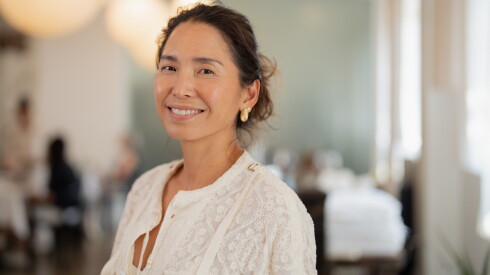

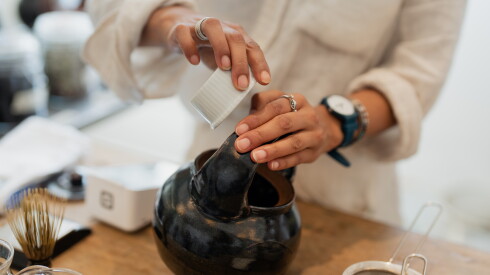
Choy Black set down the verdant Kodemari tea she’d prepared in a glazed stoneware cup thrown by Gates. Imported from Japan by Chicago-based Spirit Tea, the matcha was bright, floral and almondy with a rounded umami edge, a far cry from the grassy, sugar-laced matcha lattes dispensed by the venti cup at the Starbucks a few blocks south.
Yet I was pleasantly surprised by the question of whether I took milk. Sitting in this beautifully restored room, consuming prix-fixe high tea from ceramic vessels worth thousands apiece, amid beeping timers coaxing rare brews to their apex, the query seemed to affirm that, here, hospitality matters more than dispensing tea dogma.
“For both Theaster and I, bringing people together and feeding them and giving them great drinks is something that really is so satisfying,” Choy Black told me later. “Our hospitality program grew out of our shared ideas about hospitality and how we move through the world, making it a deeply personal part of the project. There’s no hierarchy, in a way, to beauty, good food and drink, good ambience and hospitality; they all matter in equal amounts to both of us.”
That’s not to say that, inside Han Cha, you won’t be challenged to perhaps rethink food and drink pairings and exercise patience. Han Cha serves not so much a meal as a $75 three-course progression (including two teas) of locally produced baked delights over nearly two hours.

The imaginative answer to a landmarked building’s structural constraints, this deliciously hospitable piece of conceptual art is mostly successful. It’s getting a lift from the much-abuzzed arrival of the Obama Presidential Center. But will the momentum continue?
My adventure began in the afternoon at Yunomi, named in ceramics-speak for the handleless tea cup pervading everyday life in Japan. A collection of stoneware cups and teapots crafted by Gates and his Dorchester Industries adorn a wooden shelf on one wall of this dark wood-accented bar.
“I always return to the vessel,” Gates told “Ceramics Monthly” in 2021.
One of the singular features of this artist bar is an all-artist-created cocktail list that includes a Lavender Drop named after abstract visual artist Caroline Kent — with Earl Grey-infused vodka and lavender syrup — and a peppery ginger and lime-based gin Mule from performing artist Yaw Agyeman.
But I wanted to get a sense of Gates’ own tastes, so I ordered Theaster’s Gimlet. It came highly suggested: a docent who led me to the bar said he often drinks one when he stops by.
The drink, served in a tapered white chawan tea bowl with a lipped rim, was bracing and tart-sweet in the daiquiri style the gimlet has taken on since the cocktail revival of the early aughts. In place of gin, mezcal lent vegetal and smoky brawniness, with sweetness from blood orange syrup and a woody aroma from bourbon mist. It cost $18 (the cocktail menu ranges from $18-$20).
Choy Black said she set prices at both spots to reflect the “care, craftsmanship, and collaborative labor required to realize an experience of this nature.”
“Chicago’s South Side communities, which have been historically underserved and mischaracterized, deserve access to ambitious cultural experiences of the highest caliber,” she added.
Though the walk-in bar sat empty on that weekday afternoon, I’m told it’s steadily building traffic from the neighborhood — including folks new to the Arts Bank who saw promotions in their social feeds touting the recently instated Thursday and Friday happy hour. Between 4 and 6 p.m., cocktails cost $10 and beer ($5) and wine ($10) are discounted.
“Drink in hand, they’re like, ‘Now tell me about the Arts Bank,’” Choy Black said.
Cradling my delicately ridged tea bowl, I gazed up at one of several restored arches featuring carved lion busts that accent the space. In the main gallery hall, mixed flooring materials collided beneath the soaring ceiling that contained hexagonal tinprint remnants from the old bank. An abstract mixed-media painting by Gates ran almost the length of the hall. Upstairs, the Arts Bank also houses a small gallery that’s currently showing a collaborative exhibit with Volume Gallery, and the sporadically open Johnson Publishing Library, which Gates acquired and agreed to safeguard.
Leaving the moody bar, I passed the DJ booth in the main hall and entered the bright and serene Han Cha. Off-white, round and oblong paper lanterns clustered above, while filtered daylight seeped in through gauzy white fabrics of different sizes adorning the large windows.
While conceiving Han Cha’s design, Choy Black thought of the importance of cafes as intentional gathering places in places like Seoul, where she spent time as a child, and how to encourage contemplative slowness through tea.
“When I go to a lot of cafes in the U.S., you see a lot of people working or being alone,” she said, “almost like the third space is a work space. Whereas in Seoul, there’s so much importance placed on cafe culture — connecting with people, enjoying food and drink and conversation.”
Nine teas range from herbal tisanes to Korean black teas, Taiwanese oolong and Thai white tea. It took almost 25 minutes between ordering and receiving my first tea, partly because the restaurant was training a new brewer that afternoon.
My Red Chai steeped for five minutes at exactly 207 degrees before getting strained, poured into a glass carafe and carried to the table. Heady with Saigon cinnamon, it expressed gentler background notes of spicy ginger, cardamom and black pepper.

“It smells stronger than it tastes,” a woman at the next table said to her companions. I could see what she meant until I started sipping it with course one: a jewel box of crackers, cookies, pickles and cheese that our server playfully dubbed “an adult lunchable.” Han Cha’s vegetarian, mostly gluten-free menu was developed by former Momotaro pastry chef Jessica Vazquez and Marguerite Singson, who sells pastries independently under the Instagram handle What Margie Made.
A confoundingly moist, Sujeonggwa (Korean cinnamon punch)-inspired almond drop biscuit with warm spices tasted like a buttery brown sugar cookie when washed down with the chai. Its spice matched the heat of a tender cornbread ring studded with fresh corn and exhaling oniony chive notes. Umami-packed pickled cucumbers and aged English cheddar with meaty richness highlighted the tea’s inherent sweetness. Meanwhile, every bite begged for a smear of sticky-sweet, spicy, savory gochujang hot-honey butter. (Package that butter; I’ll pay an irresponsible amount for it.)
Vazquez and Singson make everything offsite, owing to the Arts Bank landmark status. Renovations to accommodate, for example, a stove and proper ventilation must adhere to strict preservation codes. This menu will be available until at least mid-August. (Upcoming culinary collaborations will include the artist and cake maker Hyun Jung Jun [Dream Cake Test Kitchen] and Hsing Chen from the hospitality group behind Asador Bastian and Andros Taverna.)
The only time I felt the downside of Han Cha’s constraints was tucking into course two of the high tea: a triangular pair of photogenic tea sandwiches. Assembled on springy, porous Japanese milk bread, one packed rice vinegar-spiked Japanese egg salad, the other a magnetically heady Ottogi (Korean curry) pimento cheese. Time is of the essence with a bread containing almost as much moisture as tres leches cake. Its snow-white edges had already begun to shrivel.
By now, Han Cha was about half full.
“How close are we to the Obama Center?” the woman next to me asked after requesting the check. The server recited driving directions as if she’d given them several times before.
The woman turned to her companions. “Might as well make a day of it.”
Meanwhile, a pair of desserts arrived last to melt my earlier disappointment. A cloudlike banana s’mores in a sturdy, almost savory cocoa-sesame pastry case sat beside a mochi-esque honeydew canele with a bouncy, jammy interior beneath a boldly caramelized shell. Tropical, fragrant with burnt-sugar sweetness, it was a final bite worth savoring, like the last few drops of matcha — the best I’ve had in Chicago, I might add — and that cup.
I ran my fingers over the ridges beneath which the glaze felt thicker, examining the mossy-green tea against the white mottled with sunbaked orange. The vessel mattered more than I realized. This was as much an interactive art gallery as a fine-dining tearoom.
“Seeing the joy of people feeling the cups in their hand, to me, it’s truly so special,” Choy Black said. “So many restaurants have beautiful wares, right? This is just coming from a very different, deep artistic place.”