Around 10 p.m., a haze of gray smoke wafted down a hallway lined with prison cells at the Joliet Treatment Center. The window of cell A9 began to glow red as the fire within grew. Jason Stephens was locked inside. Minutes ticked by, and the smoke became so thick you could not see more than a few feet. No one came to let Stephens out.
There have been more than 70 fires at the facility in the last three years, according to an investigation by The Marshall Project, WBEZ and the Chicago Sun-Times. That includes a dozen cases in which men incarcerated there set themselves on fire.
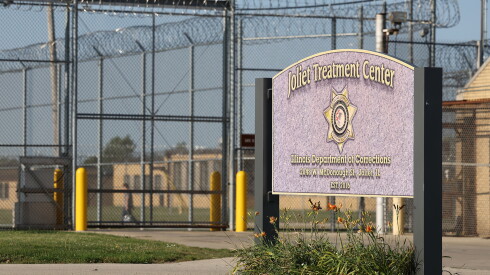
The Joliet Treatment Center opened in 2017 with the promise of being a new kind of prison in Illinois, designed to provide intensive mental health treatment. But in the years leading up to that night in the summer of 2024, incarcerated men and civil rights lawyers who visited the facility said the conditions declined. Men were kept locked in their cells for long stretches, with nothing to do. They complained about a lack of medical care and mental health treatment, which the prison system is legally obligated to provide. Men reported that guards used excessive force.
As the men grew more despondent, some became willing to do anything to draw attention to their troubles and resorted to setting their cells — or themselves — on fire.
One man needed surgery to graft new skin onto his charred calf.
Another lost a leg.
Two have died.
Last year, the prison — with a population of about 200 people — recorded roughly three fires a month.
Despite that, officials at the Joliet Treatment Center have repeatedly failed to meet their responsibilities to prevent or respond to the fires, government records show.
Cellblocks lacked sprinklers, and fire alarms were turned off or inoperable. At an annual inspection, the prison would not provide a fire evacuation plan. Guards delayed ambulances responding to emergencies at the prison or trying to take men with serious injuries to the hospital.
The Illinois Department of Corrections did not answer questions about the epidemic of fires at Joliet Treatment Center, but in an email a spokesperson wrote that it is “committed to ensuring the safety and security of staff, individuals in custody, and all persons who enter our facilities” and takes its responsibility to uphold requirements related to facility safety seriously.
Craig Haney, a professor at the University of California, Santa Cruz and an expert on mental health in prisons, said the frequency of fires at the Joliet Treatment Center is a sign of abject hopelessness.
“These are the kinds of desperate acts that somebody takes when they feel they have no alternative,” Haney said.
A disastrous delay
As the blaze in Stephens’ cell intensified, three correctional officers gathered around a desk in a nearby room. Security camera footage from that night on July 27, 2024, shows that they seemed to notice something was wrong on the wing and grabbed a fire extinguisher. A call for help went out over the prison radio, and more officers slowly trickled in and put on medical gloves and masks.
About 10 minutes after smoke began to seep out of Stephens’ cell, officers entered the hallway.
Guards sprayed a fire extinguisher and pepper spray into his cell through a slot in the door usually used to deliver food.
Then, with Stephens still locked inside, they walked away.
A prison worker called 911. The fire department arrived within minutes, but precious time had already been lost. And more was about to be wasted.
Corrections officers told firefighters that the fire was out and that they needed help to clear out the smoke. According to a fire department incident report, it wasn’t until later, as the firefighters set up fans and officers meandered nearby, that prison employees mentioned that someone was still locked inside the burnt cell.
A group of guards and firefighters opened Stephens’ door, stained black with soot. Firefighters found Stephens lying on the floor, unconscious but still breathing, after having spent a half hour in a smoke-filled cell.
They looked into his airway and found it charred. Guards handcuffed his unconscious body, and he was loaded into an ambulance waiting outside.
But at the prison’s exit, guards refused to open the gate for the ambulance to leave until prison employees filled out paperwork and guards were ready to follow in a van.

An argument erupted, and a guard walked up to the ambulance, yanking open the driver’s door. A group of firefighters and guards rushed over to intervene.
According to one guard, a firefighter said, “This man can die while y’all pussyfooting around.”
As the guards and firefighters argued with each other, one guard pulled another away, attempting to defuse the tension.
But the prison still would not allow the ambulance to depart.
A firefighter called his dispatcher again and again to report that the ambulance was stuck, with Stephens in the back hooked up to a machine forcing air into his lungs. Guards made the ambulance wait for nearly 28 minutes before finally opening the gate, allowing it to drive to a nearby hospital.
The next day, Stephens was moved to a Chicago-area hospital. Doctors performed a tracheotomy, cutting a hole in his throat so they could insert a breathing tube. But they could not save him.
Two weeks later, at age 38, Jason Stephens died. The medical examiner listed his official cause of death as “complications of inhalational injuries due to mattress fire.”

A hope betrayed
Patrice Daniels sifted through a gray box of Stephens’ belongings. While incarcerated at the prison, Daniels’ job was to pack up the property of men who transferred out or died.
For Daniels, the fires — and the hopelessness that led men to set them — felt especially tragic because the Joliet Treatment Center was supposed to be a model of a prison that prioritized mental health treatment and healing, instead of punishment.
As a child, Daniels survived sexual abuse and would injure himself by banging his head on the wall. In his teens, he was in and out of mental hospitals and juvenile detention, where he put glass in his ears and eyes. At 18, he killed a woman in a park. He turned himself into police and confessed and was sentenced to life in prison for murder. He continued to mutilate himself. Instead of receiving therapy, he said, he was put in solitary confinement for stealing razor blades that he had cut himself with.
Sometimes, he said officers tied down his limbs and injected him with psychotropic drugs.
More than a decade after Daniels landed in prison, a lawyer asked him to join a lawsuit accusing the Illinois Department of Corrections of failing to treat the mental illnesses of people in the state’s prisons.
After a yearslong battle, the Department of Corrections settled the case and committed to opening a facility dedicated to providing mental healthcare: the Joliet Treatment Center. Daniels called it the most gratifying day of his life.
In 2017, Daniels was among the first people transferred to the new prison in what had been a juvenile detention center. The building smelled clean, nothing like the overwhelming scent of mold and feces he was used to in other prisons. The officers played cards and basketball with the men. Therapy and psychiatry were readily available.
In the first two years of the Joliet Treatment Center, a court-appointed monitor reported that men there routinely had plenty of time outside their cells and received 15 hours of structured therapeutic activity a week, unlike in some other prisons. But then, the once-hopeful mood dimmed.
A new warden took over in early 2020. According to Daniels, she had a more punitive approach. Daniels said the start of COVID-19 that year gave the prison an excuse to keep men isolated in their cells for long stretches with little treatment, and the facility never rebounded.Over the next few years, the prison began to cancel mental health groups and recreational time. Men complained about frequent use of pepper spray.
Daniels said that in the early years of the Joliet Treatment Center he’d allowed himself to become emotionally vulnerable. He felt betrayed by the prison’s new harshness.
Fires as a way to be heard
A mental health worker at the prison said she noticed men hurting themselves more frequently when the coronavirus lockdowns began. Prison employees got numb to the routine self-harm.
They “experienced something that the human brain was not meant to process,” said the worker, who asked not to be named because she still works in corrections and fears retaliation for talking about the conditions she saw at the Joliet Treatment Center.
“In order to do our job every day, we had to expect it,” she said, “and we had to get used to it.”
Around the same time, men began to set fires.
The Marshall Project interviewed or corresponded with seven men and asked why they set their cells, or themselves, on fire at the Joliet Treatment Center. They described poor medical treatment, and loneliness while being locked in their cells.
Many said that prison employees had grown inured to other forms of self-harm. But fires were impossible to ignore.
“We try to talk and write to them, but they don’t respect that. But when we act like animals and set things on fire and ourselves on fire, they listen,” one man said.
In the spring of 2020, Alexander Yracheta set himself on fire, after he said the prison repeatedly canceled his mental health groups, and he spent much of his time alone in his cell. He used the spark from an electrical outlet to light a cloth tied to his leg.
According to prison investigations, guards pulled him from the cell and put cuffs on his legs while his shorts were still on fire. He later had to have skin graft surgeries to repair the damage to his leg. The pain had been excruciating, but he said it was worth it to go to the hospital and get a break from his cell.
“I couldn’t really take it,” he said, adding, “I knew I had to do something extreme to get out.”
“A really busy shift”
No one knows for sure what made Stephens start the fire in his cell. But examining his path to that day in 2024 offers some clues.
Stephens had a difficult life, according to his family and court records. As a toddler, he was diagnosed with sickle cell disease, a genetic disorder that can cause blood cells to become misshapen, leading to episodes of extreme pain and organ damage. Sometimes, his muscles hurt so badly he couldn’t move and would just scream.
Around age 7, he and his mother were living on the street and in shelters. By 14, he had dropped out of school and would pick up odd jobs in construction. Stephens’ medical records say he began struggling with mental illness as a child and was eventually diagnosed with major depressive disorder, with psychotic features and PTSD.

When Stephens was 27 years old, he was arrested and charged with shooting a friend in a drug dispute a few years before. Stephens maintained his innocence. Court records note he had been hearing voices, but a judge found him mentally fit to stand trial. In 2015, a jury found him guilty of murder, and he was sentenced to 50 years in prison.
Behind bars, Stephens routinely complained to guards, nurses and doctors about extreme pain from his sickle cell disease.
Dr. William Weber, a physician and medical director at the Medical Justice Alliance, an organization dedicated to ensuring that people in prison get proper healthcare, reviewed Stephens’ medical records for The Marshall Project. Weber said the records show that when the prison took him to outside hospitals, doctors prescribed Stephens with medications for sickle cell pain, but the prison often failed to provide them to him.
By early 2024, housed at a maximum-security prison, Stephens made more desperate pleas for attention. He staged a hunger strike that lasted for 34 days. When that failed to get him the medical help he wanted, he asked employees, “What do I need to do to get medical treatment or sent to the hospital? Cut myself or swallow a bunch of pills?”
Later that day, he swallowed two razor blades and a nail clipper. The prison system refused to send him to the hospital because the facility was on lockdown due to a staffing shortage.
His medical records note several hospital visits in the ensuing weeks, but it’s unclear when, or if, those objects were ever removed.
Prison officials transferred Stephens to the Joliet Treatment Center in May 2024, presumably to give him additional mental health help. Stephen’s mental health records show some psychiatric visits, but rarely mention indivdual therapy and largely reflect brief mental health evaluations conducted to assess his risk of suicide.
At the Joliet Treatment Center, Stephens continued to complain about the lack of medical treatment. He insisted he needed a specific kind of blood transfusion that had helped him in the past. A prison doctor acknowledged that he would have “been better off” with the transfusion but failed to make sure he got the treatment.
In early July 2024, an officer at the Joliet Treatment Center wrote in a report that Stephens said he was going to do whatever he needed to do to get medical help, including hurting himself. “This has been an ongoing issue,” the officer wrote.
One day, a few weeks later, several men on Stephens’ wing began to harm themselves. Two of the men were sent to a separate part of the prison, and guards tied down their arms and legs in what are called four-point restraints. A doctor sent a third man to the emergency room.
The mental health worker, who was also on duty that day, said even with all the chaos, it was a normal day at the Joliet Treatment Center.
“It’s just what we would call a really busy shift,” she said.
By the end of the day, Stephens was one of only two men remaining on the wing. The other man said later that they both told officers they were also in crisis and wanted help. But no one from the mental health team responded.
That night, Stephens set a fire in his cell.
A lack of fire preparedness
The Illinois Department of Corrections did not answer questions about the fire in Stephens’ cell or about his complaints about medical care, citing pending litigation. The department has refused to provide a full investigative report about the incident, and The Marshall Project has sued to obtain the record, along with those of other fires. The lawsuits remain ongoing.
Still, there is evidence the Joliet Treatment Center was unprepared for the fire that killed Stephens, even after more than a dozen earlier blazes at the prison.
In an interview with prison investigators, an electrician at the facility said that the wing where Stephens was housed didn’t have working alarms or sprinklers. The only safety plan, he said, was for “correctional staff to be vigilant to watch for fires.” He said the issue was raised in staff meetings prior to Stephens’ death, but the fire protection systems never got fixed.
The Illinois State Fire Marshal’s Office, which inspects buildings to ensure that they meet fire codes, repeatedly documented problems at the prison. In 2023, a year before Stephens’ death, a fire marshal noted alarms in other parts of the prison were disconnected or inoperable and that prison employees said they said they didn’t know if the alarms worked on the wing where Stephens would later set the fire. The prison also couldn’t produce a written plan for how to evacuate the building. Days before Stephens set his fire, a marshal again noted similar violations.
As far back as 2020, local fire officials had complained that guards delayed ambulances trying to enter and exit the prison grounds to respond to fires. Jeff Carey, chief of the Joliet Fire Department, said that his department reached out several times to the prison’s administrators before Stephens’ death to get the problem fixed, to no avail.
“Treatment doesn’t happen there”
In the years since Stephens’ death, the fires have persisted unabated at the Joliet Treatment Center. There have been more than 60 since then, including at least eight cases of self-immolation, according to department records.
In November 2024, officers saw flames coming from under the cell door of a man named Latrell Edwards. They evacuated other men housed on his wing before letting him out of his cell, according to prison reports. Edwards was taken to the hospital with labored breathing and soot coating his throat and died two months later.
Since Stephens’ death, fire officials have continued to note delays at the gate and problems with alarms and evacuation plans.
The mental health worker at the Joliet Treatment Center said that prison employees had grown used to the fires, even after two men had died. That made it easier to ignore problems. “It’s almost like there’s nothing they can do that will shock us anymore,” she said, adding, “No matter what they do, it’s not enough.”
As the prison environment became more focused on security and punishment, and opportunities to provide meaningful therapy declined, she decided to leave.
Daniels said that for a long time he had hoped he could help the prison return it to its mission of healing. But the culture became so toxic that last year he asked the Illinois Department of Corrections to transfer him to another prison.
As he rode away in a prison van, his legs and hands shackled, he saw the sign for the Joliet Treatment Center, and he thought, “That’s a sham. Treatment doesn’t happen there.”

This story was published in partnership with The Marshall Project, a nonprofit news organization covering the U.S. criminal justice system.
If you or someone you know is in crisis or considering suicide, help is available at the Suicide and Crisis Lifeline by calling or texting 988. For more information, go online to https://988lifeline.org/.