Mexican drug kingpin Ismael “El Mayo” Zambada was sentenced in a U.S. court on Monday to life in prison and took the occasion to call for an end to the brand of brutal violence that he used to build the Sinaloa cartel into what prosecutors said was the world’s largest drug-trafficking organization.
“No one wins in a war like this,” Zambada, 76, said in federal court in Brooklyn through a Spanish-language translator.
With cartel co-founder Joaquin “El Chapo” Guzmán Loera — who was convicted in 2019 and is serving a life sentence at the federal Supermax prison in Florence, Colorado — Zambada flooded Chicago, a key hub in the Sinaloa cartel’s network, and cities across the United States with tons of cocaine, fentanyl, methamphetamine and other drugs. Nearly two decades of Chicago-based drug investigations were instrumental in the downfall of both Sinaloa cartel kingpins.
Zambada “spent nearly four decades poisoning American communities to make billions of dollars in profit and ordering the murders of anyone who stood in his way,” Brooklyn U.S. Attorney Joseph Nocella Jr. said. “Today, that chapter closes for good.”
Violence was Zambada’s “tool for more than three decades when it benefited him,” according to Assistant U.S. Attorney Adam Amir, who said Zambada ordered torture and plotted killings — including that of his own nephew.
During Zamada’s reign, more than 1 million Americans died of overdoses — many from drugs from Mexico or the Sinaloa cartel, Amir said.
Zambada’s punishment was set in stone when he pleaded guilty last year to drug-trafficking charges that carry a mandatory life sentence. He also faces $15 billion in financial penalties related to proceeds from the cartel’s crimes, but prosecutors said they haven’t been able to identify or recover any assets.
After causing untold violence and crime, Zambada said in court that he’s sorry “for the harm I caused and for the example I set.” And he urged young people to “choose a different path.”
“If there’s one thing I can say that has value today, it’s this: The violence must end,” the cartel co-founder said. “In Mexico and elsewhere affected by this type of crime, too many lives are lost, too many families are destroyed, and too many young people are trapped in a cycle that leads only to prison or death.”
Zambada’s sentencing by U.S. District Judge Brian M. Cogan was the culmination of a yearslong fight by the U.S. government to bring the long-elusive drug lord to justice. He was arrested in 2024 after he said he was kidnapped in Mexico and flown to Texas.
Cogan, acting on a request by Zambada’s lawyer, said he will recommend that he serve his sentence at a federal prison hospital where he can be treated for what his lawyer described as a “complex of age-related health issues.”
The judge ordered Zambada’s medical records sealed from public view but said he suffers from a number of “progressive illnesses” and that his mental state is “drifting toward cognitively impaired.”
Judges often make recommendations about where inmates should serve time, but it’s up to the federal Bureau of Prisons to decide.
Zambada’s lawyer Frank Perez said in court that the drug lord wasn’t cooperating with prosecutors. But, in arguing to have him sent to a prison hospital, Perez contrasted Zambada’s guilty plea to Guzmán’s decision to go to trial — an 11-week saga that involved closing down the Brooklyn Bridge so he could be shuttled to and from court and jail.
Sinaloa cartel’s dealmaker
Zambada was seen as the Sinaloa cartel’s strategist and dealmaker and was more involved in its day-to-day operations than El Chapo.
Jack Riley, former head of the U.S. Drug Enforcement Administration in Chicago and later the federal agency’s No. 2 official, helped run the investigations that led to the charges against Zambada and El Chapo. Riley told the Chicago Sun-Times last year that he saw Zambada as a “Henry Kissinger” of cartels in Mexico, a diplomat who could keep a lid on tensions among rivals.
“He was the peacekeeper,” Riley said. “He’s not there now, he’s old, and the young folks are in their 20s and 30s, and they don’t see it the same way.”
Zambada was taken into U.S. custody in July 2024 after arriving in Texas on a plane with one of Guzmán’s sons, Joaquín Guzmán López, who’s said to have kidnapped Zambada to curry favor with prosecutors in his own criminal case in Chicago. According to Perez, Zambada was beaten, tied up, abducted and driven to a private plane Guzmán López. Their arrests touched off deadly fighting in Sinaloa that pitted Zambada loyalists against backers of Guzmán’s sons, dubbed the Chapitos, or “little Chapos.”
Zambada pleaded guilty in August 2025 to charges of engaging in a continuing criminal enterprise and racketeering conspiracy, acknowledging culpability for 85 underlying crimes, after prosecutors agreed not to seek the death penalty.

In pleading guilty, Cogan said, Zambada “has spared us all an exercise that we all know would’ve been very difficult.”
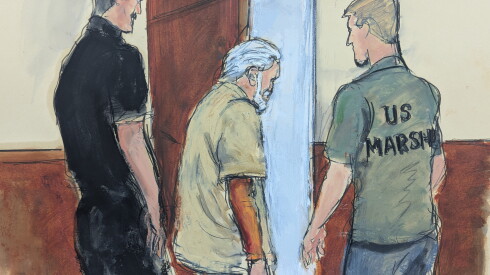
Zambada, wearing a tan jail suit over an orange T-shirt, walked gingerly as deputy federal marshals escorted him to and from the courtroom, which was packed with drug enforcement agents and prosecution staff members. The top federal prosecutors in Brooklyn, Miami and western Texas watched from the gallery.
In pleading guilty, Zambada said that, from 1980 until last year, he and his cartel were responsible for transporting at least 3.3 million pounds of cocaine, “most of which went to the United States.”
Zambada, the father of 16 children ranging in age from 6 to 55, said he first got into the drug trade as a marijuana grower in 1969 after leaving school with a sixth-grade education.
He acknowledged the scope of the Sinaloa operation, including underlings who built relationships with Colombian cocaine producers, oversaw importing cocaine to Mexico by boat and plane and smuggling the drug across the U.S.-Mexico border. He said the cartel took in hundreds of millions of dollars a year and admitted that people working for him paid hefty bribes to Mexican officials “so they could operate freely.”
Months before Zambada’s arrest, prosecutors said, he ordered the killing of his nephew Eliseo Imperial Castro, known as “Cheyo Antrax,” after finding out that Castro was claiming to be collecting debts for Zambada and pocketing the money without Zambada’s permission.
In 2023, at least three people were killed in retaliatory violence that Zambada directed after a large cache of fentanyl pills, methamphetamine and cocaine was stolen from the cartel, according to prosecutors.
“I grew up in an environment where violence and crime seemed normal, but now I know that’s no excuse,” Zambada said in court. “There comes a time when every person must take responsibility for their decisions. I didn’t, and many people paid the price.”

Click here to read the Jan. 28, 2018, Sun-Times Watchdogs report ‘How a West Side drug bust led the feds to El Chapo.’