The new production of the seminal rock musical “Hair” from rapidly rising Kokandy Productions made me remember a famous quote from Yogi Berra: “The future ain’t what it used to be.”
I’ve seen a fair number of productions of “Hair,” which first appeared on Broadway in 1968, but this is the first that’s an expression from a Gen Z-ish point of view. Director Brennan Urbi and his young, game cast embrace the protest-as-performance concept with fierce conviction. In case you miss that point, they’ll indicate it plainly and visibly. “This is a satire,” reads the tie-dyed textile unfurled early and left hanging for the rest of the show’s duration. “This is a protest, not a play,” reads one sign held up during the show’s “be-in.”
But this isn’t the Age of Aquarius we’re used to. When they talk and sing about anger, injustice and despair, you feel it. But when they talk and sing about love, harmony and understanding, you don’t. They may be wearing flowers, but very few come across as flower children.
This is a jaded “Hair,” sometimes even a tortured “Hair,” filled with confusion and complexity, with a clear, if underlying, skepticism of the idealism that was a central dimension of the show’s original vibe.
Urbi’s direction and choreography capture the organic and groovy quality of a show whose style came out of the avant-garde theater of the time, privileging in-the-moment authenticity over narrative. It moves freely and engages with the audience. The band and singing, under the musical direction of Kara Olander, sound strong and confident with Gerome Ragni, James Rado and Galt MacDermot’s famed score, which includes that opening “Age of Aquarius,” “Good Morning Starshine,” “Hair” and many more memorable mainstream hits.
It’s in the design work and some characterizations where we begin to see our world. The wood risers surrounding the main playing space in Eleanor Kahn’s set, as well as some of the walls, have been graffitied with protest aphorisms, including references to Trump, Palestinians, ICE and even artificial intelligence. Audience members can borrow a marker and add their own during intermission.
The costuming has flowy dresses and skirts for both men and women, with barely a bell-bottom in sight. We get a Woof (a likable Stone TeSelle) with red/pink in his hair and moustache, and a Hud (charismatic Joshua Emmanuel) clad in leather, neither of which read hippie. The gender fluid costume choices for the ensemble reflect today’s nonconformity to traditional norms, self-consciously comparable to men celebrating long hair.
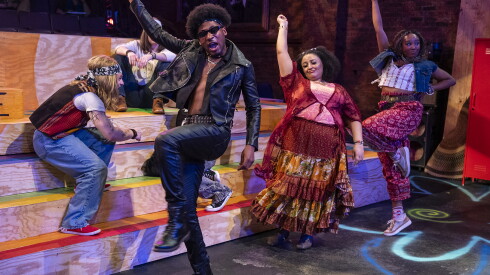
As Berger, a compelling central figure handing out joints and acid tabs, Zac Richey bravely embraces an abrasive, jittery take on the character, less championing freedom than rebelliously rejecting its opposite. Gavin Rhys plays Claude, whose internal battle over whether to burn his draft card provides the show’s dominant throughline, as particularly spaced out from the start. It’s a passive acting choice, but he sounds great singing songs like “Where Do I Go?” and it anticipates his later expressionistic hallucinations. These two form a love triangle with Sheila, played by Catherine Rodriguez O’Connor, who has among the most polished voices, and feels more convincing than others that this “tribe” is trying to transform the world.
There’s passion here, and commitment, although many of the songs, including O’Connor’s beautiful “Easy to Be Hard,” feel pitched as anthems and targeted into the ether — not the audience, and not their fellow tribe members. These characters feel partial because they don’t seem to have believable relationships with each other.
Urbi sometimes digs for complexity where simplicity will do, the most egregious example being a confusing “Frank Mills,” with Amy Yeston Kim, who portrays Crissy, summoning the memory from a journal entry.
This show gets the work’s seriousness, and plumbs its continuing relevancies with great effectiveness, particularly in its fever dream of Act 2 where we see one example after another of imperial destruction.
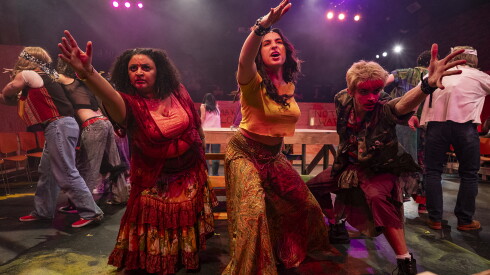
But the production doesn’t get the show’s humor and charm. “Hair” is part protest, part sexual revolution, part comedy from the same era as TV’s “Laugh-in.” Here, there’s little genuine levity. And the choice to ditch the nudity and not replace it with anything that feels thematically freeing, seems … well, uptight. Depending on where you’re sitting, the performers will come within inches, but there’s also a carefulness — in our era, people ask permission before contact.
This isn’t wrong; it’s revealing. This production exalts so much of what “Hair” is about. But I’m not sure it’s aware it is so guarded, earnest, moody and cynical, that when the cast sings the finale, “Let the Sunshine In,” they don’t.