Mayor Brandon Johnson was flanked by political allies and organizers who cheered as he inked an executive order earlier this year directing Chicago police to investigate federal immigration agents and potentially seek charges.
The “ICE on Notice” order felt, for many, like a vital punch back after the city endured Operation Midway Blitz, the Trump administration’s brutal deportation campaign last fall.
Residents and even cops were tear-gassed. Agents caused car crashes to carry out arrests. A woman was shot five times on the city’s Southwest Side. And an immigrant father was shot to death in suburban Franklin Park.
“We need to send a clear message: If the federal government will not hold these rogue actors accountable, then Chicago will do everything in our power to bring these agents to justice,” Johnson said in January.
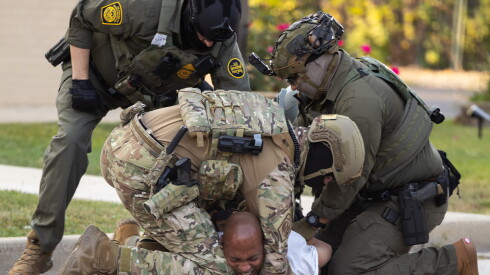
Police were directed to form new procedures within 30 days to implement the mayor’s order. But nearly five months after that deadline, it’s unclear what the decree has accomplished or what more needs to be done to enforce it.
Those questions will be the topic of a City Council hearing this week as enforcement intensifies in the Chicago area, with advocates reporting at least 17 arrests last week by U.S. Immigration and Customs Enforcement.
“We are seeing many more ICE incidents — we’re seeing a surge,” said Pooja Ravindran, the chief of staff of the Committee on Immigrant and Refugee Rights, which is holding the hearing. “It’s July, we want to know what the holdup is.”
Johnson’s order mostly clarifies that standard police work — like taking complaints, using body cameras and rendering medical aid — shouldn’t stop, even if federal agents are considered crime suspects.
But it also has some controversial new tenets.
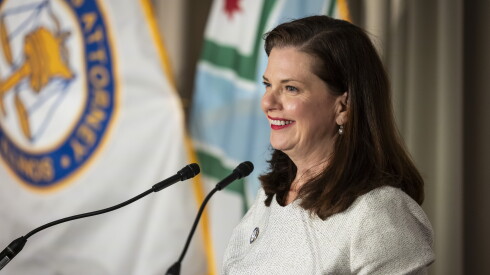
It requires the police department to try to identify the name and badge number of top federal agents on scene. And it requires officers to refer felony matters to Cook County State’s Attorney Eileen O’Neill Burke “at the direction of the Mayor’s Office.” O’Neill Burke has slammed that piece as “wholly inappropriate.”
Ahead of the hearing, Ravindran shared a list of nearly four dozen questions for the mayor’s office and police department, including:
Which sections of the executive order are new directives, and which are just re-statements of protocol that exist? What happens if a police officer doesn’t follow these orders? Can you share the exact training curriculum and materials that pertain to this order? Is there a test at the end to assess understanding?
But the public might not get those answers at Friday’s hearing, at least from police leaders. That’s because the department has declined the invitation, Ravindran said. The department referred all of WBEZ’s questions to Johnson’s office, which does plan to attend.
A mayoral spokesperson defended the impact of the executive order, saying it “reaffirmed the City’s commitment to ensure that reports alleging federal officials have violated state or local law are accepted, processed, and tracked appropriately” — indicating there may previously have been a problem with cops processing complaints against federal agents.
“CPD has clarified to its members that they must accept reports” against federal officials and “process those reports,” the spokesperson said in a statement.

But the mayor’s office also appeared to walk back previous assertions.
For instance, Johnson told reporters in March that, after further review, he didn’t believe that a new police policy was necessary to implement the order, despite the 30-day stipulation.
“It turns out that the policy that [police] have in place is applicable to what we’re asking them to do,” Johnson said at the time.
The spokesperson acknowledged that formal guidance is still under development. That includes issuing guidance for tracking allegations against federal agents and publishing data on complaints, as required by the order.
Johnson’s office hasn’t reviewed or consulted on any potential referrals for criminal charges to the state’s attorney since the order was signed, the spokesperson said.
“The Mayor’s Office’s role is to establish that policy direction, not to review, oversee, or participate in individual investigations or referral decisions,” the spokesperson said.
Pushing for answers
Ald. Andre Vasquez (40th), who chairs the committee holding Friday’s hearing, said the goal is to understand what more needs to happen to give these policies teeth.
“We need to find out what that protocol should be so that it’s actually functioning as intended. Because if it isn’t, then it is at best misguided and at worst lip service,” Vasquez said.
Advocates who want to see the executive order enforced point to a recent, high-profile incident in Albany Park, where an ICE agent crashed an SUV into a woman’s car and fled before police arrived.

Ravindran said this is the type of case that could be investigated and potentially referred for criminal prosecution. Instead, officers simply “clocked it as a traffic incident” because that’s how witnesses characterized it, Ravindran said.
“To kind of put the burden on residents knowing what buzzwords they need to say in order for the officer who is doing the intake is a little difficult … Your average resident of Chicago is not an expert in a CPD process,” Ravindran said.
Omar Flores, with the Chicago Alliance Against Racist and Political Repression, blames the police department, not the mayor’s office, for “dragging their feet on this overall policy.” He wants to see a formal outline of the department’s process for identifying a federal agent on scene, for instance.
“A few individuals of their force may be a little upset that they got tear-gassed,” Flores said, referring to an incident during Operation Midway Blitz in which police officers were caught in the middle of a chaotic scene.
But “it’s nothing compared to what they risk supporting” the executive order, Flores argued.
“They’re also people that don’t want to be held accountable … They’re not missing the forest for the trees. They see this as a risk to themselves as well,” he said.
Flores said his group hasn’t seen formal policy related to the executive order, but he believes it has moved the needle by forcing the state’s attorney’s office to respond to concerns about ICE prosecutions.
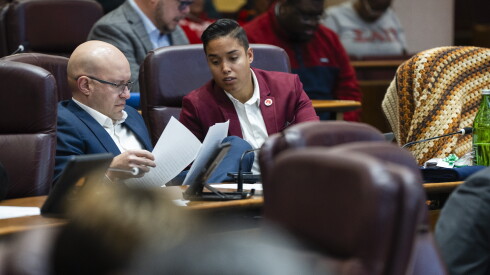
Part of the impetus for the meeting was a June hearing where a top official in the prosecutor’s office testified on an unrelated subject. Ald. Jessie Fuentes (26th) took the chance to grill Yvette Loizon, chief assistant state’s attorney of policy and external affairs, about the office’s handling of federal agents.
“Your office has refused to bring charges to ICE agents who have shot, killed and assaulted individuals in Cook County,” Fuentes said.
Loizon strongly disputed that assertion.
“The state of Illinois has significant, significant restrictions put on our ability to investigate crime,” Loizon said. “That is the responsibility of law enforcement. Once law enforcement has investigated a crime, they can come to our office and seek investigative support, and they can all also ask us to review a case for charging.”
Jordan Esparza-Kelley, an advocate with the Council on American-Islamic Relations who was present at the ceremonial signing of the executive order, said the finger-pointing between the police department and state’s attorney’s office is eroding trust with “everyday average people.”
“You tell us we have laws, then ICE doesn’t follow the laws. Neither does CPD,” he said. “Are we the only people under the law? Are these lawless agencies? What is going on?”