Megan Mullally, who played the narcissistic, perpetually condescending Karen Walker on “Will and Grace,” can make reciting the alphabet funny.
In fact, at one point she does just that in “Iceboy,” the absurd new musical comedy — emphasis on absurd and comedy — receiving its world premiere at the Goodman.
Here, Mullally portrays Vera Vimm, a narcissistic, perpetually condescending 1930s Broadway diva who at the start buys a pre-historic caveman encased in a block of ice. That caveman then thaws and becomes a star. Just go with it!
When Vera starts the alphabet — “A…. B…,” she’s standing over her semi-comatose housekeeper/assistant (not Rosario as in the sitcom, but not completely dissimilar), trying to help her communicate what happened to her. Vera’s butler, Frankenstein — again, just go with it! — grunts and gesticulates and urges Vera to go a whole lot faster. She doesn’t, continuing to elongate the pauses at irregular intervals: “C…..D…..”
A lot of the nearly two-and-a-half hour “Iceboy,” subtitled “The Completely Untrue Story of How Eugene O’Neill Came to Write ‘The Iceman Cometh,’” is like this. It’s comic bit after comic bit — familiar, funny, meticulously timed.

Mullally’s real-life husband, Nick Offerman (the dry, whiskey-loving Ron Swanson on “Parks and Rec”), plays O’Neill, our dry, whiskey-loving, depressed narrator, who keeps promising that at some point we’ll get to that subtitle. But in the meantime, he takes a degree of pleasure in informing the audience when characters lose consciousness: “That’s right! It’s a two-coma show, people.”
If you want to see two very famous, very talented comic actors with Chicago roots doing exactly what they do best, then “Iceboy” is ideal. To add to that, the supporting performances show off two gifted, Tony-nominated up-and-coming stars in Grey Henson as Iceboy and Sarah Stiles as Lambert, Vera’s housekeeper and Iceboy’s love interest.
Their proposal scene is silly and raunchy, as the humor often is, and it provides the most fulfilling song of the evening in a show where the score by Mark Holliman (“Urinetown”) and Jay Reiss (“25th Annual Putnam County Spelling Bee”) primarily serves to punctuate the punch lines.

Here, as the characters navigate the cultural differences between modern-day and imagined pre-historic mating rituals, there’s actually a layer of social commentary that Reiss and Erin Quinn Purcell’s book generally avoids.
“This is a musical,” O’Neill explains, “You didn’t come here to think.”
The show’s relentless vacuousness must be admired for sheer commitment alone.
Unfortunately, though, no matter how funny, “Iceboy” suffers from its own iciness. Stiles invests Lambert’s ballad explaining perimenopause to Iceboy with both humor and heart, and yet still their romance lacks any chemistry, which director Marc Bruni really should have nurtured.
The musical strives to put forward a theme — all the characters, you see, are unfrozen by Iceboy’s innocent loyalty and their recognition of love for each other. But when that moment finally arrives, the show hasn’t established even the minor depth of character, let alone the emotional connections necessary to make us give a hoot.
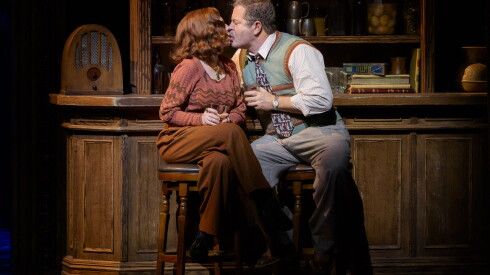
Some of the funniest moments of the show have authentic observations about being a woman in any era, delivered deliciously by Mullally. Having become Iceboy’s mother (the song “Can you call me ‘Mama’?”), Vera amusingly over-embraces the burdens with the too-short “Working Mother.”
But simple motivations get derailed by unnecessary over-complications, such as returning references to Vera’s own orphan beginnings, or a whole subplot involving her refusal to marry her longtime boyfriend Floyd (Cedric Yarbrough). Middle-aged Vera’s extremely ridiculous insistence on playing a teenage immigrant in a show about unions make it impossible to later engage with her psychological insecurity, even comically.
With Vera as the center, the plot feels like it never moves forward, because everything she does feels predictable to the point of being pre-determined. Even having O’Neill as narrator seems an effort to prop up the story, hoping that somehow the inspiration of “The Iceman Cometh” can become the plot. It doesn’t.
This all means the show comes off as a glitzily produced, exceedingly extended comedy sketch, lacking even the slightest bit of surprise.
It’s funny —- and occasionally very funny. And its hefty flaws melt away – don’t pardon the pun – whenever Henson’s Iceboy commands the stage. He’s sort of like the snowman Olaf in “Frozen”: so easy to love and goofy that you can’t get enough of him.
I could watch Henson play caveman-turn-crooner for another two hours.
Note to the creators, though: Don’t do that.