Homelessness rates increased among Latinos in Illinois in recent years, exacerbated by the influx of migrants bused to Chicago by the governor of Texas, according to a new report. But experts are worried that potentially tens of thousands more people without permanent housing are flying under the radar.
Titled “Latine Homelessness in Illinois: Structural Drivers of Inequality,” the report found that on any given night in the past decade, more than 1,000 Latinos were staying in Illinois homeless shelters, with another 200 living on the streets.
Another 30,000 Latinos were “doubled-up,” meaning they didn’t have stable housing and were temporarily staying with family or friends.
Report co-author Ivan Arenas, associate director at the Institute for Research on Race and Public Policy at the University of Illinois at Chicago, said doubled-up homelessness is far more prevalent among Latinos than other populations.
“Homelessness looks very different for this community than the picture that most people have in their heads,” Arenas said. “We don’t tend to think about people that are doubled up in a friend’s home, in a family home, or even with strangers in apartments.”

Arenas added that Texas Gov. Greg Abbott’s busing of more than 37,000 migrants from the United States’ southern border to Democrat-led states spurred Latino homelessness in Illinois. Rates of Latinos living on the streets more than doubled from 2023 to 2024, and rates of Latinos staying in shelters more than quadrupled, the report shows.
WBEZ has previously reported on housing challenges many asylum-seekers face, from rental scams to sky-high rents and unsafe living conditions.
Arenas said the arrival of so many people who didn’t have secure housing meant homeless shelters were stretched even thinner and affordable housing was further strained throughout the state, affecting non-Latino groups, too.
Leaders at local community organizations said the report’s findings are crucial in understanding Latino homelessness in Illinois.
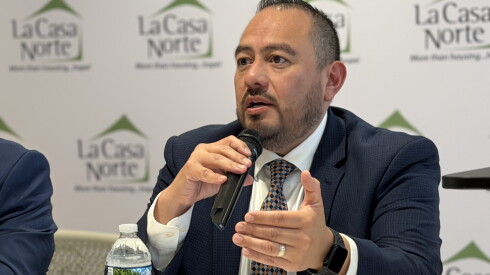
“There is no one thing that is causing homelessness,” said Jose Muñoz, executive director of La Casa Norte, a Humboldt Park-based nonprofit that serves homeless youth and families. He added that homelessness is not simply about individual choices, pointing to “structural barriers, rising rents, unstable work, language access, health access, immigration status [and] discrimination.”
Muñoz said rents are climbing fast throughout the city, and residents are struggling to keep up.
“There are people that are working, have jobs, and the target keeps moving for them,” Muñoz said.
The Institute for Research on Race and Public Policy previously found that Black residents are almost eight times more likely to be homeless than white residents.
Experts also said the U.S. Department of Housing and Urban Development likely undercounts the number of homeless people throughout the country. The feds mandate local governments to conduct a “point-in-time” count on one night each year, but it only records people staying in shelters. The count, done by volunteers, misses people living in abandoned buildings or in cars, or those who are couch-surfing or staying with friends or relatives.
For the Latino community in particular, experts say “doubled-up” homelessness is even more hidden.
“It’s just buried by cultural practices,” said José Marco-Paredes, vice president of civic engagement at the Latino Policy Forum. “About a third of Latino households are multi-generational. It is good that we have families, that we have communities that come together. But there’s a key difference when you’re living in a multi-generational situation and you do it by choice [versus] when it’s done because of economic necessity.”
Marco-Paredes and Muñoz were among more than two dozen experts who served on a roundtable on Latino homelessness convened by the Illinois Office to Prevent and End Homelessness. On Thursday, some members of the group, along with researchers, will head to Springfield to brief Gov. JB Pritzker on the report’s findings and to make policy recommendations.
Arenas, with UIC, said funding eviction prevention programs and improving employment opportunities for Latino residents could help stem homelessness in the community.