During the first weekend of May, dozens of people filed into a River North co-working space for what was billed as a hands-on, phone-free experience.
After slipping their devices into small cloth pouches stamped with the words “Fulfillment Center,” visitors made their way over to a pair of industrial shelves stacked with activity boxes labeled “make,” “play,” “read” and “write.” Inside the boxes, they found crafts, readable materials and games – plenty of things to do instead of scrolling endlessly on their mobile phones.
Meanwhile, up in Edgewater, theater leaders from [producingbody] are introducing audiences to magnetically locking Yondr pouches starting this week with the Chicago premiere of “Spaceman.” Audiences can sit with their phones in the pouches — but they won’t be accessible for the length of the 100-minute show.
If you want a deep dive into Chicago arts and culture, check your phone at the door: The “unplugged” trend is growing locally among arts groups responding to a collective desire for more phone-free experiences. Organizers say they aim to deepen human connection and offer spaces for creating art.

For some Chicago cafes and lounges, such as Kibbitznest Books, Brews & Blarney and Verzênay in Lincoln Park, the unplugged trend is nothing new. These cafes are intentionally Wi-Fi free, opting for board games and books instead of a sea of silent and disconnected remote workers.
Major musicians such as Phoebe Bridgers and David Byrne have enforced no-phone zones at their events, too, using similar phone pouches or, in the case of Byrne’s “Theater of the Mind” theater installation in River North, requiring fans to place their devices in lockers.
The idea for the phone-free Fulfillment Center — a pop-up for people of all ages — started with a simple question, event creator and Little Council marketing co-founder Jessa Fuller said: “What if we took up a little bit of space in our communities with a center that was geared toward personal fulfillment?”
Fuller said she kept hearing from clients of her immersive marketing company about the desire for unplugged spaces, where people could engage with each other in meaningful and accessible ways.

“I think there really is a trend [of] people trying to be like, wait a minute, I want to look at this directly through my eyes and not through my screen,” Fuller said.
After guests picked one of the four boxes, they took the box over to a table dubbed the “line” and unpacked it. Inside, the materials and packing slip described the activity: “play” boxes included classic games like Uno and Jenga, while “make” boxes contained magazines and other supplies for collage-making.
One box contained supplies for a game of “exquisite corpse” — a drawing game invented in the 1920s, where artists come together to create a character without seeing the previous contributions. The result is usually something like a “magical creature,” Fuller said.
The boxes are filled with things that people “might not always make time for, like creating or writing or reading or just playing,” Fuller said.
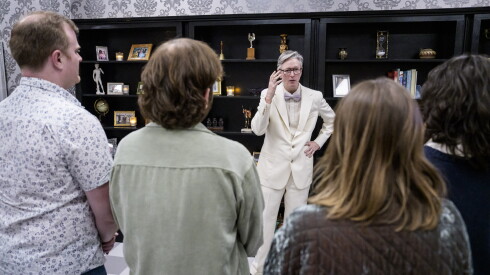
“Read” boxes included articles from Chicago-based publications, such as copies of “The Pub” (which is print-only), or The Poetry Foundation’s poetry magazine. And inside the “write” boxes, attendees received bios of senior citizens (through the group Love For Our Elders), and were inspired to write letters to friends and family. In the background, the party offered free beverages from Hopewell Brewing and Buenos Days Coffee and a soundtrack by DJ Ray Mora and local singer-songwriter Kaina, who curated sounds from the Sooper Records catalogue in a listening room.
Up north at the theater, [producingbody] founders Amy Carpenter and Taylor Dalton said their aim with the phone-free push is to restore the communal intimacy of traditional theater.
The phone-free expectations are set early, with a note on the ticket sale page and confirmation messages. The only exceptions that theater administrators will consider are related to accessibility concerns, especially for individuals whose medical devices are connected to their phones.
“We’re not trying to reinvent the wheel here,” Dalton said. “We have lived and engaged with theater and the arts without our phones for longer than we have with our phones.”
Plenty of humans are “addicted” to their phones, even if just a little bit, Carpenter said. Though reminders to silence or power off phones are ubiquitous with pre-show warmups across Chicago theaters, devices are still a problem, she added.
![Yondr Image [producingbody] SPACEMAN Yondr Announcement.png](https://cst.brightspotcdn.com/dims4/default/eaeae7e/2147483647/strip/true/crop/3624x2034+0+145/resize/490x275!/quality/90/?url=https%3A%2F%2Fchorus-production-cst-web.s3.us-east-1.amazonaws.com%2Fbrightspot%2F00%2Fcc%2F545e1aea4fe2b90933c44e9d6586%2Fyondr-image-producingbody-spaceman-yondr-announcement.png)
“It’s tough because you want to believe that people will follow instructions and then we just see time and time again that they don’t,” Carpenter said.
“Spaceman,” written by Brooklyn-based playwright Leegrid Stevens, is a solo show about an astronaut who’s traveling to Mars with the sole task of laying the roots for a Martian colony. All that alone time gives the astronaut plenty of time to sit with her own thoughts and fears about life on Earth and what might await her when she arrives on the red planet.
Carpenter and Dalton want the phone-free experience to mirror the protagonist’s isolation. Upon check-in, guests will receive a Yondr pouch and sit, without the comfort of doom-scrolling, for at least 15 minutes before the show starts.“That will inevitably give the audience a taste of our protagonist’s experience,” they said.
Still, phone-free rules can be risky for businesses, especially when social media is the top source for information and news about cultural events.
The Fulfillment Center team considered alternative methods for documenting their events and hired a professional photographer to capture candid images. But at a theater performance like “Spaceman,” Carpenter and Dalton hope the show gives attendees something to post about after the curtain closes.
They’re handing out physical programs and will include a few fun photo-ops in the theater lobby to encourage fans to take their own pre- or post-show pictures for social media.
“It is a risk. But I think the hope here is to ultimately make it worth it for [audiences],” Dalton said. “We wanna make the experience so special inside the theater that they forget that they don’t have access to their phones.”