The review embargo was finally lifted on Emerald Fennell’s “Wuthering Heights” this week, and we’re in for yet another classic critic pile-on. It brings a tear to my eye whenever a bad movie brings out the best in film critics. This might exceed the pile-on for Madame Web, but I’m not sure anything can reach the wall-to-wall critical spice of the Cats reviews. As we know by now, Fennell’s vision for her Wuthering adaptation has little to do with the book itself, nor does Fennell concern herself with the action within the second or third acts of the novel. This is all about Cathy and Heathcliff and how they are terrible, beautiful and sexy. Rotten Tomatoes has it holding in the 69-71% range. But critics are having a field day. Here are excerpts from two reviews, one from the Independent and one from Vulture (“Finally, a Smooth-Brained Wuthering Heights.”)
From the Independent:
Our modern literacy crisis has found a new figurehead in Emerald Fennell’s “Wuthering Heights”. It’s Emily Brontë’s 1847 classic for a culture that’s denigrated literature to the point where it’s no longer intended to expand the mind but to distract it.
With its title stylised in quotation marks, and a director’s statement that it’s intended to capture her experience of reading the book aged 14, it uses the guise of interpretation to gut one of the most impassioned, emotionally violent novels ever written, and then toss its flayed skin over whatever romance tropes seem most marketable. Adaptation or not, it’s an astonishingly hollow work.
Some of this, it can be argued, was already signalled by the film’s casting and the choice to obliterate any mention of race, colonialism, or ostracisation in the telling of pseudo-siblings Cathy and Heathcliff’s destructive codependence. Heathcliff, whose ethnically ambiguous appearance is of great concern to every other character in the book, is played by white Australian actor Jacob Elordi.
…And the supposedly “wild” Heathcliff never does anything to Cathy that couldn’t be spotted in the average Bridgerton episode. Mostly, he sticks his fingers in her mouth. Robbie and Elordi don’t entirely lack chemistry, but their characters do feel so thinned out that their performances are pushed almost to the border of pantomime. She’s wilful and spiky. He’s rough but gentle. That’s about it.
From Vulture:
Wuthering Heights is Fennell’s dumbest movie, and I say that with all admiration, because it also happens to be her best to date. Fennell has an incredible talent for the moment, for extravagant scenes that bypass all higher thought functions to spark a deeper lizard-brained pleasure, and for pop-music-scored montages of such lushness that they could levitate you right out of your seat. But thematic incisiveness has not proven to be her strong suit nor something her heart is in. Promising Young Woman, her directorial debut, got off to an electric start before eventually collapsing under the weight of its own attempts to delve into rage at a world that normalizes and trivializes rape. Saltburn was a collection of delirious imagery that featured some incoherent aspirations toward class commentary. In Wuthering Heights, she throws off the burden of trying to say something significant as one would a crushed velvet cloak when the sun’s finally come out. Fennell surveys Brontë’s saga of doomed passion, obsession, and multigenerational resentment and sums it up as the story of two incredibly messy bitches who can’t stay away from one another. That she’s onto something in terms of the work’s essence makes the smooth-brained sensuality of her third feature even better.
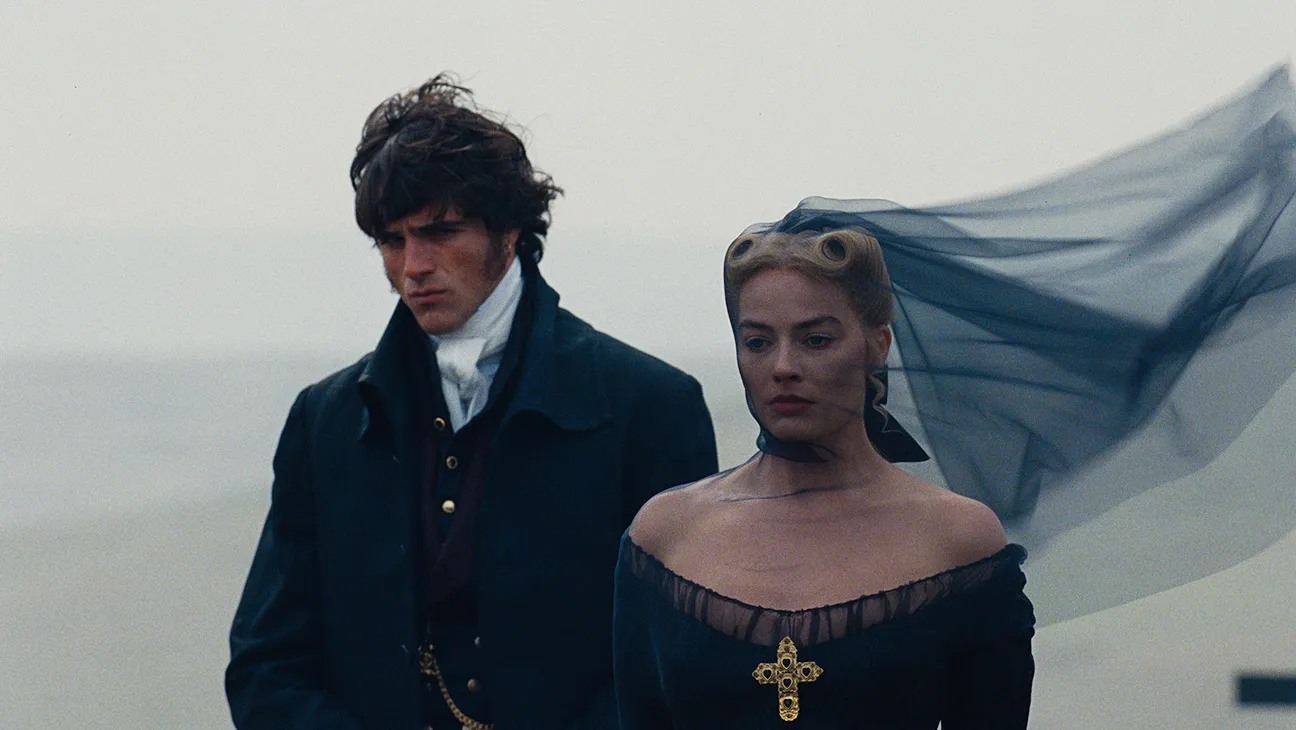
Wuthering Heights has the tunnel-vision horniness and girlish aesthetic sensibility of a high-school freshman who’s been assigned to read Brontë in class while tearing through a pile of explicit bodice-rippers under the covers at home. For instance: Heathcliff at one point grabs Cathy by her corset in order to hoist her up one-handed to kiss her, which is the kind of logistically impossible move that feels lifted right out of a hormonally overheated daydream. Cathy is only ever in outfits that billow, whether that involves veils, dresses, or the full red skirts she starts wearing after marrying Edgar Linton (Shazad Latif), the wealthy bachelor next door who’s a more sensible match than the societally inappropriate Heathcliff.
[From The Independent & Vulture]
I’m starting to feel a similar guilt for when I enjoyed the Madame Web pile-on. Like, it’s good to support women directors. It’s good to make movies explicitly for a female audience. It’s fan-service to make a horny adaptation which has little to do with the actual book. But I just can’t bring myself to defend any of this. It sounds dreadful and stupid and I really wish Fennell had just… made an original movie.
Photos courtesy of Avalon Red, Backgrid, ‘Wuthering Heights’ stills & poster.